


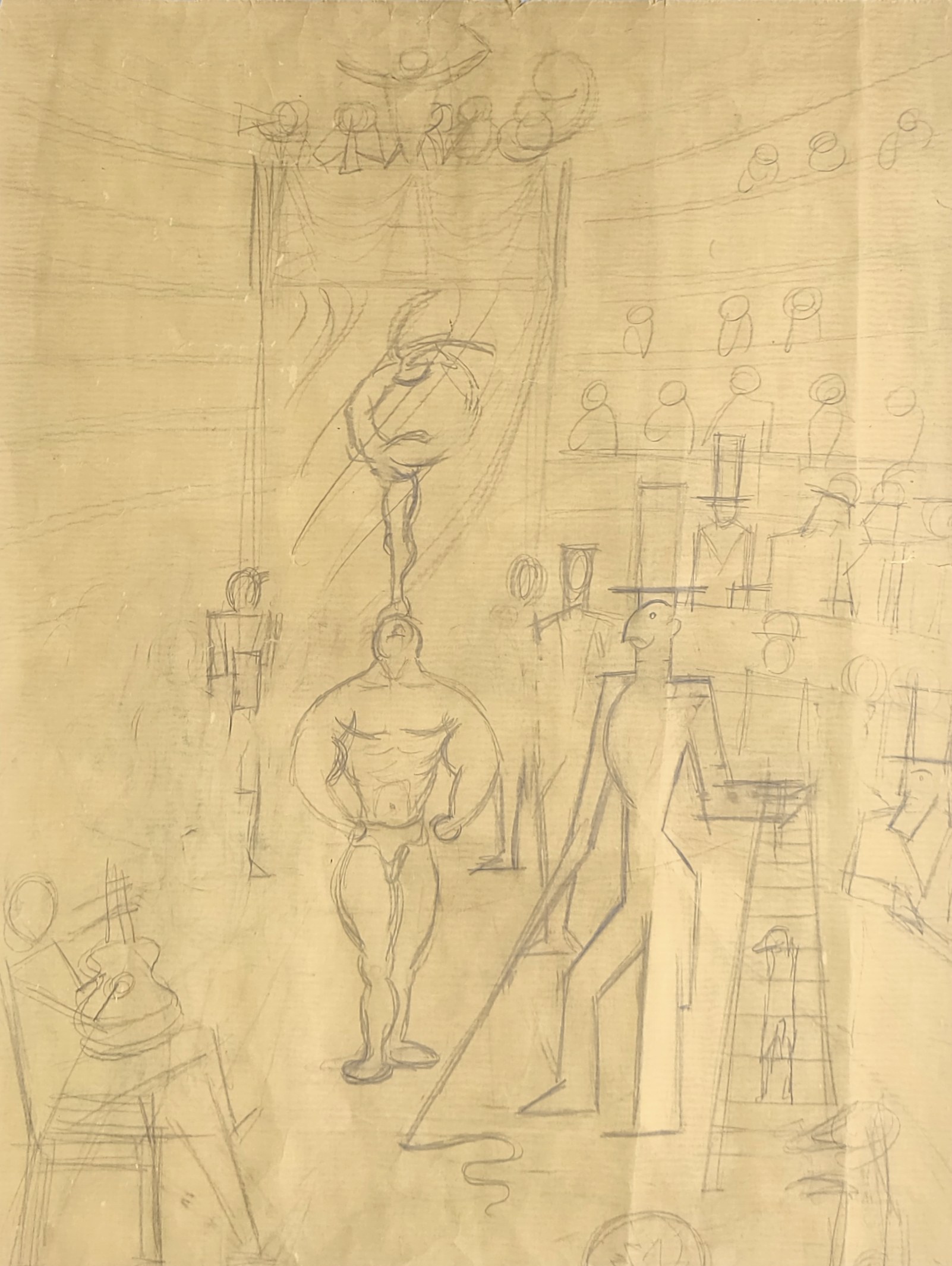
Zygmunt Waliszewski (1897–1936)
Don Quixote, Circus, 1930s
watercolor, pencil on paper, 57 x 43.3 cm
double-sided work
He studied painting and drawing in Tiflis, Georgia, under Nikolai Sklifasovsky and B. Vogel. At the age of 11, he exhibited his works at the “Child Prodigy” exhibition. During World War I, he fought in the Russian army. In Moscow, he met artists from the World of Art group. He also visited Sergei Shchukin’s and Ivan Morozov’s collections of French paintings in Moscow. In 1920, he left for Poland. From 1921, he studied under Wojciech Weiss and Józef Pankiewicz at the Academy of Fine Arts in Kraków. From 1924 to 1931, he continued his studies in Paris under Józef Pankiewicz. In 1930, he participated in an exhibition of the Kapists at the Galerie Zak in Paris. While in Paris, he contracted the incurable Buerger’s disease. Both of his legs were amputated. He faced the possibility of having his arms amputated as well. In 1931, he returned to Poland and lived in Warsaw and Kraków. In 1933, he got married. Despite his disability, he continued to paint. Between 1935 and 1936, he created a ceiling painting in Kurza Stopka at Wawel. In 1936, he designed the set for Pergolesi’s opera *La serva padrona*. He died shortly thereafter.











