


Jan Feliks Piwarski (1794–1859)
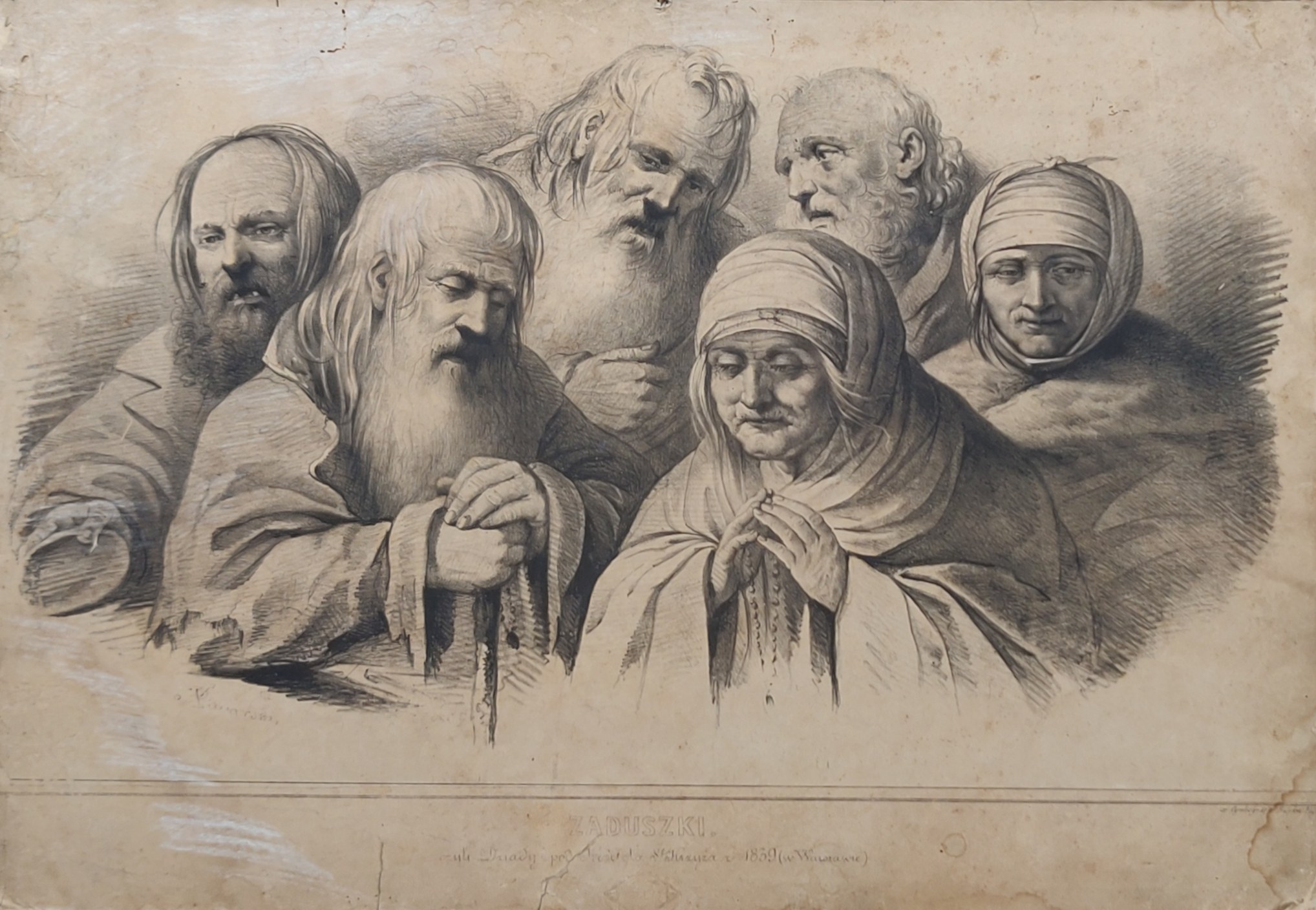
All Souls’ Day, or “Dziady” near the Church of the Holy Cross, 1839 (in Warsaw)
zinc engraving/cardboard, 31.5 x 44 cm
from the Album of Warsaw Zinc Engravings and Drawings, comprising 12 images
Condition: stains, creases
His family was connected to the Czartoryski estate in Puławy. He studied drawing under Józef Richter in Puławy (before 1811) and printmaking techniques under Adam von Bartsch at the Imperial Cabinet of Prints in Vienna (1819), but he did not pursue formal artistic studies. He arrived in Warsaw in 1816 and began working as a civil servant. In 1818, he was hired at the Public Library and the Print Room of the newly established University of Warsaw. After a year of study in Vienna in the fields of printmaking and art history, he was appointed curator of the Print Room. He is considered the first Polish museologist to have organized and cataloged the valuable collection of prints entrusted to him in a modern manner—chronologically and by school. He served as curator until the collection was confiscated and transported to St. Petersburg as part of the post-uprising repressions (1832). The inventory report he compiled facilitated the return of the collection to Poland in 1922. Today, the collection is housed at the University Library in Warsaw.
Piwiarski wrote exhibition reviews and articles about artists and the art of lithography for the press; he also published Poland’s first overview of the history of European printmaking, highlighting the Polish national school (1822). Between 1821 and 1845, he participated in the Fine Arts Exhibitions, where he presented prints and drawings for which he received awards (e.g., works commemorating the mourning ceremonies following the death of Alexander I).
The artist was also a distinguished educator who earned the deep respect of young people. Beginning in 1826, for over 30 years, he taught at Warsaw’s secondary schools, private schools, and his own studio. He taught drawing, composition, and landscape painting. He also provided guidance in the field of printmaking. He was one of the main initiators of the founding of the School of Fine Arts in Warsaw in 1844, where he taught for four years. He was the first in Polish art education to introduce plein air studies. He organized hiking trips in the vicinity of Warsaw as well as longer excursions throughout the country, during which students made sketches and painting notes of the local landscape, monuments, and people.











