


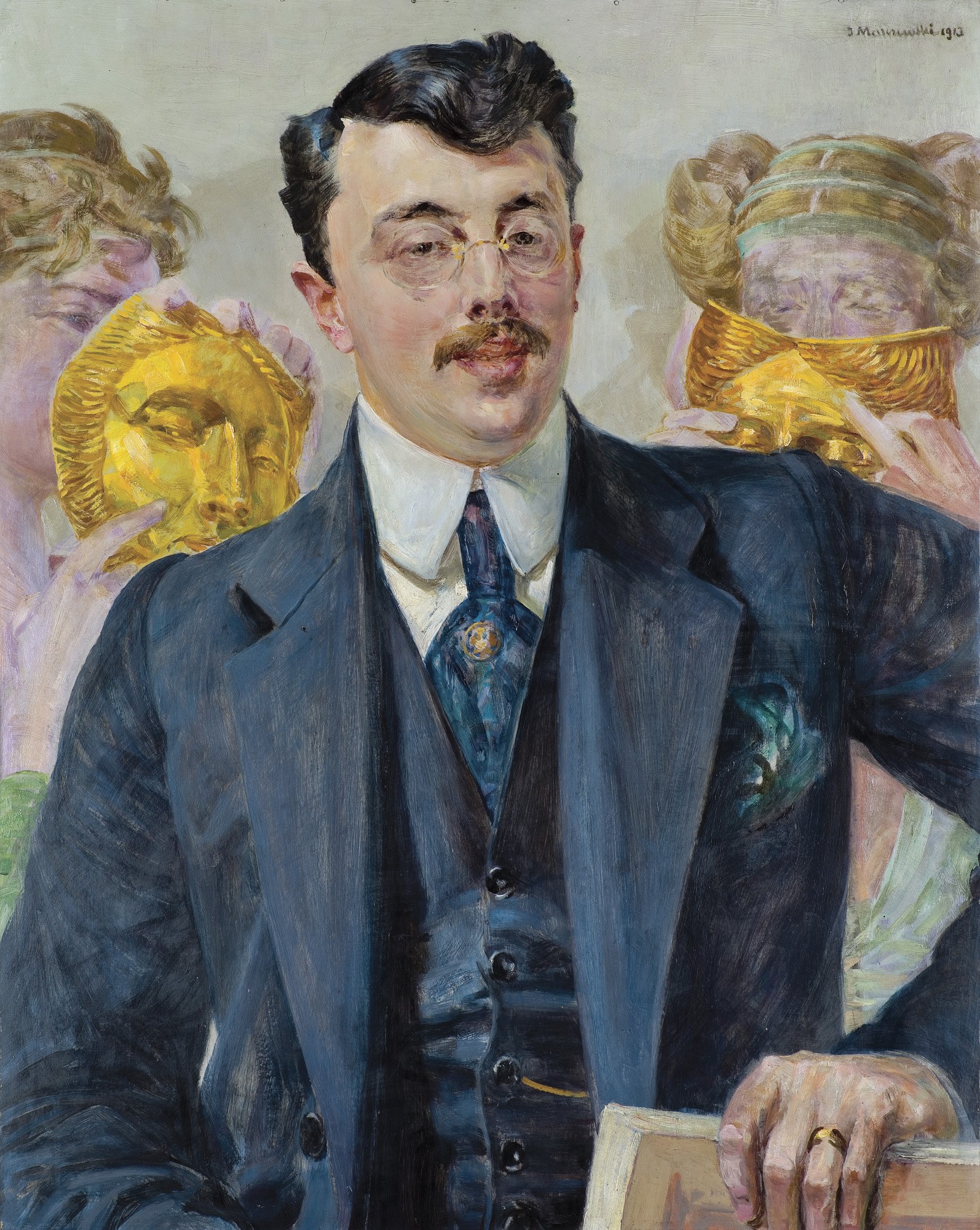
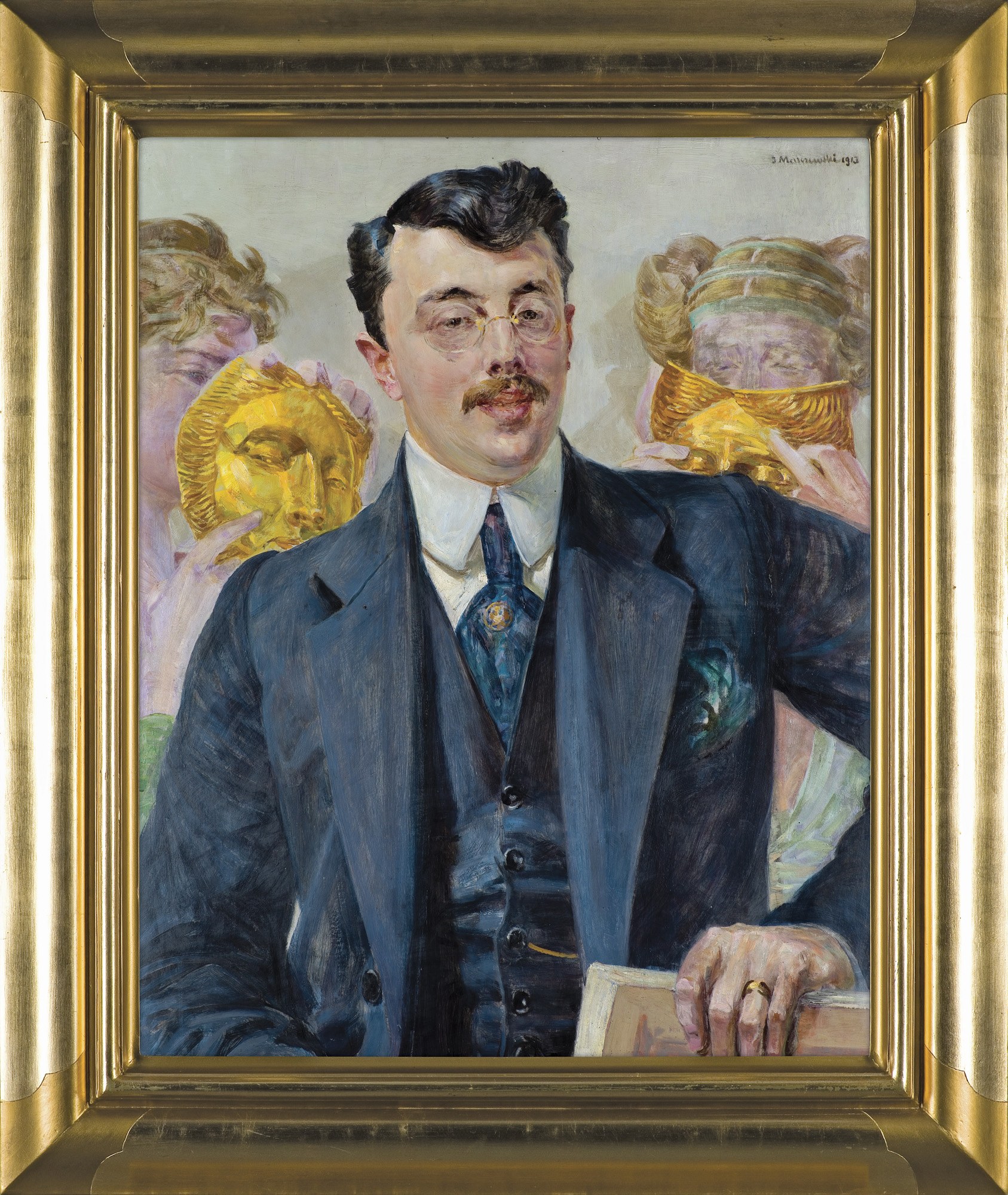
80.0 x 65.0cm - oil, cardboard signed p.g.: J Malczewski 1913
On the upper bar of the painting loom, exhibition sticker (print, ink): [TOWARZYSTWO] PRZYJACIÓŁ SZTUK PIĘKNYCH W KRAKOWIE | Author Jacek Malczewski | [Title ] of the work Portrait of a man with figures | [Type] of work oil on cardboard | Price [crossed out] size 80 x 65 | Signature of the author on his own.
In the center, a stamp of the "Lefranc et Cie" company: an anchor crossed with a caduceus between the letters L F.
On the upper bar of the frame a sticker Agra-Art from 2001.
Image exhibited, mentioned and reproduced:
- Ignacy Krieger, Portrait of Adolf Schwarz, reproduction of a painting by Jacek Malczewski, 1913, National Museum in Cracow, inv. no. MNK-XX-f/8101/Mp;
- Catalog of Jacek Malczewski's Jubilee Exhibition (1874-1924), TPSP in Kraków, Kraków 1924/1925, p. 14, cat. no. 83 (titled Portrait of Dr. A.Schwarc; owned by Dr. A.Schwarc);
- Agnieszka Yass-Alston, Jewish art collectors of interwar Cracow. Adolf Schwarz, Rudolf Beres, Seweryn Gottlieb - figures who have passed into the oblivion of history, "Krzysztofory. Scientific Journals of the Historical Museum of the City of Cracow", 2017, p. 273, il.
Dr. Adolf Schwarz (Schwarc, Szwarc; born Krakow 1882) - collector and antiquarian, brother of the famous Viennese antiquarian Simon Schwarz. Both Adolf and his father Markus were donors and bidders for the National Museum in Krakow. Adolf belonged to the Society of Friends of the MNK, was a respected citizen of the city of Cracow and a member of the Jewish community: "The director of the MNK, Feliks Kopera," writes Agnieszka Yass-Alston, "gave Schwarz letters of recommendation to the world's largest museum institutions. Schwarz's patriotic attitude is evidenced by his gesture to Polish President Ignacy Moscicki, celebrating the 10th anniversary of his presidency. Schwarz sent him, as a gift, through the National Museum, a painting from the scattered gallery of Stanislaw August, Cabaret flamand (A. Yass-Alston, Jewish Collectors..., op. cit. p. 274).
Schwarz was a prominent collector of Eastern and English ceramics, in addition to having a rich collection of works of art, both handicrafts and paintings - the walls of his luxurious apartment were decorated with paintings by Stefan Filipkiewicz, Alfons Karpinski, Juliusz and Wojciech Kossak, Ignacy Pienkowski, Wojciech Weiss, Stanisław Ignacy Witkiewicz, Franciszek Żmurka. Among the most valuable were Maurycy Gottlieb's Sulamitka, as well as portraits of the family by Teodor Axentowicz and Jacek Malczewski.
The portrait of Adolf, his wife Rosa, and daughter Irena were on loan at the artist's request for Malczewski's jubilee exhibition, which took place at TPSP in Cracow (cat. no. 128, 133, 134).
The golden masks held by the muses behind the figure of the portrayed Adolf refer to his profession - Schwarz was probably an archaeologist by training. At the same time, this is an artifact that was in his collection. During World War II, when Schwarz's collection was hidden in the MNK, curator Dr. Jozef Kwiatkowski described it as follows: the gold excavation, originating according to some from Kerch, according to others being a forgery in the type of Saitafernes' tiara (.... was acquired 50 years ago by Mark Schwarz, Simon's father, during the period of the Saitafernes tiara affair, and later passed to Adolf Schwarz (quoted in A. Yass-Alston, Jewish Collectors..., op. cit, s. 274).
Jacek Malczewski (Radom 1854 - Cracow 1929) - a prominent representative of Polish modernism painting, began his artistic studies at the School of Fine Arts in Cracow, where in 1872-1875 he studied under Feliks Szynalewski, Władysław Łuszczkiewicz and Jan Matejko, whose studio he attended again in 1877-1879. He then studied at the Paris École des Beaux Arts under E. Lehmann (1876-1877).
In 1880, he traveled to Italy. In 1884-1885, he took part - as a draughtsman - in Karol Lanckoroński's scientific expedition to Pamphylia and Pisidia in Little Asia. At that time he was also in Greece and Italy. In 1885-1886 he stayed in Munich for several months. Upon his return, he settled permanently in Cracow, from where he made further trips to Munich and Italy. In 1896-1900 he taught at the Cracow School of Fine Arts, and from 1911-1922 he was a professor and twice rector of the Cracow Academy. He spent the years 1914-1915 in Vienna and returned to Krakow in 1916. In the last years of his life he stayed mainly in Luslawice and Charzewice near Zakliczyn. He was a co-founder of the Society of Polish Artists "Art" (1897) and a member of the "Zero" group (1908).
In the early period of his career, he painted portraits, genre scenes and - above all - paintings with themes related to the martyrdom of Poles after the January Uprising (Death of Ellenai, Sunday in the Mine, On the Stage, Christmas Eve in Siberia). Later, from the 1890s, he created paintings with symbolic content with intermingled patriotic, biblical, fairy-tale, literary and allegorical-fantastic themes.








Laatst bekeken
Log in om de kavellijst in te zien
Favorieten
Log in om de kavellijst in te zien