


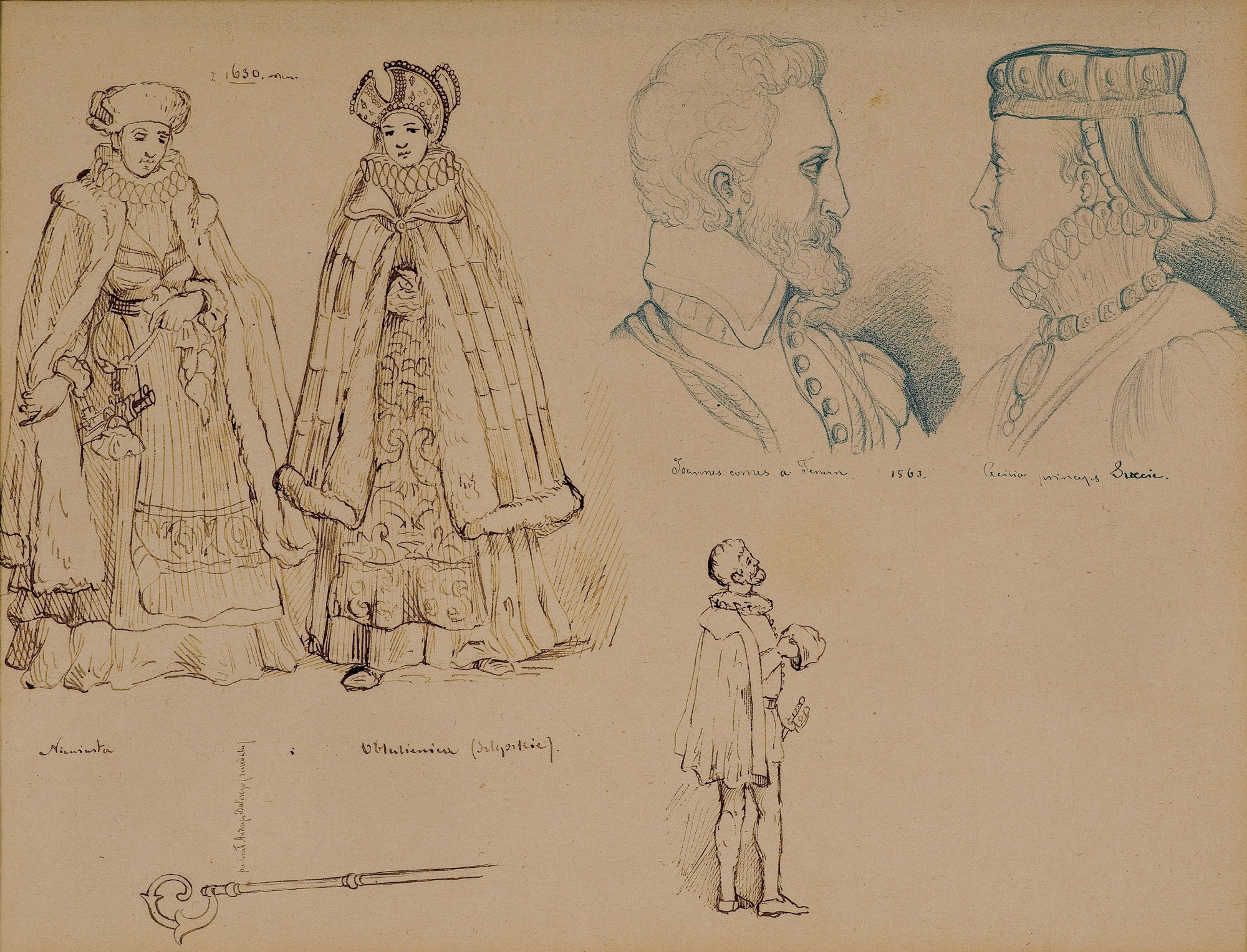
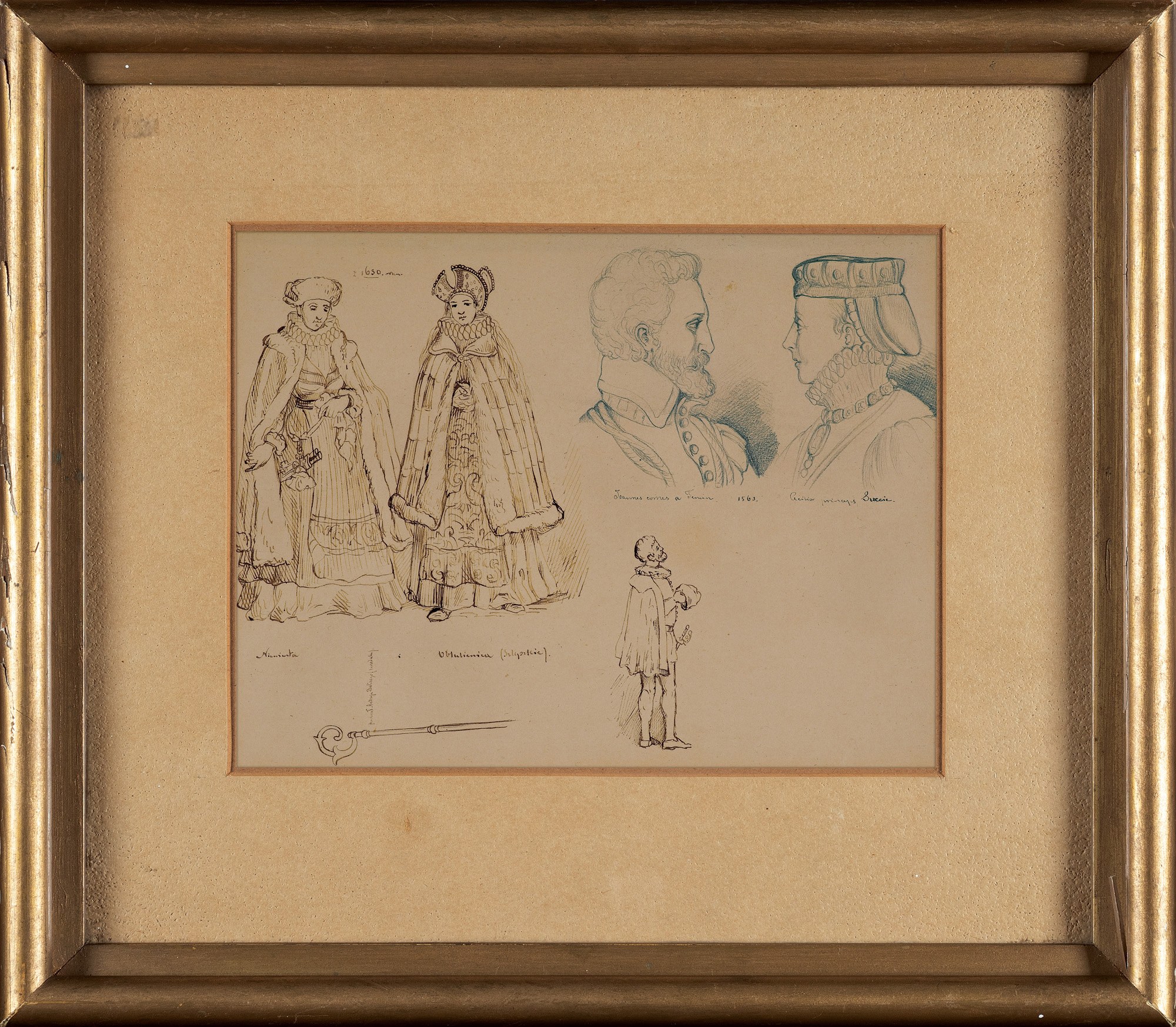
19.7 x 25.5 cm — ink, pen, pencil, paper
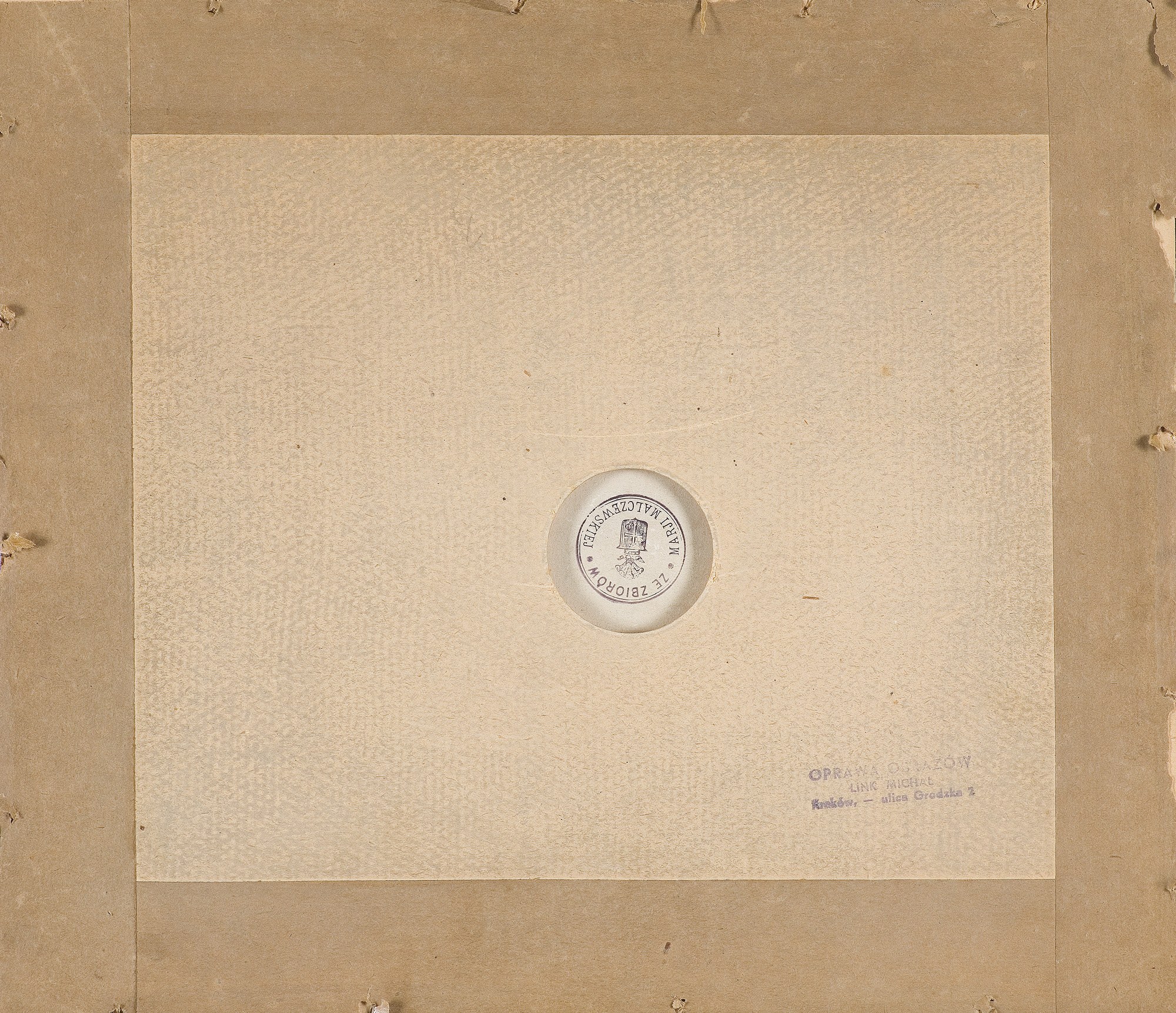
On the reverse, a circular seal bearing the Tarnawa coat of arms and the inscription in the border: FROM THE COLLECTION | OF MARIA MALCZEWSKA.
A pair of female figures on the left, labeled (in ink): The Woman and the Bride (Szkopskie); above the composition: 2. 1630. [...];
below, a drawing depicting a crosier with the inscription (in ink): “Andrzej Batory’s crosier”;
next to it, a small drawing of a man in historical costume.
On the right, two busts drawn in pencil, with the following inscription below (in ink): Joannes comes a Tencin 1563. Cecilia princeps Swecie.
Jacek Malczewski (Radom 1854–Kraków 1929)—a prominent representative of Polish modernist painting—began his artistic studies at the Kraków School of Fine Arts, where from 1872–1875 he studied under Feliks Szynalewski, Władysław Łuszczkiewicz, and Jan Matejko, whose studio he attended again from 1877 to 1879. He then studied at the École des Beaux-Arts in Paris under E. Lehmann (1876–1877).
In 1880, he traveled to Italy. In 1884–1885, he participated—as a draftsman—in Karol Lanckoroński’s scientific expedition to Pamphylia and Pisidia in Asia Minor. During that time, he also visited Greece and Italy. In 1885–1886, he spent several months in Munich. Upon his return, he settled permanently in Kraków, from where he continued to travel to Munich and Italy. From 1896 to 1900, he taught at the Kraków School of Fine Arts, and from 1911 to 1922, he served as a professor and, on two occasions, as rector of the Kraków Academy. He spent the years 1914–1915 in Vienna and returned to Kraków in 1916. In the final years of his life, he lived mainly in Lusławice and Charzewice near Zakliczyn. He was a co-founder of the Polish Artists’ Society “Sztuka” (1897) and a member of the “Zero” group (1908).
In his early career, he painted portraits, genre scenes, and—above all—works on themes related to the martyrdom of Poles following the January Uprising (The Death of Ellenai, Sunday in the Mine, On the Convoy, Christmas Eve in Siberia). Later, beginning in the 1890s, he created paintings with symbolic content, interweaving patriotic, biblical, fairy-tale, literary, and allegorical-fantastical themes.









Laatst bekeken
Log in om de kavellijst in te zien
Favorieten
Log in om de kavellijst in te zien