


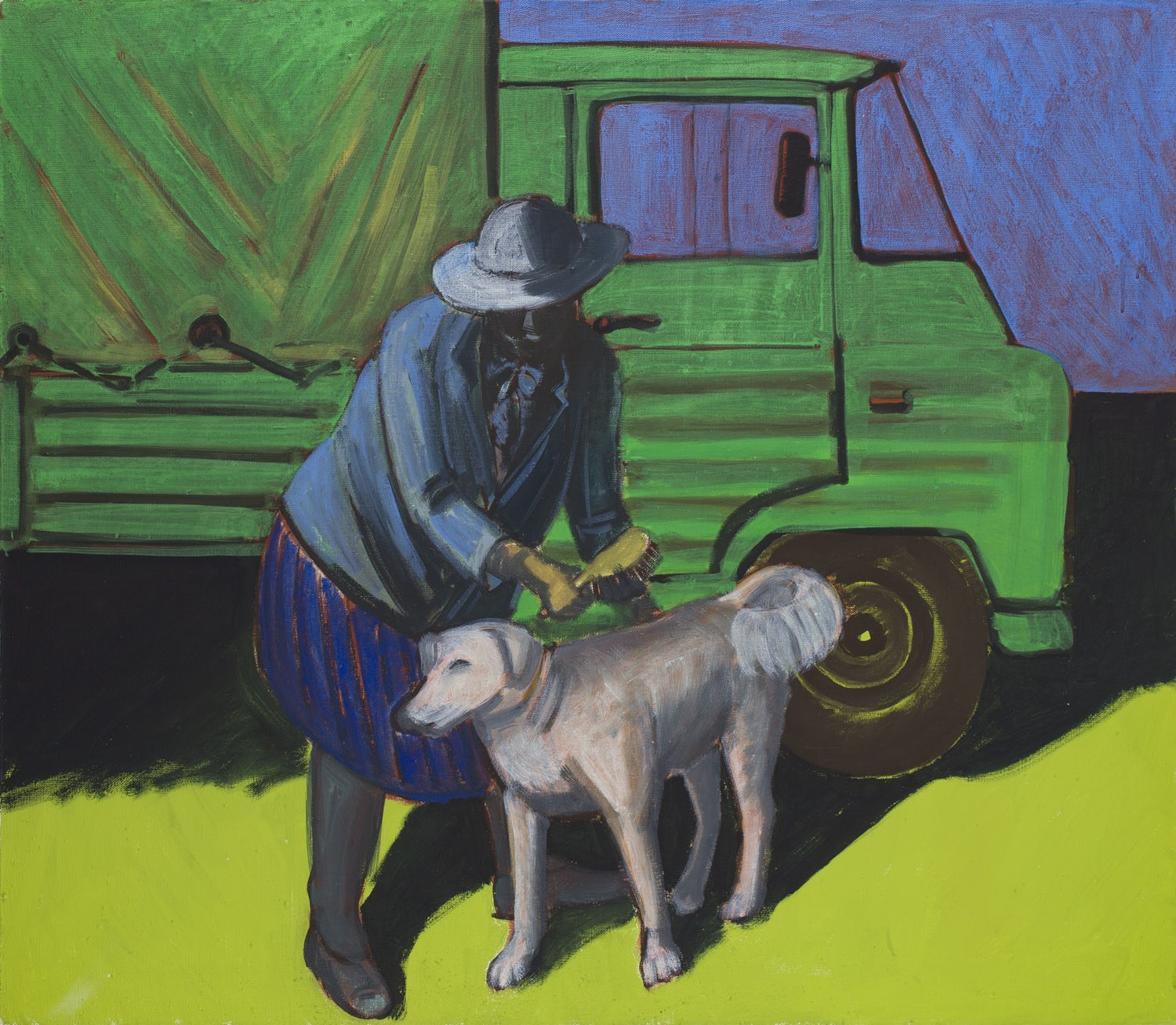
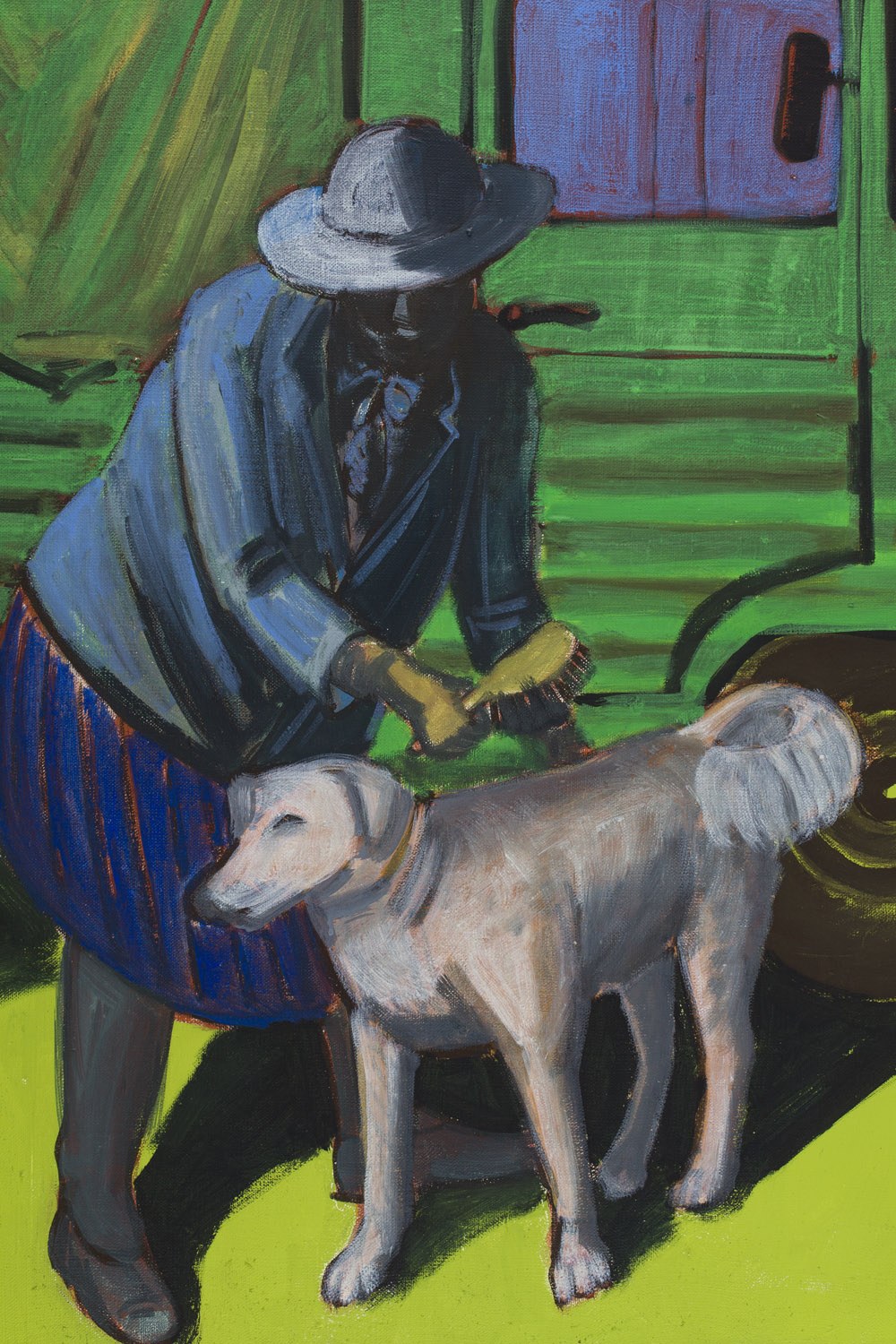
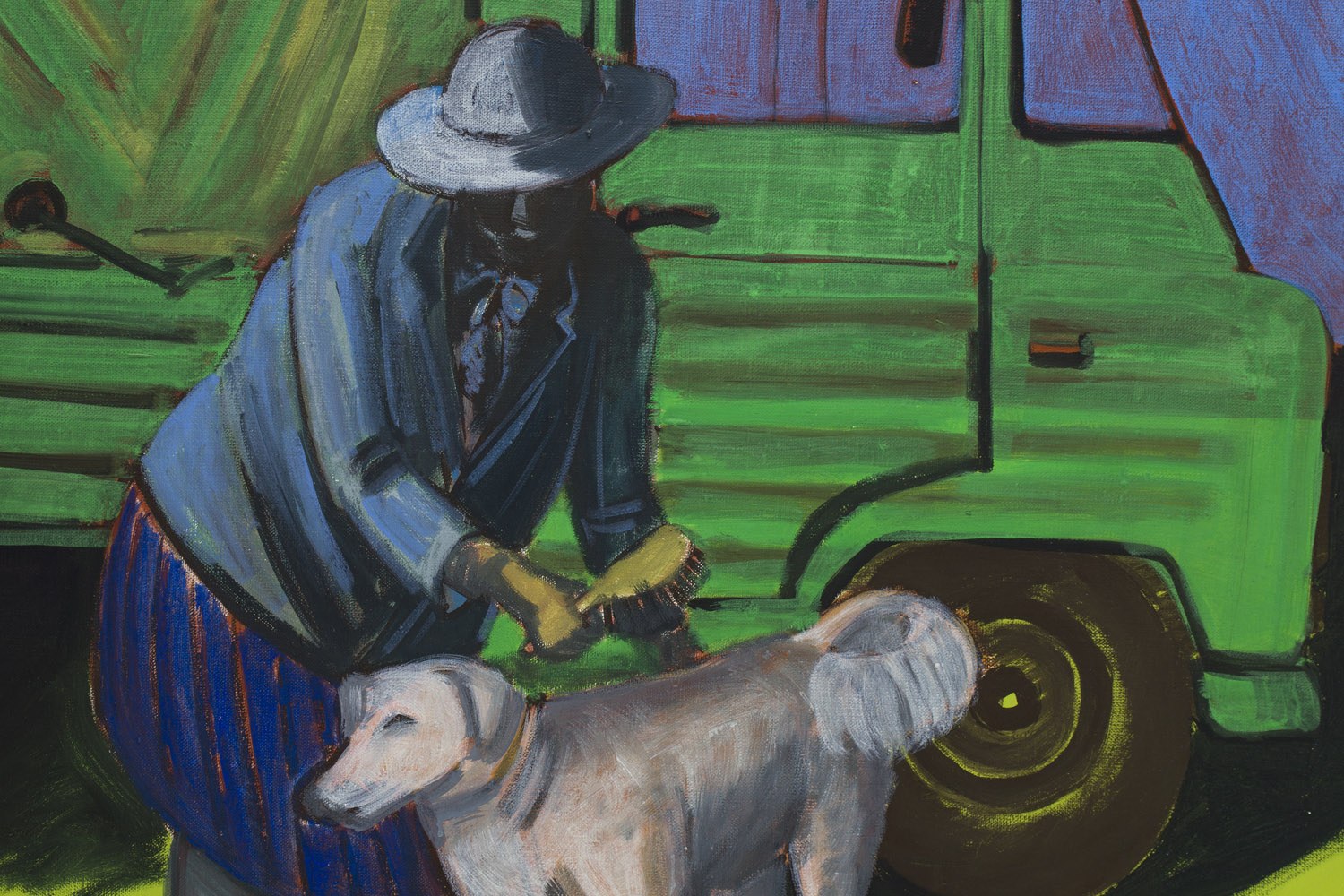
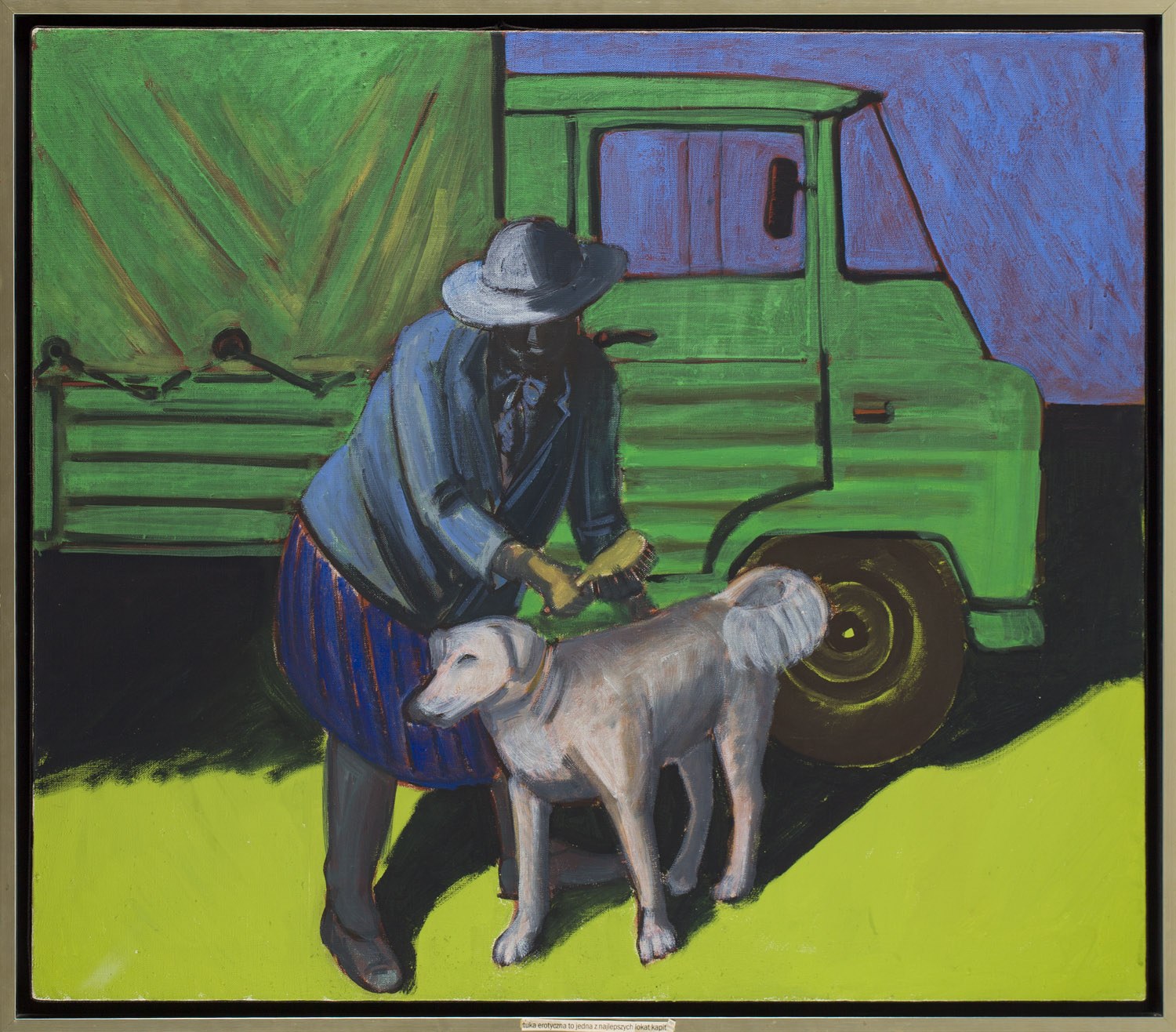
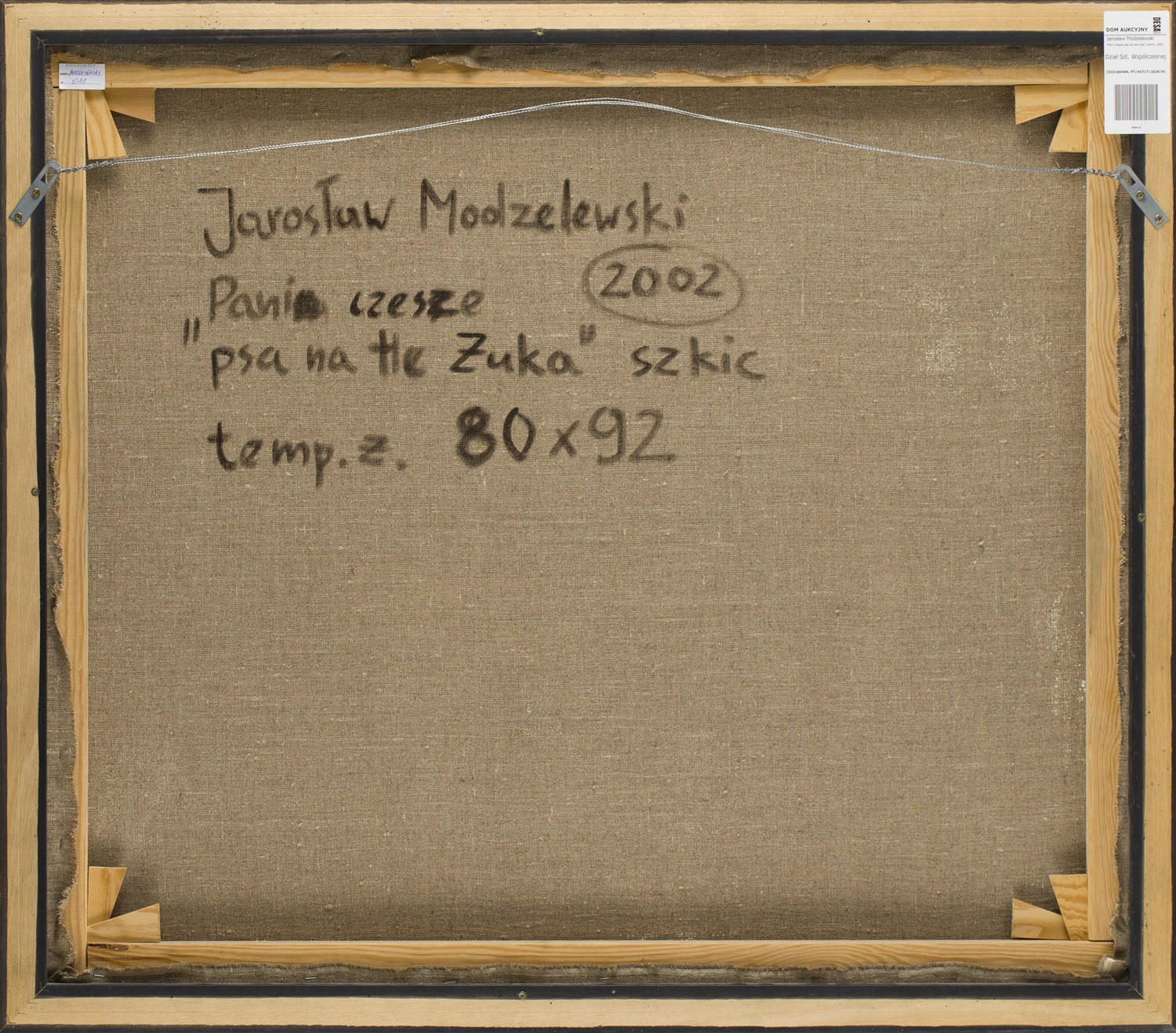
Dimensions: 80 x 92 cm
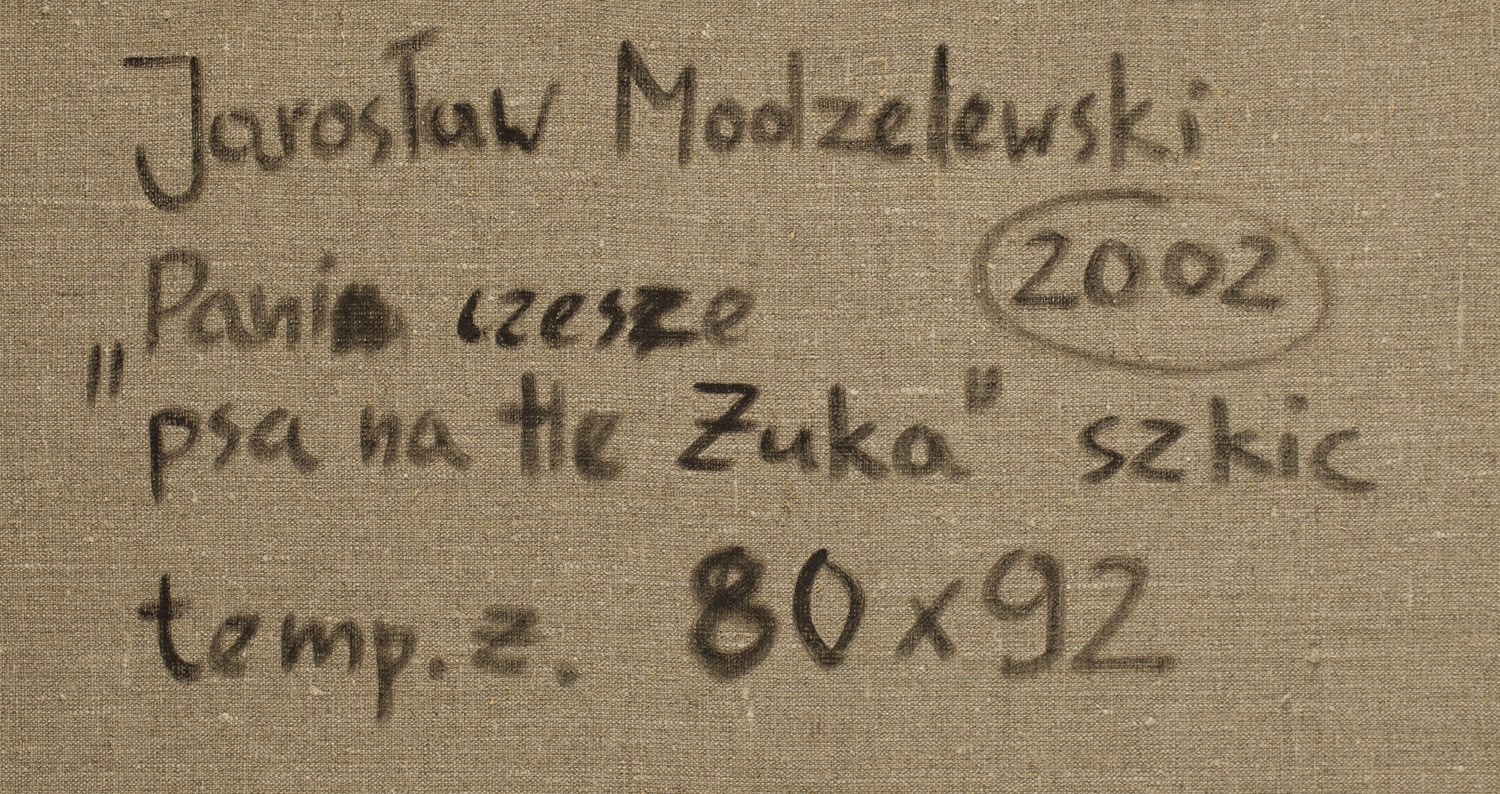
Signed, dated, and inscribed on the reverse: 'Jarosław Modzelewski | 2002 | "A Woman Combing a Dog Against the Background of Żuk" sketch | egg tempera 80 x 92'
Provenance
purchased from the artist
Bibliography
Jarosław Modzelewski. Paintings 1977–2006, ed. Jan Michalski et al., Galeria Zderzak, Kraków 2006, p. 213 (ill.)
Biography
He studied at the Academy of Fine Arts in Warsaw—in 1980, he received his diploma in painting from Prof. Stefan Gierowski’s studio. He was a co-founder of Grupa, with which he exhibited from 1983 to 1992. During this period, the artist’s paintings reflected the events that were shaping Poland at the time. He is considered one of the leading figures of “1980s Expressionism.” From 1986 to 1989, he created figurative paintings whose form (color, modeling, perspective) adhered to the principles of realism; however, the characterization of the figures—and especially the situations in which they were depicted—was marked by a jarringly unusual quality. The artist achieved this effect, for example, by duplicating figures (Photographer. Photographer, 1986), depicting figures in situations of uncertainty, discomfort, or the threat of falling (Difficulties in Moving, 1987), and manipulating space (Romanica Toscana, 1987). At times, the surreal atmosphere stemmed directly from the subject matter or the existential situation depicted. In his own view, the artist considers the 1990s to be a far more significant creative period than his earlier works. In the 1990s, he ran a private art school in Warsaw together with Marek Sobczyk. In 1997, Jarosław Modzelewski switched from oil painting to tempera. The artist’s intention was to breathe new life into his canvases through the tempera technique, which allows for freer manipulation of the canvas’s texture. New themes soon emerged in the artist’s work. At the turn of 2001 and 2002, the Kordegarda Gallery in Warsaw hosted an exhibition titled “The Painting as an Expression of Observation of a Church Interior.” The paintings presented at this exhibition were the result of Modzelewski’s discovery of a new area of interest—church interiors. Of particular significance is the artist’s observation of the mundane nature of these interiors, which contrasts with their spiritual and sacred purpose. The distinctive atmosphere of Modzelewski’s paintings and his cinematic approach to framing his subjects have led critics to frequently compare him to Edward Hopper.










