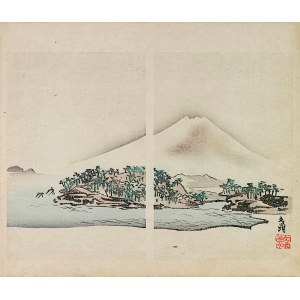
Japanese woodcut, ink, paper, 24x30 cm (diptych paper size), artist's signature
The woodcut is from the magazine "Miyo no hana" (translation: Flowers of the Empire or Flowers of the Magnificent Reign), No. 3, published in Japan in 1892 (Meiji 25). An analogous piece is in the collection of the British Museum in London.
The magazine was published by Fujii Magobe, the publisher and editor was Yamada Kōtarō, and the woodcuts were done by Nakamura Busuke. "Miyo no hana" contains woodcuts created from paintings by artists such as Imao Keinen, Takeuchi Seiho, Kikuchi Hobun, Taniguchi Kokyo, Kamisaka Sekka, and Kubota Beisen.
Imao Keinen (1845 - 1924) was a Japanese painter and graphic designer, in 1904. was appointed chief artist of the imperial court. He received a comprehensive education in various styles of Japanese art. In 1880, he became a professor at the Kyoto School of Painting. After publishing an album on birds and flowers, "Keinen Kachō Gafu," in 1892, he became a member of the Art Committee of the Imperial Court, and a member of the Imperial Academy of Fine Arts in 1919.His works are part of many museum collections around the world.
Takeuchi Seihō (1842-1942) was a native of Kyoto. He manifested his artistic skills as a child, and in 1877, despite his father's opposition, he entered the study of painter Eirin Tsuchida, a representative of the Shijō-Maruyama school. From 1880, he continued his painting studies with Bairei Kōno (1844-1895), becoming the most outstanding of his students. In time, he became one of the leading figures in Kyoto's artistic life and a lecturer at the local School of Fine Arts. In 1900-1901 he traveled to Europe, visiting the World Exhibition in Paris. He used this time to visit museums, delighting especially in the works of Turner and Corot. Upon his return to the country, he used the experience he gained then, introducing elements of European painting into his work. He created realistic paintings continuing the traditions of the Shijō school, but enriched with new subject matter and elements of European painting. The subjects of his paintings include nature (landscapes and animals), as well as Buddhist iconography and historical themes. He created landscapes imbued with lyricism and pathos; his mannerism bears the hallmarks of refined, decorative stylization. His works have had numerous exhibitions in Japan and Europe. At an exhibition in Paris in 1924, he was awarded the Legion of Honor. In 1937, he was awarded the Order of Culture. He was a member of the Imperial Academy of Arts.