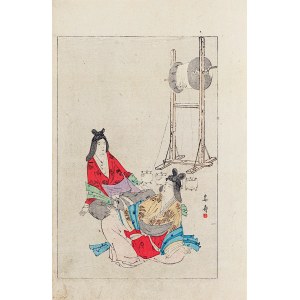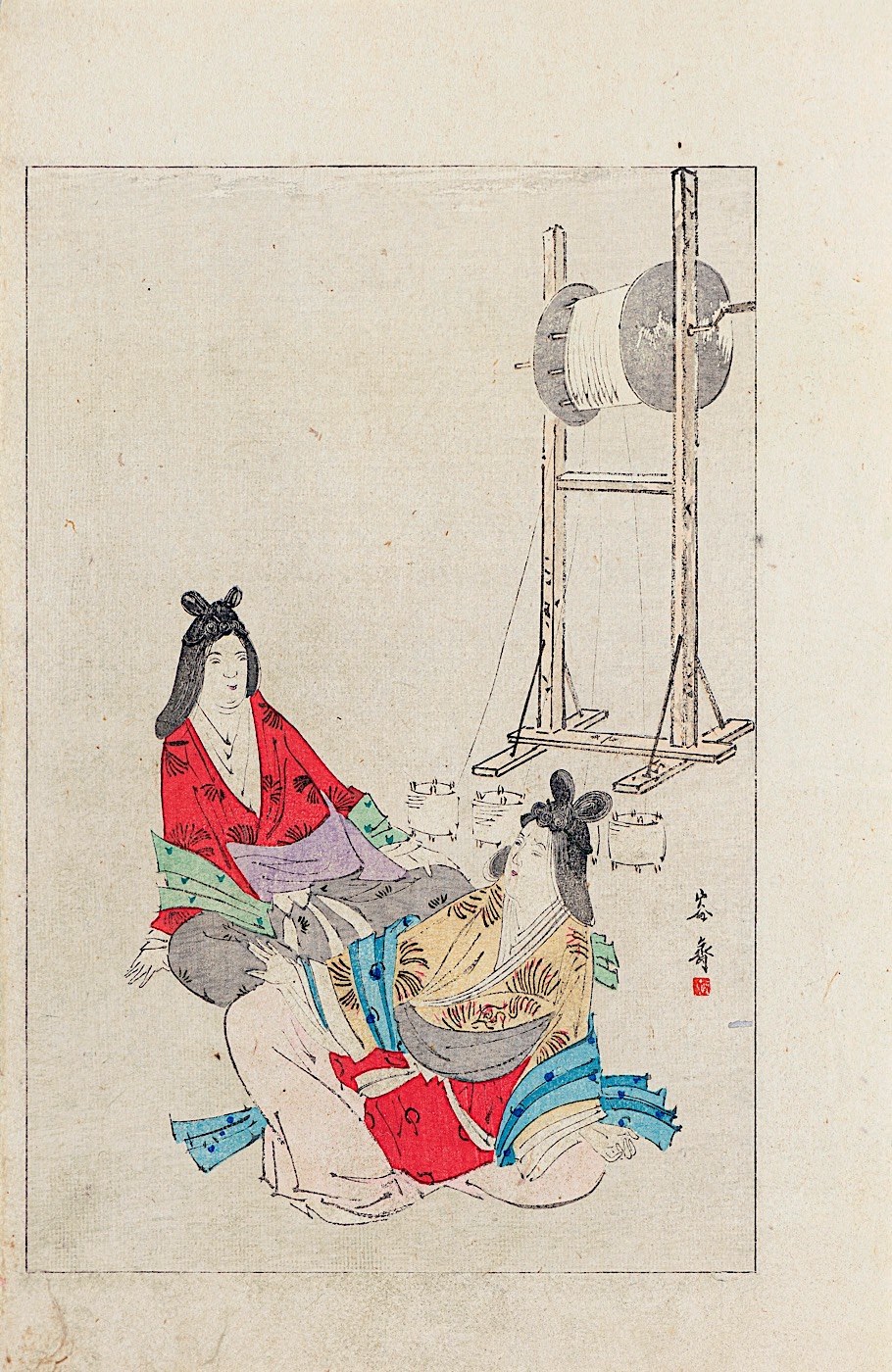
Japanese woodcut, ink, paper, 24x15 cm (paper size), artist's signature
The woodcut is from the magazine Miyo no hana (translated as Flowers of the Empire or Flowers of the Magnificent Reign), No. 1, published in Japan in 1892 (Meiji 25). The magazine was published by Fujii Magobe, the publisher and editor was Yamada Kōtarō, and the woodcuts were done by Nakamura Busuke. "Miyo no hana" contains woodcuts created from paintings by artists such as Imao Keinen, Takeuchi Seiho, Kikuchi Hobun, Taniguchi Kokyo, Kamisaka Sekka, Kubota Beisen and many others.
The history of Kurehatori and Ayahatori dates back to ancient times - these two "princesses" came to Japan from the Kure region of China. The famous weavers taught their skills to local women and are commemorated in two temples in Ikeda Osaka. The caption on this woodcut illustration reads "Rosai," which was an alternate name used by Ogata Gekko (1859-1920). Ogata Gekkō was a Japanese artist considered one of the greatest ukiyo-e woodcut artists of the late 19th century. He was the son of a samurai family. He studied under Kawanabe Kyosai and Taiso Yoshitoshi, two prominent ukiyo-e artists, during the Meiji period. Gekkō was self-taught in art and began by decorating porcelain and rickshaws and designing pamphlets for pleasure districts. Around 1881, he took the Ogata name at the urging of a descendant of the painter Ogata Kōrin. He soon took to designing prints and illustrating books and newspapers, but his talents soon attracted the attention of publishers and collectors, and he began creating woodblock prints. Gekko's works reflected the changing times in Japan during the Meiji period, when the country opened to the West and modernized rapidly. His prints often included contemporary subjects such as train stations, factories and steamships, as well as historical scenes and traditional Japanese motifs.