


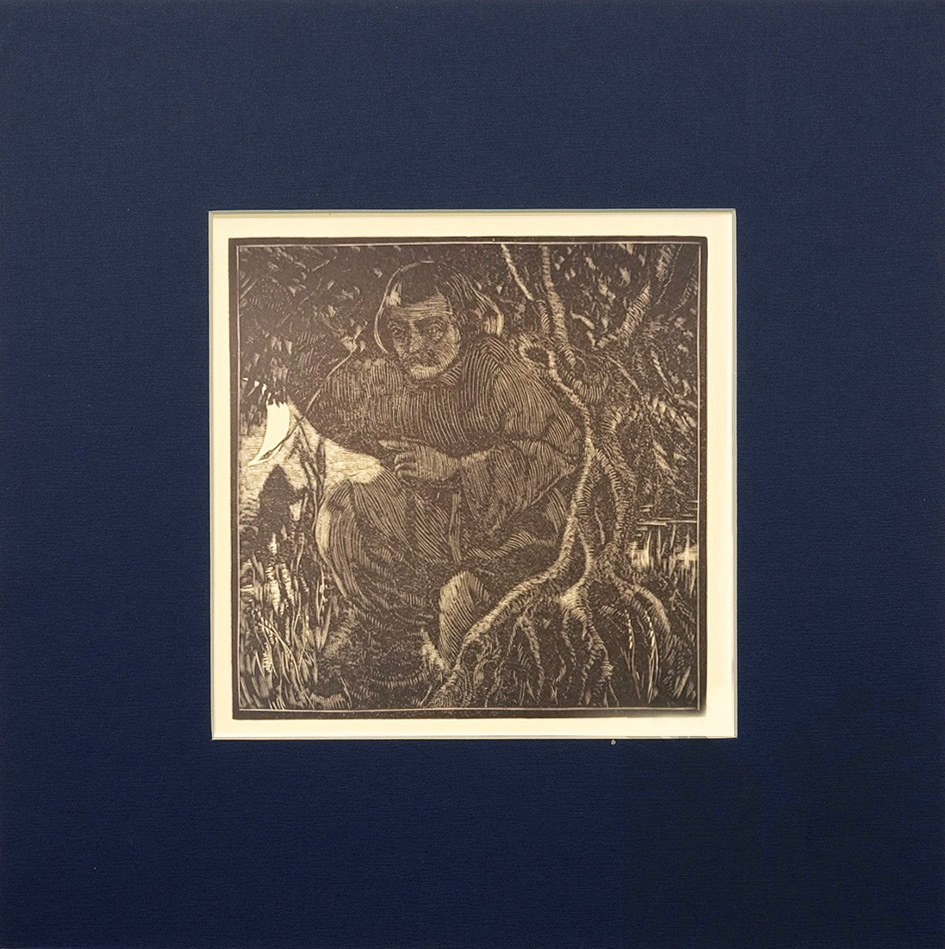
The Gods of the Slavs - Perepłut
1933 woodcut, cardboard; 15 x 15 cm (inside the passe-partout). From the portfolio *The Gods of the Slavs* – *Bogowie Słowian* – *Le Dieux des Slaves*. Kraków, 1933: Prowe, Veles, Stryboh, Mokosh, Simargl, Pereplut, Dazhbog, Radgost, Porenut, Perun, and Arkona. Marzanna, Marzana, Marena, Morana, Morena, Mora, Death, Śmiercicha, Śmiertka.
Perepłut—an enigmatic figure from the beliefs of the Eastern Slavs, a deity or demon with an unclear function. He appears in the list of gods and demons in the 12th-century Ruthenian interpolation of the Word of St. Gregory (the manuscript itself dates from the 15th century), as well as in the Word of St. John Chrysostom. Arkona—a city and religious center of the Baltic Slavs, located on the island of Rügen, destroyed by the Danes in 1169. It served as a religious hub, uniting many Slavic tribes. It was ruled by the high priest of the god Sviatovit. Stanisław JAKUBOWSKI (April 14, 1885, Kosów – June 9, 1964, Kraków) was a graphic artist and painter. He initially studied at the School of Woodworking in Stanisławów (sculpture department), and from 1907 to 1912 he studied at the Academy of Fine Arts in Kraków under Teodor Axentowicz, Stanisław Dębicki, and Leon Wyczółkowski; from 1912, he taught in secondary schools; from 1946, he was a lecturer and later an associate professor at the Academy of Fine Arts in Kraków. From around 1914, he focused primarily on artistic printmaking. A master of woodcut, he also practiced metal engraving techniques; he created approximately one thousand prints and was, moreover, a prolific commercial graphic artist and an expert on ornamentation and Slavic themes (see: “Dictionary of Polish Artists …,” vol. 3, pp. 185–187). Bibliography: Maria Grońska, *Graphic Art in Books, Portfolios, and Albums: Polish Art and Bibliophile Publications*, Wrocław–Warsaw–Kraków 1994, p. 241, entry 282.










Laatst bekeken
Log in om de kavellijst in te zien
Favorieten
Log in om de kavellijst in te zien