


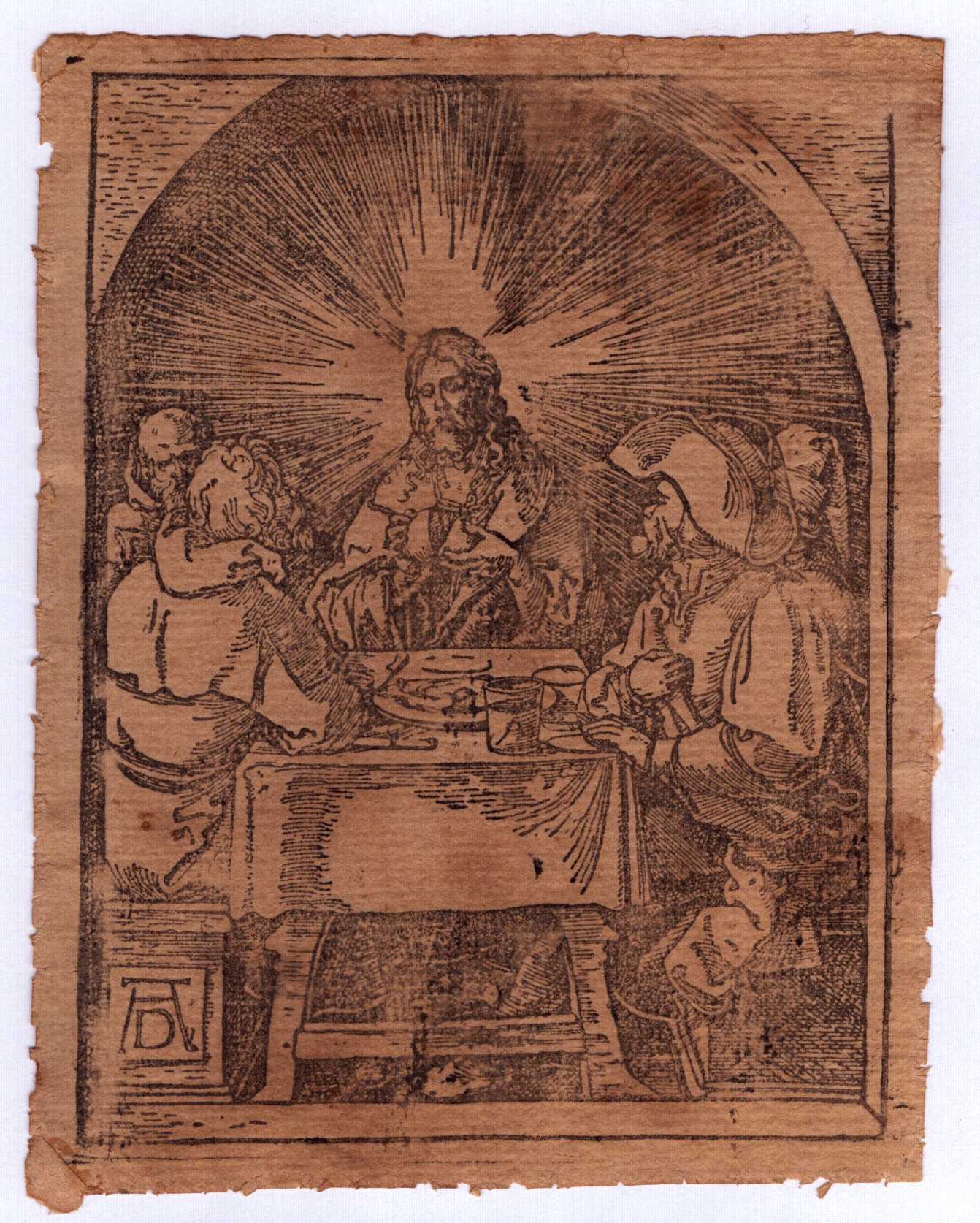
Albrecht DÜRER (1471-1528), according to. Woodcut, ribbed paper, print 12.5 x 9.5 cm, paper 13.2 x 10.5 cm, signed on woodblock l.d. with monogram AD. State of preservation: print is pale, paper yellowed, with worn edges, stained, glued on back p.-g. side and l.b.
Painter, printmaker, draughtsman, and art theorist. One of the greatest artists of the turn of the century, friend of scholars and artists, court artist of Emperor Maximilian I and later Charles V. He studied in his father's goldsmith's workshop and with painter Michael Wolgemut at the time of the creation of the Liber Chronicarum. He took a journeyman's tour of Alsace and Switzerland. He went to Italy twice (1494-95 and 1505-06), where he copied Mantegni's copperplates. In Venice he excelled in his technique of chiaroscuro and halftones. Upon his return, he settled in his hometown of Nuremberg, where he ran a painting and printmaking workshop that employed many apprentices and journeymen. Dürer revolutionized printmaking, overcoming the technical limitations of woodcuts. He introduced a thinner, more delicate line, made shading more subtle, greatly expanding the scale of value, learned to render the texture and spatiality of things, which allowed him unprecedented detail and programmatic complexity in his compositions. He mastered not only woodcut and copperplate, but also tried his hand at acidite and drypoint. He gave the engravings the status of independent works of art. He consciously took advantage of the easy spread of prints to build his fame, publishing whole series of engravings (the most famous: "Large and Small Passion", "Apocalypse"," Life of Mary") and taking care to place his monogram in a prominent place. Dürer's flagship engraving works were three copper engravings known as the so-called master engravings: "St. Jerome in the Studio," "Knight, Death and the Devil," and "Melancholia I," named by Panofsky as his psychological self-portrait. He also did not shy away from more explicit self-images, as in "Men's Bath," where he also placed his learned friend Wilibald Pirkheimer (the obese man on the right) in addition to himself.










Laatst bekeken
Log in om de kavellijst in te zien
Favorieten
Log in om de kavellijst in te zien