


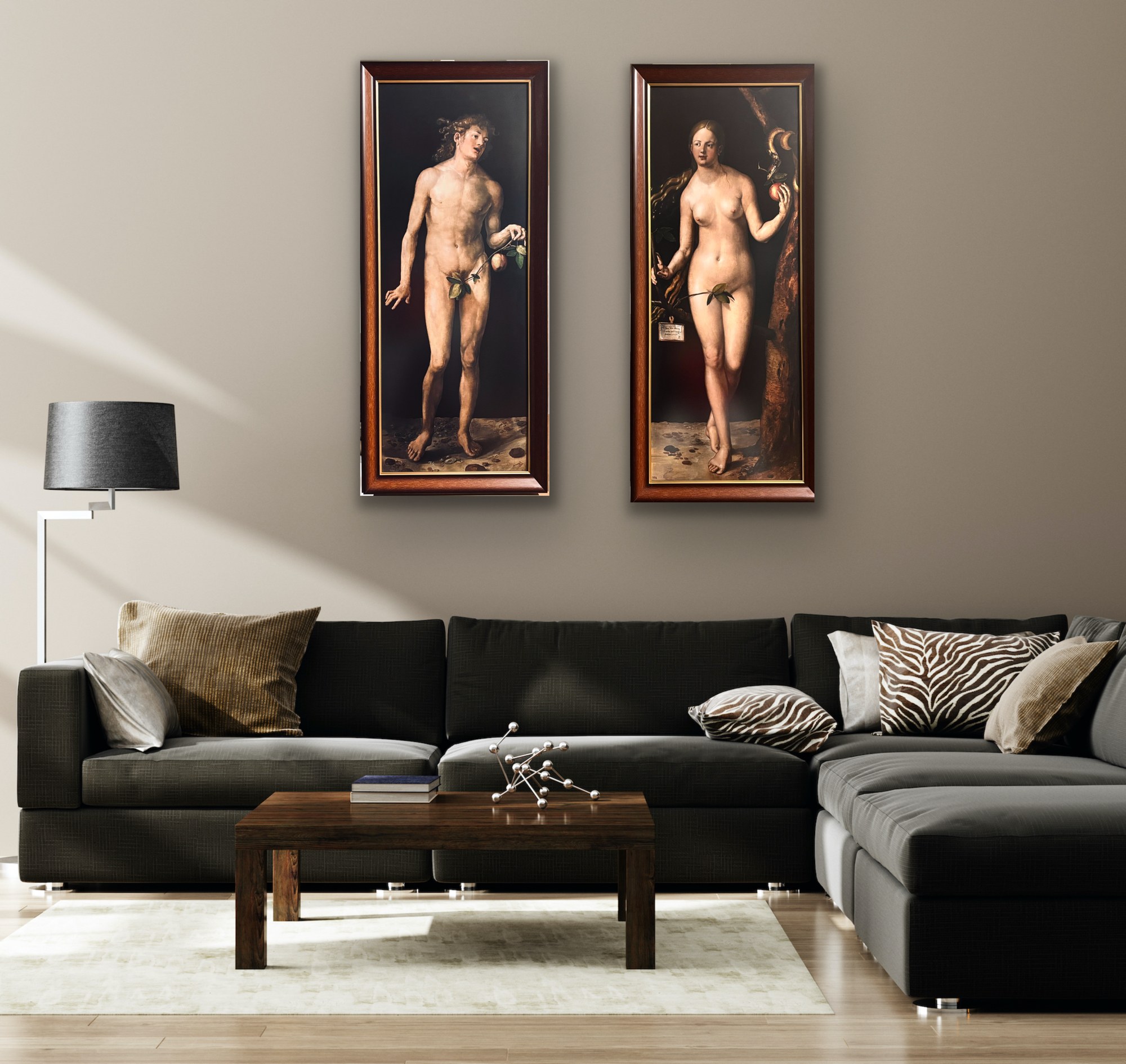

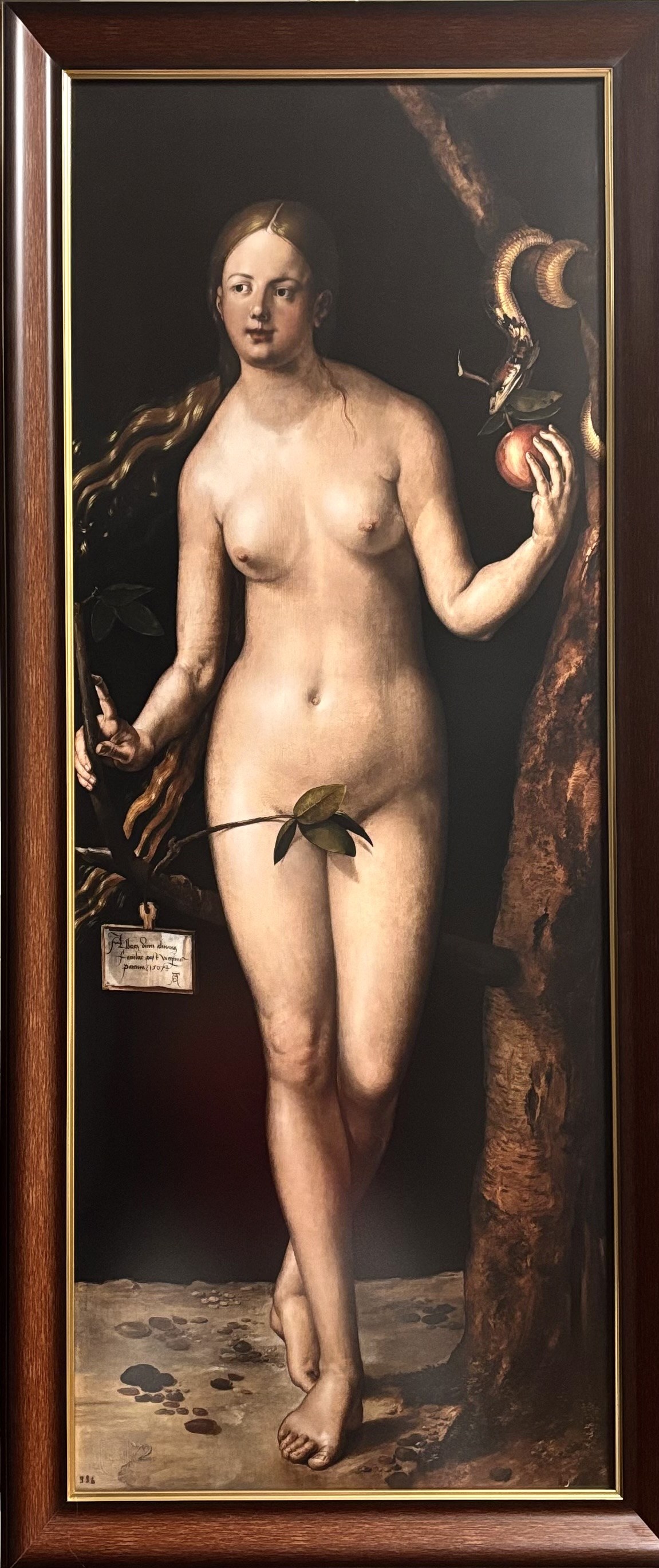
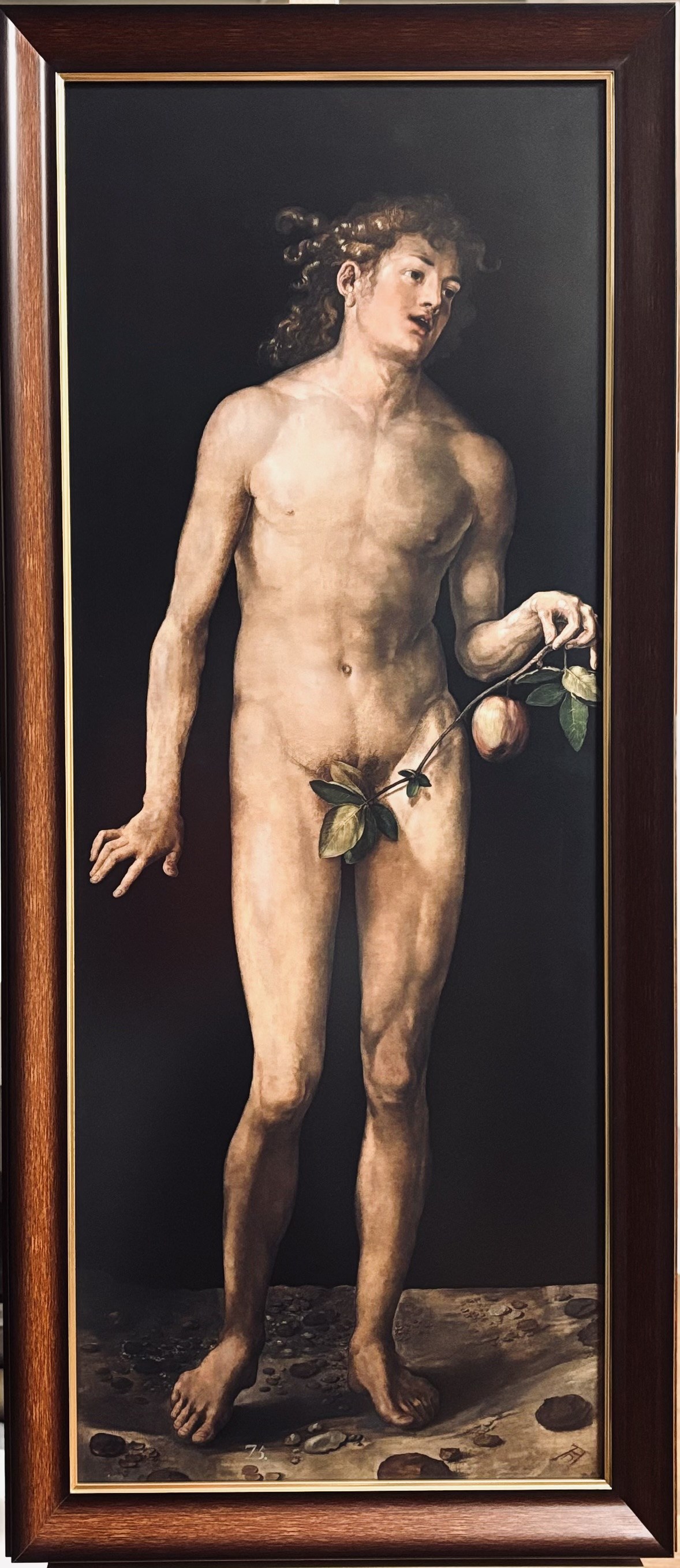
A set of two prints, *gouttelette*, each measuring 108 x 41 cm (inside the frame), *
*. Publisher: Felix Rosenstiel’s Widow & Son. A dry seal on each print, lower left.
The two panels, “Adam and Eve,” were created in 1507 and are currently housed at the Museo del Prado in Madrid. Each panel is approximately 209 cm high and 81 cm wide, making the figures life-size. These were among the first life-size nudes in painting.
The figures are characterized by classical proportions, inspired by ancient sculptures, reflecting Dürer’s interest in humanist ideals of beauty. Adam resembles the Belvedere Apollo, and Eve resembles Venus. Adam is depicted standing frontally, with his weight resting on one leg (contraposto). His genitals are covered by a twig, symbolizing the Tree of Life. Eve also stands facing the viewer, in a similar contrapposto pose. In one hand she holds a fig branch, symbolizing the Tree of the Knowledge of Good and Evil. The serpent offers her the forbidden fruit, and she accepts it without even looking in the serpent’s direction.
The work is rich in symbolic elements associated with original sin: the Tree of the Knowledge of Good and Evil—a serpent wraps itself around the tree’s trunk, holding a fruit in its mouth. Eve reaches out to take it, while Adam stands beside her, seemingly unaware.
On the twig held by Eve in the 1507 painting, there is indeed a small plaque bearing Albrecht Dürer’s signature and the date “1507.” This is an important element of these paintings, characteristic of many of Dürer’s works. Placing his signature in such a prominent spot underscored his status as an artist and his self-confidence.
The oil paintings “Adam” and “Eve” from 1507 are monumental and significant works by Albrecht Dürer that demonstrate his mastery of painting, his interest in the theory of proportion, and his interpretation of the biblical motif of original sin under the influence of the Italian Renaissance. Dürer’s work was very frequently copied and imitated, which attests to its immense popularity and significance for artists and audiences of the time. It was considered a model depiction of the biblical couple and proof of the artist’s mastery in rendering ideal proportions, and its idealized representation of the human body became an important point of reference in art history.
The paintings belonged to Queen Christina of Sweden, who gifted them to King Philip IV of Spain. They arrived at the Prado in 1827.











Laatst bekeken
Log in om de kavellijst in te zien
Favorieten
Log in om de kavellijst in te zien