


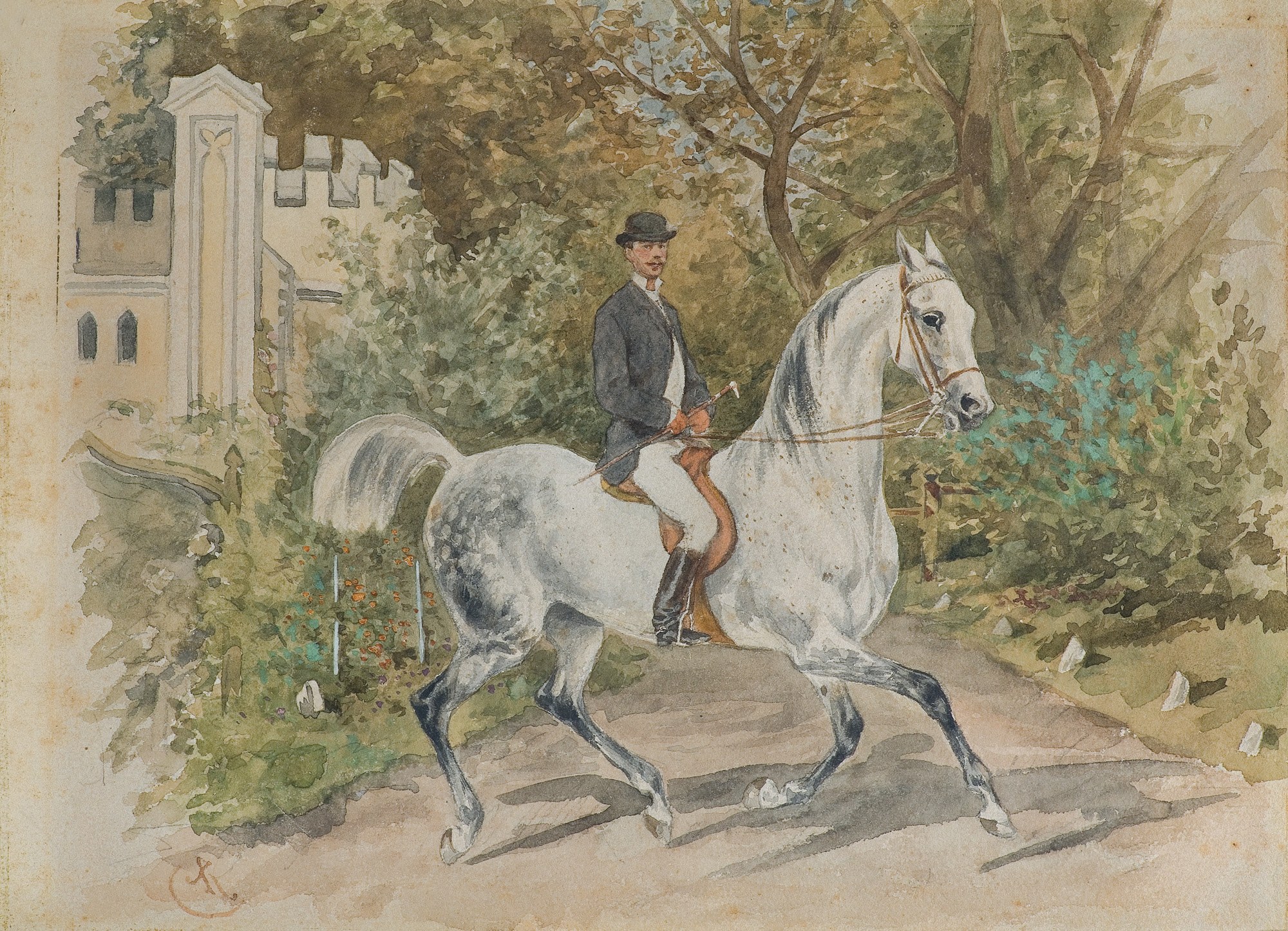
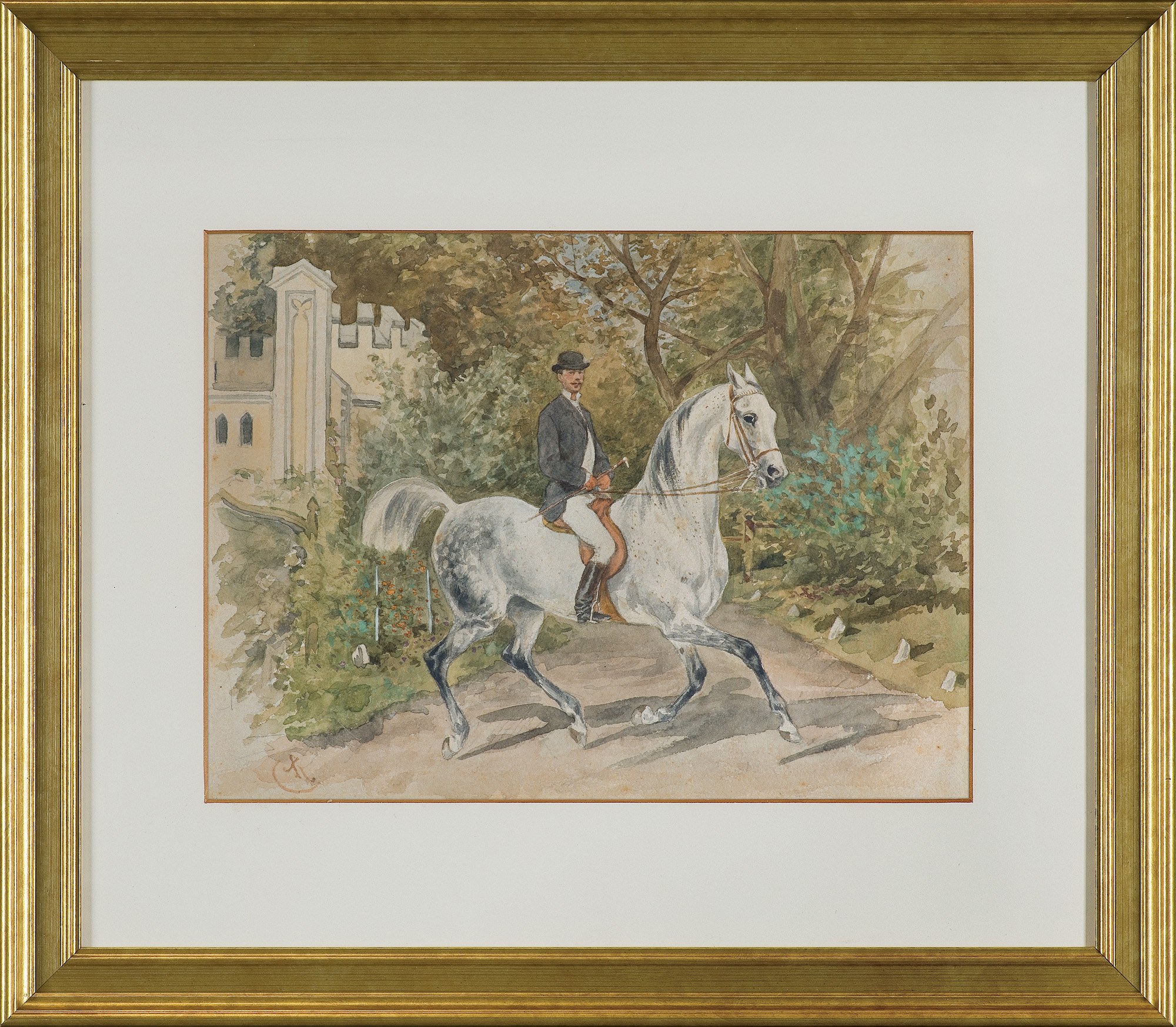
25.2 x 34.3 cm — watercolor, pencil, paper mounted on cardboard
signed lower left: JK [linked initials]
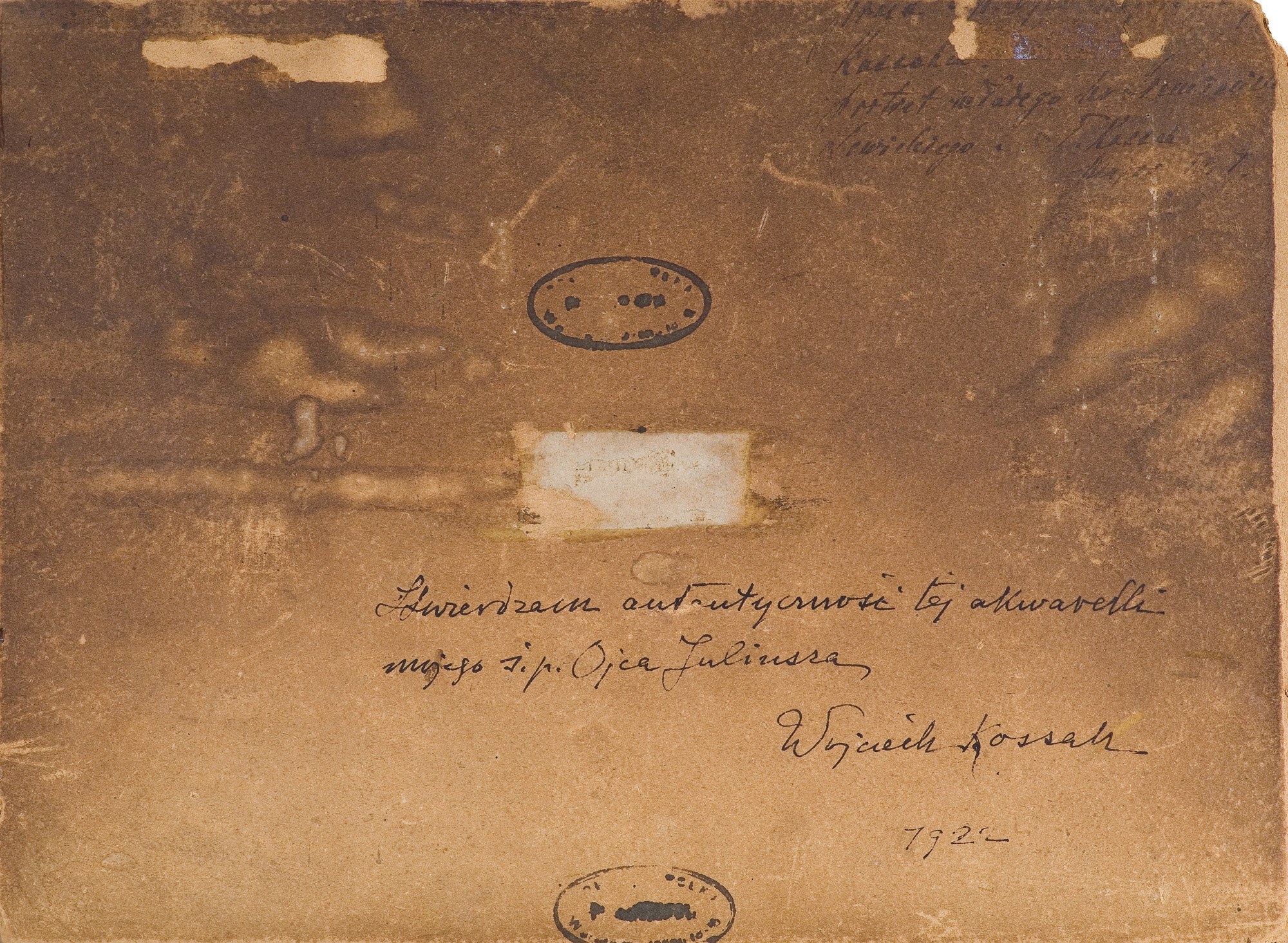
On the reverse, lower right (in ink): Work [...] by Father [...] | Kossak | portrait of the young Count Siemieńsk[i] |
Lewicki. T. Kossak | Major W.P.; at the bottom (in ink): I certify the authenticity of this watercolor |
by my late father, Juliusz | Wojciech Kossak | 1922; additionally, two oval, illegible stamps.
The painting is accompanied by an expert opinion by Dr. K. Olszański dated April 2001.
The portrait, described by Wojciech Kossak as a depiction of the young Count Siemieński-Lewicki, depicts Stanisław Konstanty Maria Siemieński-Lewicki (1864–1918), the third heir to the Chorostów estate. After the death of his father, Wilhelm Stanisław Siemieński (1827–1901), Stanisław Konstanty inherited the family estate in Pawłosiów, located a few kilometers from Jarosław, in what is now the Podkarpackie Voivodeship.
In the early 17th century, Anna née Kostków (1575–1635), wife of Prince Aleksander Ostrogski, bequeathed the estate to the Jesuit Order. Following the First Partition of Poland, the Pawłosiów estate became the property of the Austrian government. They were subsequently sold to Stanisław Wilhelm Siemieński of the Dąbrowa coat of arms—owner of Biecz, Ropa, and Magierów, as well as a chamberlain and a member of the Galician Estates.
After him, the estate was inherited by his son Konstanty, who died in 1866, and then by his grandson Wilhelm Stanisław. The next owner of Pawłosiów was Stanisław Konstanty, the third entailed heir of the Chorostów estate, who is depicted in a portrait. It was during his time that the family manor was significantly expanded and transformed into a palace-like residence. The manor was picturesquely situated on the slope of an escarpment descending toward the meadows. It was surrounded by a vast landscape garden and a park where many rare species of trees grew. It was this park, despite the destruction of the residence itself, that proved to be one of the more enduring remnants of the former estate. It survived both world wars and has been partially preserved to this day. The manor house in Pawłosiów, along with its furnishings, did not survive to the present day. The manor was completely destroyed during World War I, on May 14, 1915. There are no detailed accounts regarding the appearance of its interiors or the furnishings housed within. However, surviving accounts indicate that the residence housed a valuable Polish-French library, rich in illustrated works, as well as a collection of Polish and foreign art.
The portrait presented here depicts a young Stanisław Konstanty Siemieński-Lewicki walking along a park avenue. Seated on a gray horse, the count has lush greenery and a fragment of the historic buildings of his family’s manor as a backdrop. This stately portrait is a record of a world that has, for the most part, disappeared forever. It bears witness to the environment, culture, and lifestyle of the Polish landed gentry at the turn of the 19th and 20th centuries.
Bibliography: – R. Aftanazy, *Materials on the History of Country Estates*, ed. A. J. Baranowski, vol. VIII, Warsaw 1991, p. 169.
Juliusz Kossak (Wiśnicz 1824–Kraków 1899)—painter and illustrator—was one of the most popular Polish artists of the second half of the 19th century. He began studying drawing and painting in Jan Maszkowski’s studio in Lviv; later, he drew extensively from life while visiting noble estates in Ukraine, Podolia, and Volhynia. In 1852, he traveled to Vienna, Hungary, and St. Petersburg, and subsequently settled permanently in Warsaw. He spent the years 1856–1860 in Paris, where he was friends with Horace Vernet. Upon his return to Warsaw, from 1862 to 1868 he served as artistic director of *Tygodnik Ilustrowany*. In 1869, he moved permanently to Kraków, from where he would still travel to Munich to paint in the studio of the battle painter Franz Adam. Kossak was, above all, an outstanding watercolorist; he used the oil technique less frequently. He painted historical and battle scenes, as well as genre scenes illustrating the life and traditions of the noble court and the customs of the Polish people. But the true heroes of his paintings were horses, whose movement, temperament, character, and individuality he was able to depict masterfully. He was also the author of numerous illustrations for magazines and books, unerringly capturing both the atmosphere of literary works and the longings and needs of his audience—the readers of Wincenty Pol’s *Song of Our Land*, Henryk Sienkiewicz’s *Trilogy*, *Pan Tadeusz*, and Adam Mickiewicz’s poems.













Laatst bekeken
Log in om de kavellijst in te zien
Favorieten
Log in om de kavellijst in te zien