


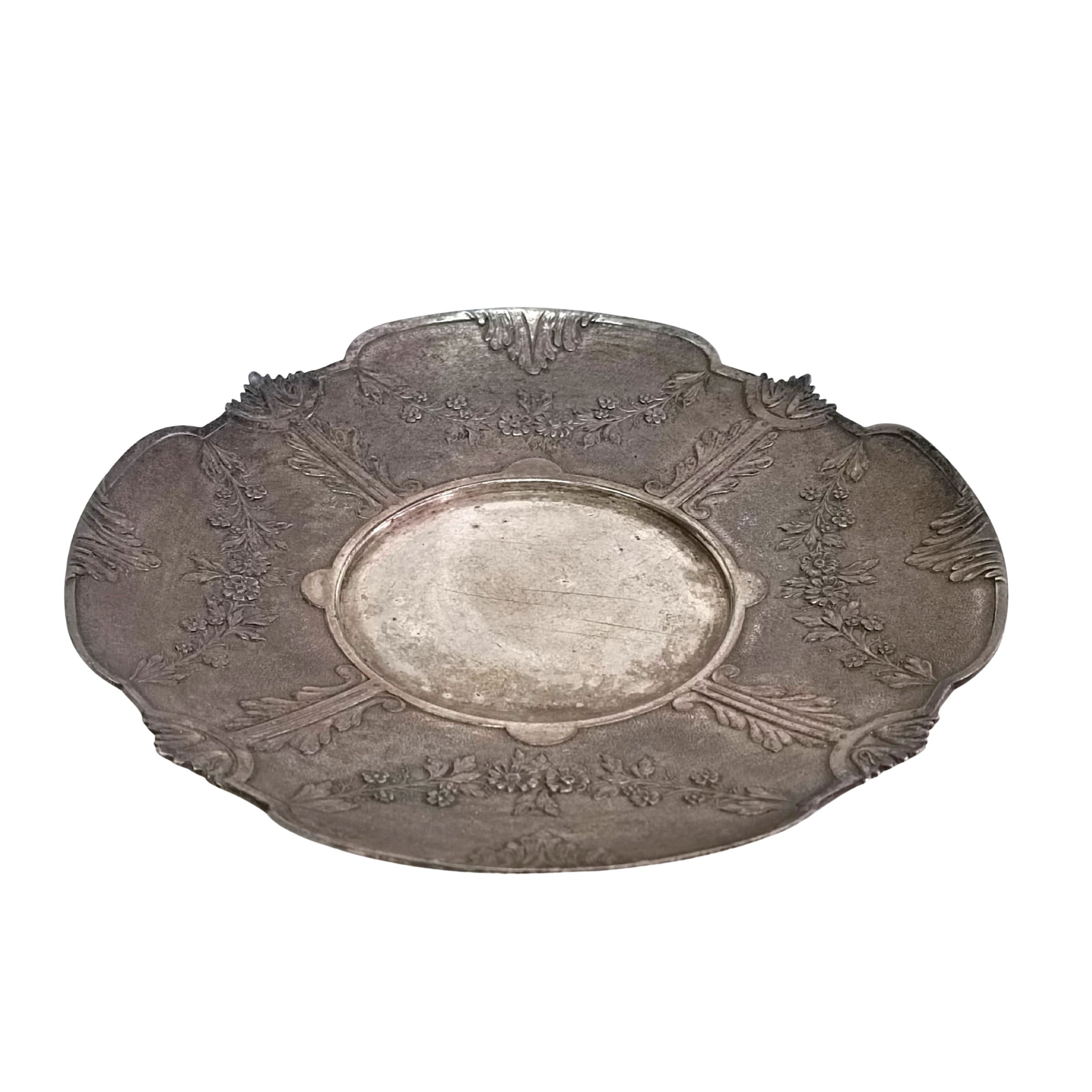

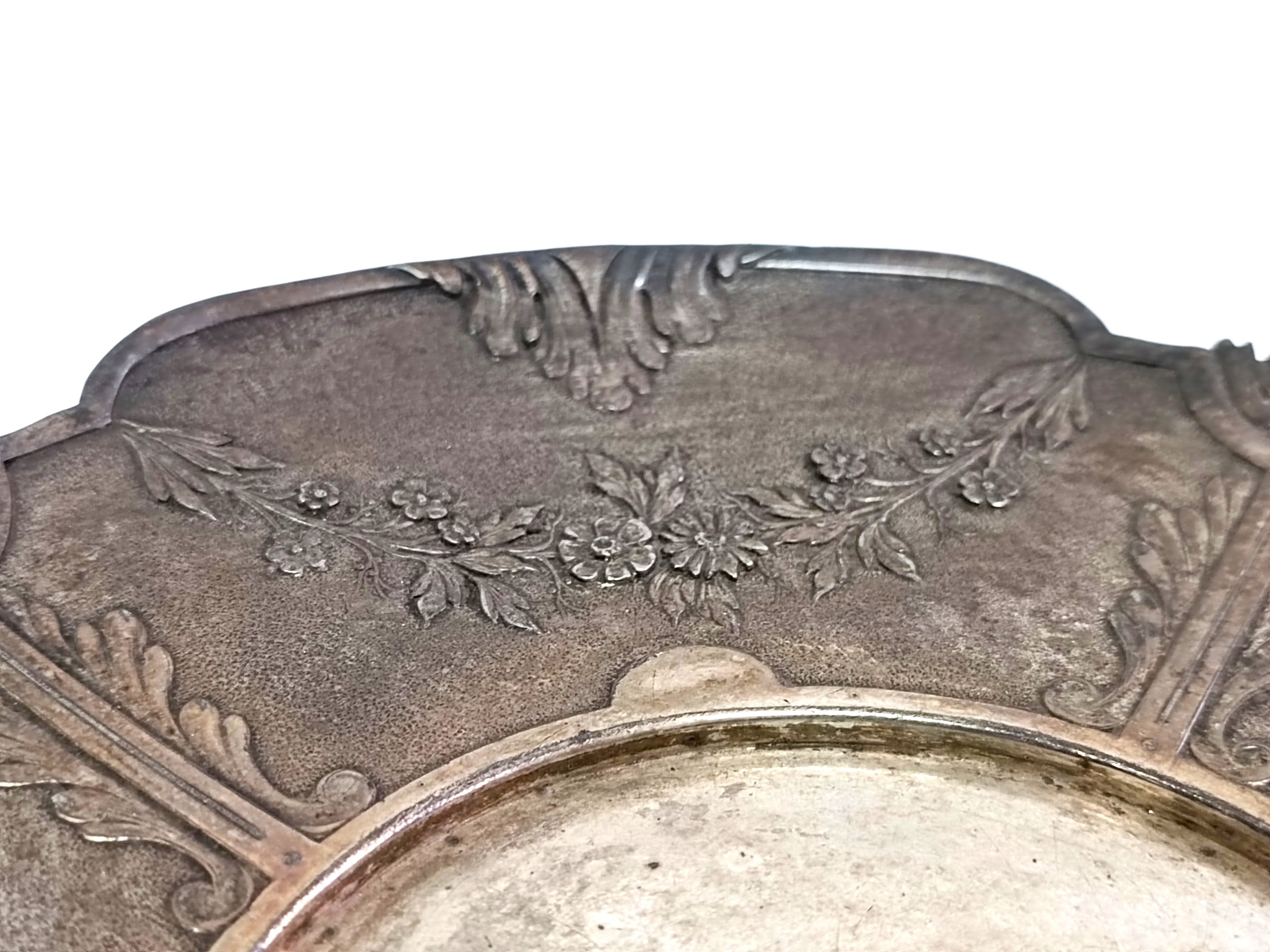
Ornate nickel silver plate, Christofle, France, late 19th–early 20th century.
A small plate richly decorated with floral motifs, made of so-called nickel silver*. On the underside are hallmarks identifying the material (a goat’s head within a rhombus inscribed in a square = nickel silver) and the manufacturer—the Christophle workshop (a rooster with the inscription “Orfèvrerie Gallia” = Christophle*). In very good condition.
Dimensions: 19.5 x 2 cm.
* Nickel silver, also known as melchior, alpaca, alfenid, arfenil, neusilber, Sheffield silver, Chinese silver, or Christofle metal, is an alloy containing 40–70% copper, 10–20% nickel, and 5–40% zinc—contrary to its name, it does not contain silver, but was so named due to its visual similarity; for this reason, it was widely used by manufacturers of silver and silver-plated items and sets. It was particularly popular in France in the second half of the 19th century and at the beginning of the 20th century (the name “Alphenide” comes from the surname of the French chemist and goldsmith Charles Halphen, who brought this alloy to France from China and popularized it in Europe). The Alphenide manufactory was acquired in 1908 by the market leader, the Christophle brand, and renamed Orfèvrerie Gallia.









