


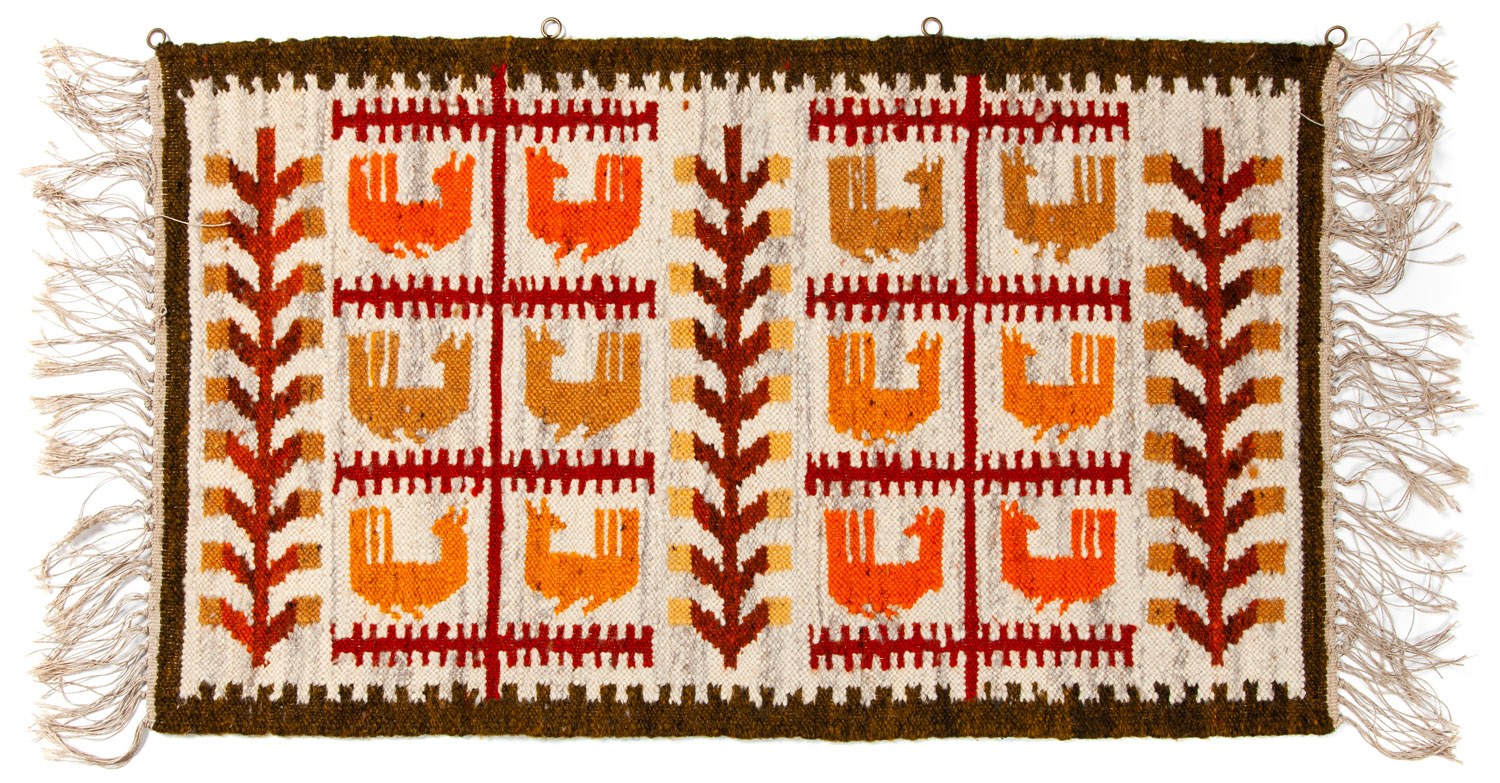
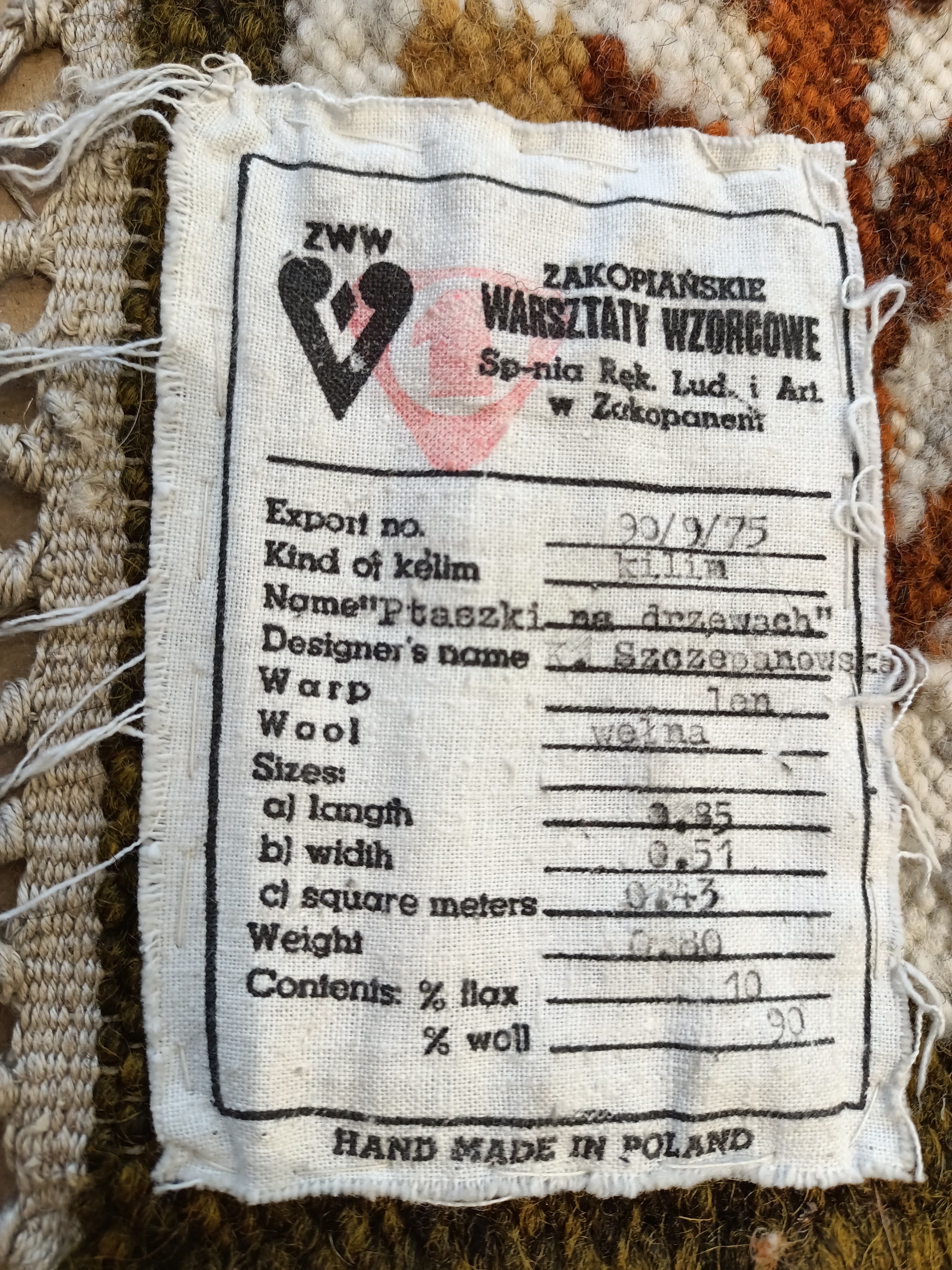
wool on linen warp, woven by hand; 85 x 51 cm
preserved label
"She shaped her surroundings, radiated widely." This is how Magdalena Abakanowicz remembered Krystyna Szczepanowska-Miklaszewska. Although there was almost 20 years of age difference between the two artists, they studied together at the Warsaw Academy of Fine Arts.
Krystyna Szczepanowska was born in Boryslaw. She spent her childhood and youth in Lviv. Her first teachers of weaving were her aunts: Eleonora Plutyńska and Wanda Szczepanowska. Krystyna then studied at the Lviv Polytechnic Institute and the Institute of Fine Arts in Lviv (1934-1939). She also graduated from the Academy of Fine Arts in Warsaw (1961), when a diploma obtained in the People's Republic of Poland proved indispensable to her.
Coming from a patriotic family with artistic and scientific traditions, it was Krystyna Szczepanowska who saved numerous valuable family heirlooms, including works of art, from wartime destruction. Indeed, she was the last one to take care of the Szczepanowskis' house in Lviv, and when it was occupied by the Red Army headquarters, she carried out its evacuation.
She made her way to Warsaw, where she joined the underground, then, as "Klementyna," fought in the Warsaw Uprising (without weapons, as she always emphasized). After the uprising she was imprisoned in the Lamsdorf camp, and later in Zeithain, and there, despite the very harsh conditions, she organized lectures on art history and literature for her fellow prisoners. After the liberation of the camp, she returned to Warsaw. She was associated with the city for the rest of her life, dividing her time between the capital and Zakopane, where she worked as an art manager first at the Peasant Self-Help Cooperative, later the Zakopane Pattern Workshops of Cepelia. Her duties included designing and supervising the production of textiles. At the time, she studied traditional folk motifs from the Podhale region and adapted them in the realization of contemporary decorative fabrics. When she returned to Warsaw in 1950, the management of ZWW was taken over by Maria Bujakowa, with whom Szczepanowska was still acquainted from her Lviv days. She developed her interest in Podhale art while working with Wanda Telakowska at the Institute of Industrial Design (1950-1957).
Szczepanowska-Miklaszewska was also an educator. She taught at the Basic Vocational School in Zakopane (later the H. Modrzejewska Artistic Weaving Technicum) and was the author of the school program for weaving technicians; she also developed the theoretical basis for creating kilims at Cepelia.
At the same time, the artist designed original unique textiles throughout her professional life. Transposing folk motifs, mainly from the Podhale region, she created abstract or even metaphorical weaving forms. Her works have been presented at numerous exhibitions in Poland and abroad. They have been awarded many times. ( Cover text for the monographic exhibition at the Arton Foundation)











Laatst bekeken
Log in om de kavellijst in te zien
Favorieten
Log in om de kavellijst in te zien