


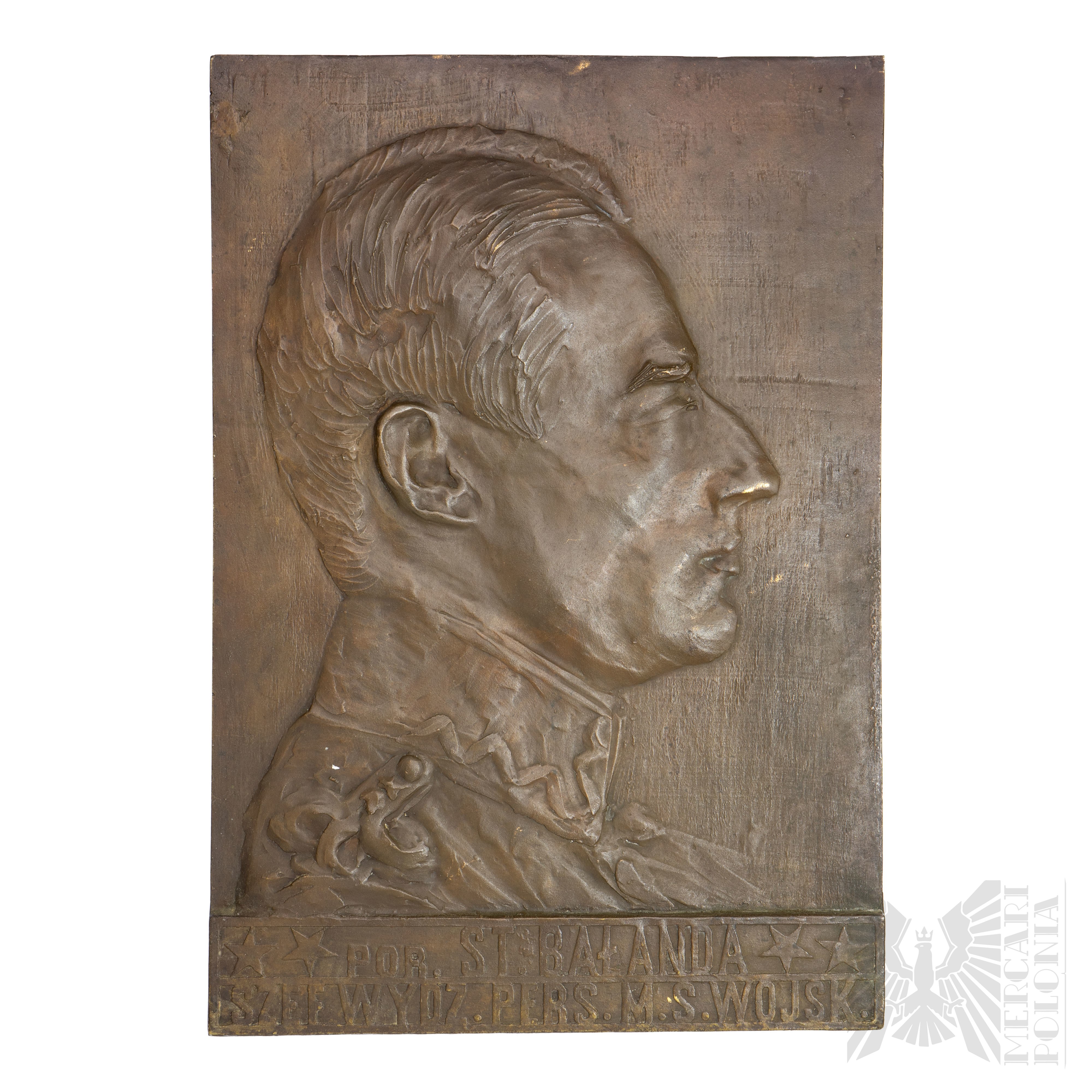
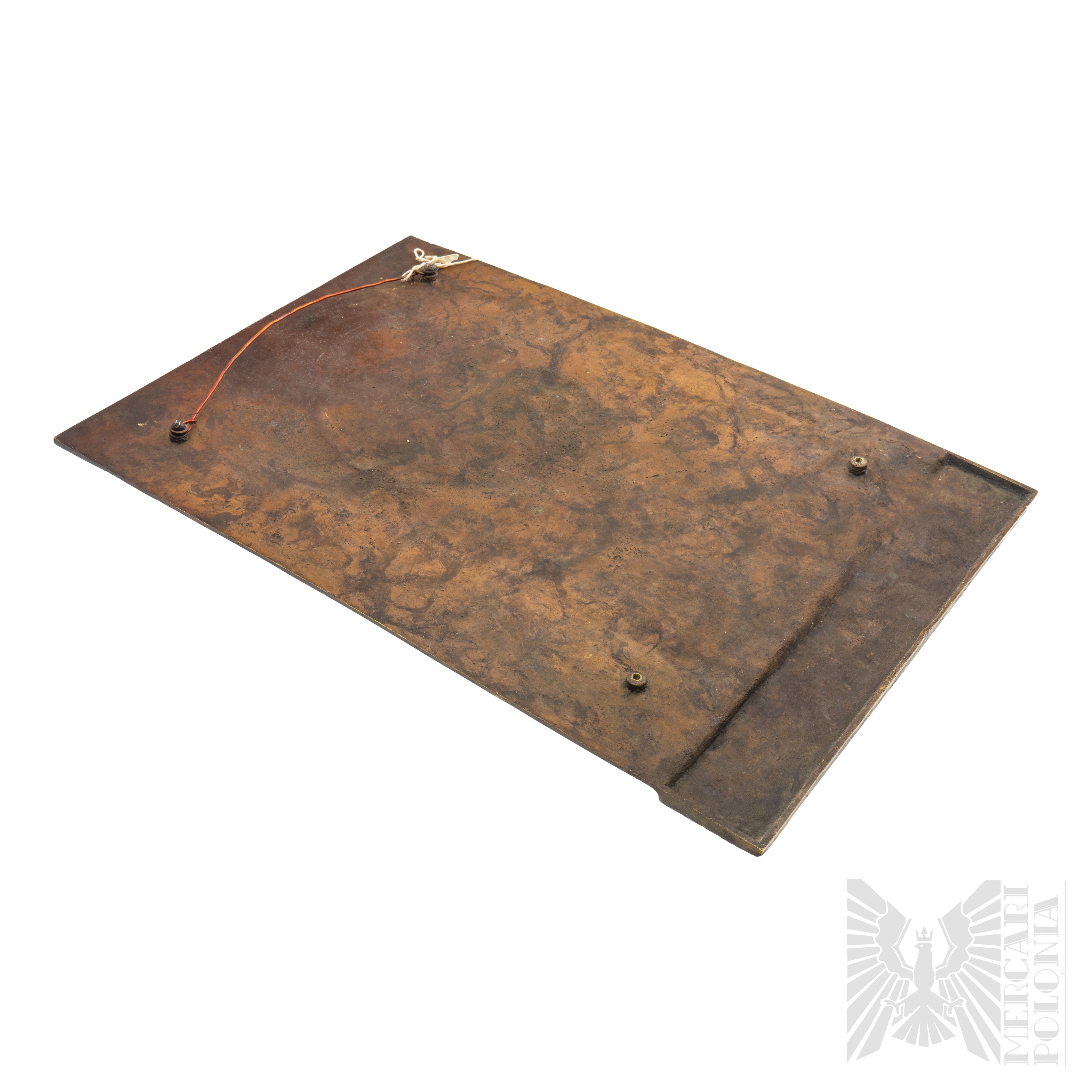
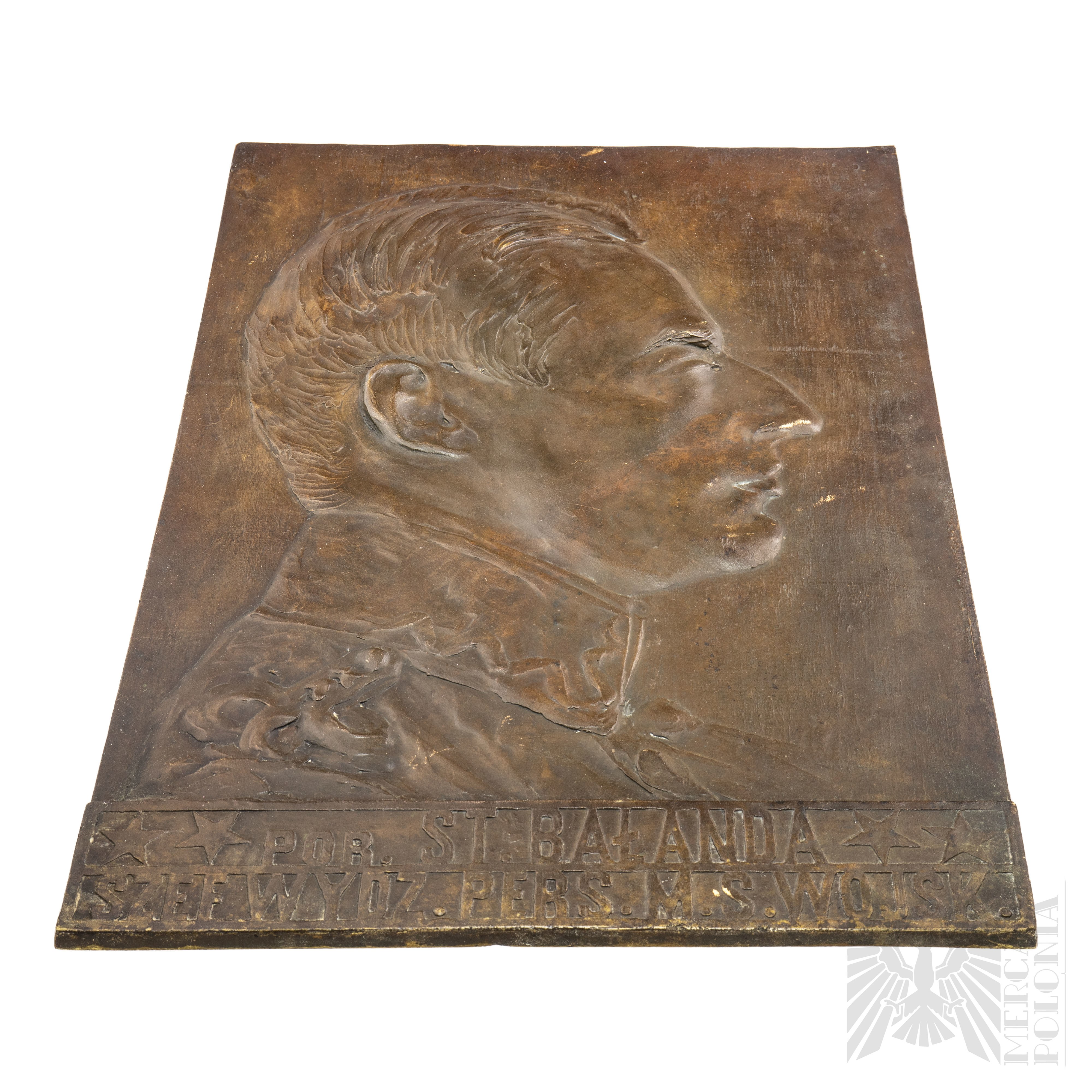
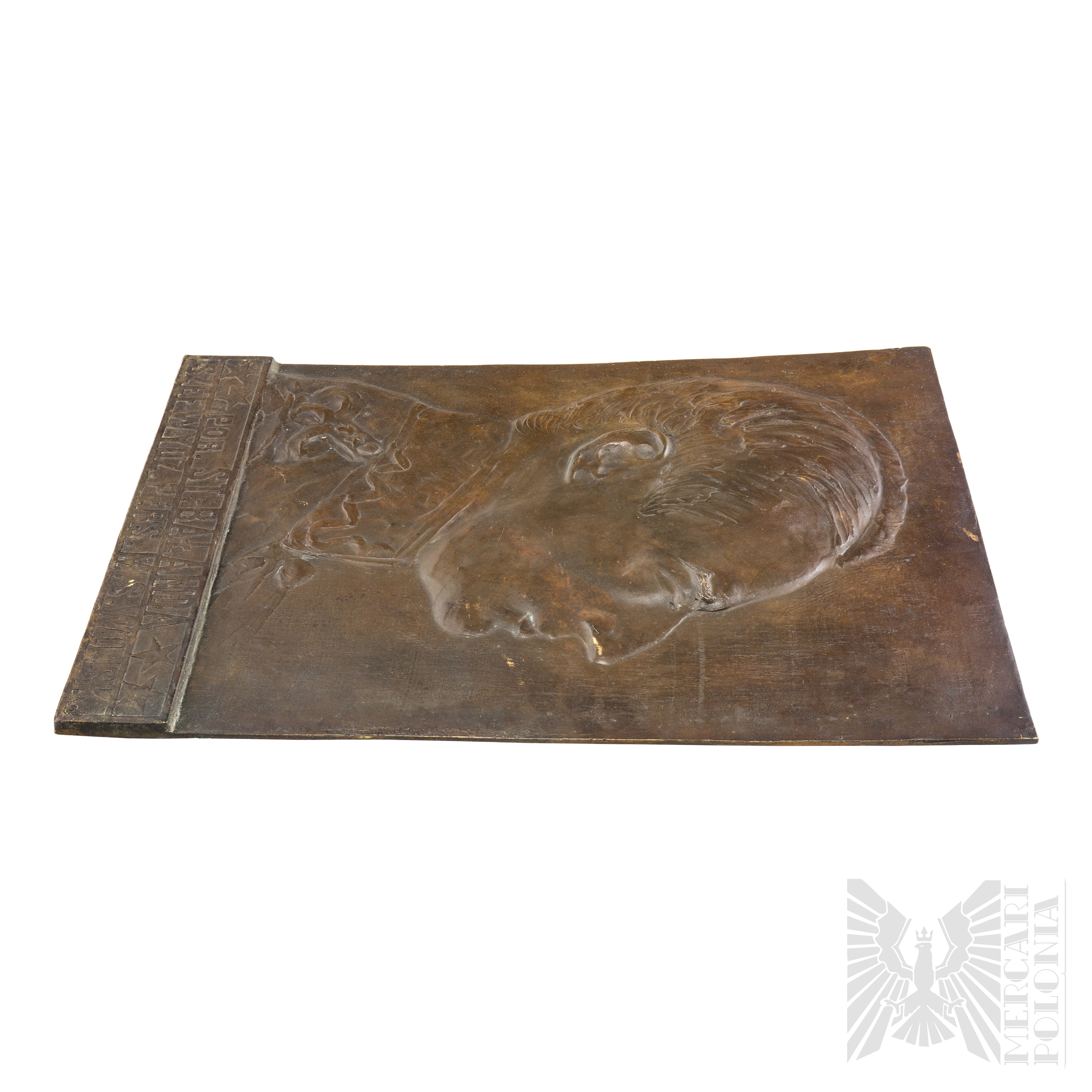
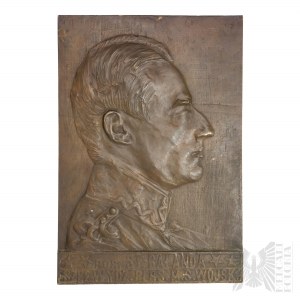
A unique giant bronze plaque depicting Lieutenant Stanislaw Baland (1885-1948), Officer of the Polish Army, Head of the Personnel Department of the Ministry of Military Affairs. Made in a characteristic realistic style. The relief shows a profile portrait in officer's uniform wz.17 in the rank of lieutenant, with clearly marked details of the uniform and distinctive facial features. By an unknown talented artist.
Dimensions: 47.4cm x 32.4cm.
The lower strip of the badge bears the inscription: "POR. ST.BALANDA CHIEF OF THE WYD. PERS. M.S. WOJSK", suggesting that this object may have been a commemorative item for his service in the Ministry of Military Affairs. The style of workmanship and precision of detail and indicate the workshop of an experienced medalist, and the form itself is in the tradition of military and patriotic art, often used in official commemorations.
Plaques of this type and size were often made as tributes to distinguished officers, placed in military institutions, offices or given as honorary mementos. An excellent example of a commemorative sculpture of great historical and collectible significance.
Good state of preservation as shown in the photos. In the upper left part a trace of damage, probably shot through and professionally repaired.
"Bałanda Stanisław Franciszek Antoni
Born on June 13, 1885 in the town of Jeleśnia near Żywiec, son of Bronisław and Klementyna née Waligóra.
Graduated from the gymnasium in Cracow and the local Academy of Commerce, obtained a degree in law from the Jagiellonian University. From 1911 he belonged to the ZS. From August 5, 1914 in J. Pilsudski's rifle units, then in the LP. Appointed on December 24, 1914 to the rank of art. ensign, promoted on September 17, 1915 to the rank of art. lieutenant. Officer of the ammunition park (commander of the art. column PA/1. From January 2 to 16, 1917 he was a student of the course at the Artillery Rifle School in Rembertów. After the oath crisis (VII 1917) in the Polish Positive Corps - 1st officer of the howitzer battalion. After the Locomotion (15-16 II 1918) he was interned in Szeklenka. He was accused in the trial of legionaries in Marmaros-Sziget (8 VI - 2 X 1918). After the court proceedings were dropped, he joined the Polish Armed Forces, taking over the personnel desk in the command on October 31, 1918. On November 8, 1918 he was promoted to lieutenant-gunner with seniority of October 12. He took part in disarming the Germans. Admitted to the Polish Army by the Regency Council's rescript of 31 X 1918 and by the decree of 8 XI 1918 appointed (confirmed in rank) as lieutenant with seniority of 12 X 1918 and successively by the decree of 4 XII 1919 as of 1 XII 1919 as captain of art. He served in the Ministry of Internal Affairs, headed the personnel desk in the office of the Minister of Military Affairs. Verified after the war in the rank of art. major with seniority from June 1, 1919, he held a position in the Office of the Chief of Army Administration. On August 15, 1924 he was promoted to lieutenant colonel of art. He was transferred to the armaments service, serving in the Inspectorate of Armament Technology (1928) and in the Military Armament Supply Establishment in Warsaw (1932). On June 30, 1933 he retired. He lived in Warsaw. He worked in the Anti-Aircraft and Anti-Gas Defense, and was vice-president of the Capital District of the ZLP. After the 1939 campaign, he made his way west. In VII 1940 he was sent to a camp at the Officers' Concentration Station in Rothesay on the Isle of Bute. After the war he remained in exile. He died on January 1, 1948 in London. He was buried in Streatham Park Cemetery there. Married to Natalia Wanda, née Prunmajer. Decorated with KN, OOP 5th class, KW x2, Gold KZ and Romanian Order of the Star of Romania 4th class, Austrian Gold Cross of Merit on Ribbon (11 XI 1916)."
Biographical Source: https://zolnierze-niepodleglosci.pl/%C5%BCo%C5%82nierz/181896/










Laatst bekeken
Log in om de kavellijst in te zien
Favorieten
Log in om de kavellijst in te zien