


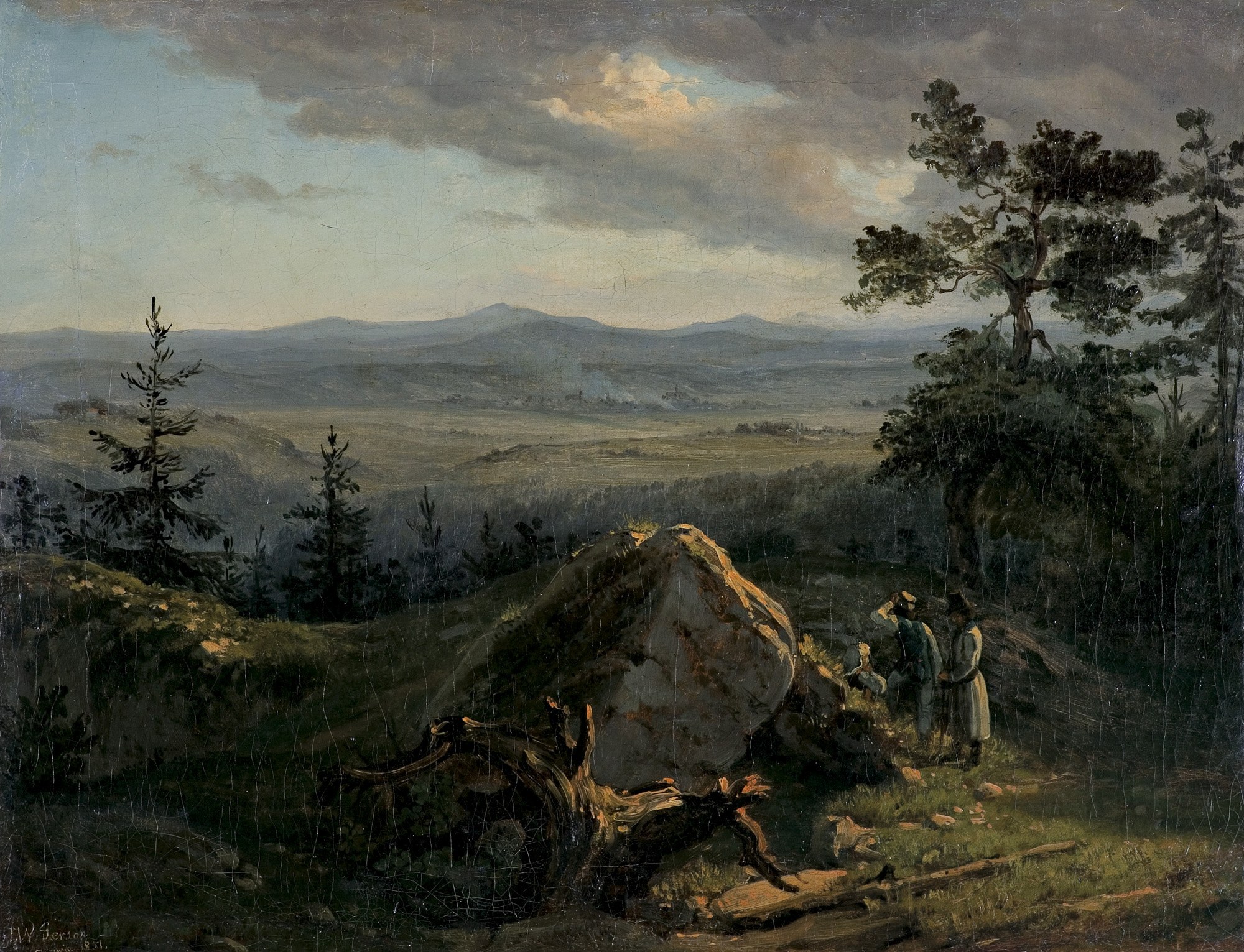
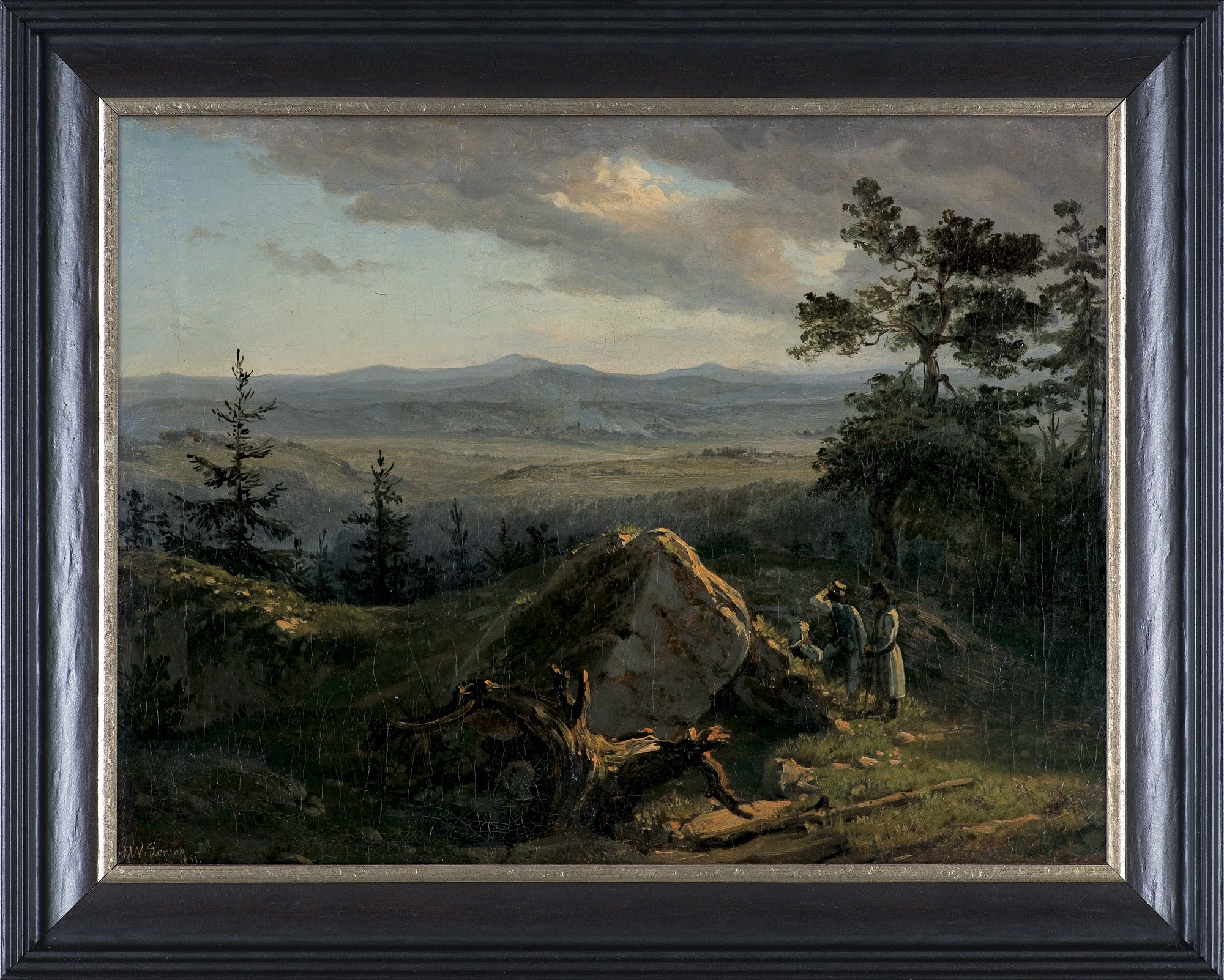
40.2 x 52.3cm - oil, canvas signed l.d. (scratched): W. Gerson | [in Wa]rszawa 1851.
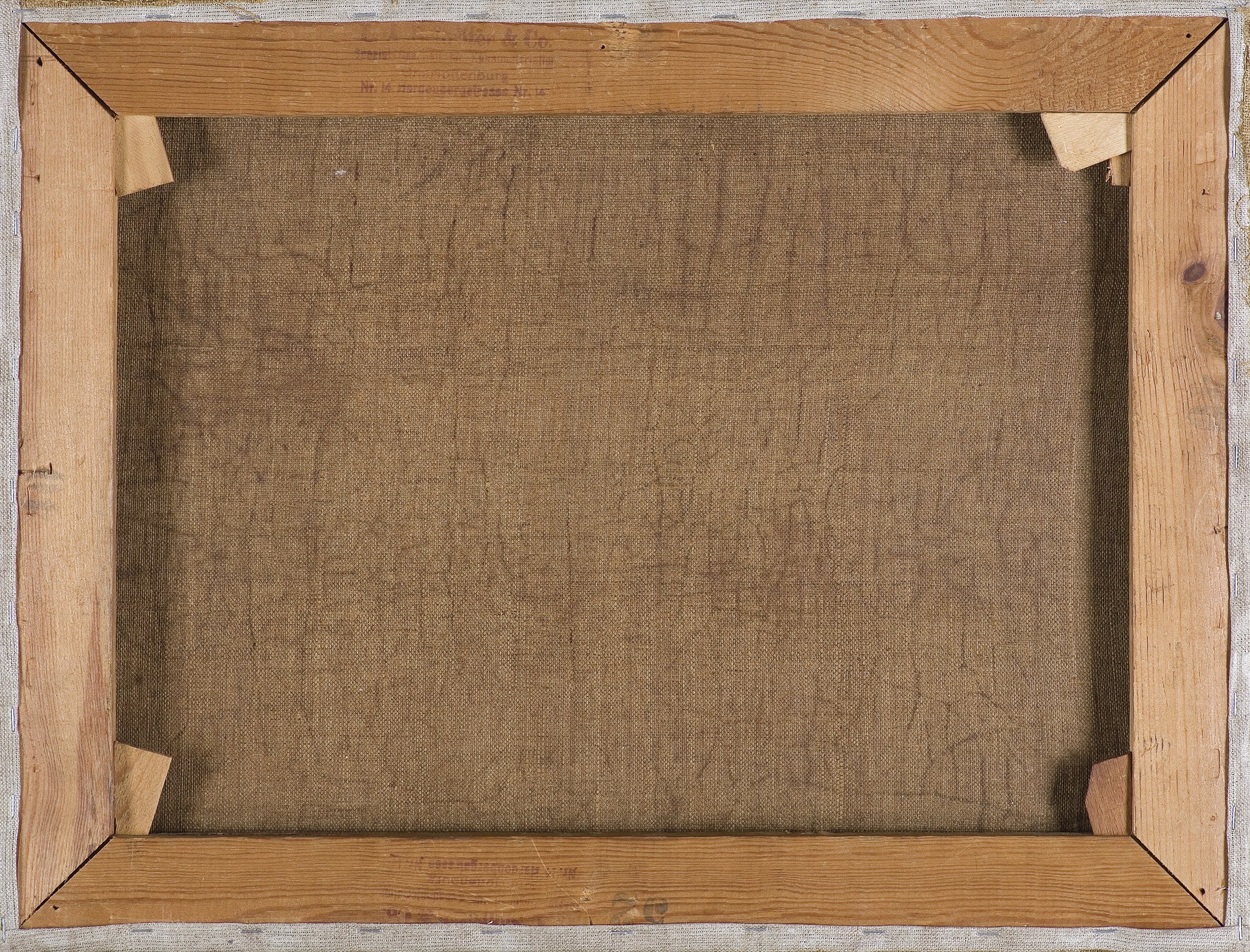
On the reverse, on the upper and lower slat of the loom stamp: L. A. Schröter & Co. | Spezial-Geschäft für Kunstmaterialien | charlottenburg | Nr. 14 Hardenbergstr Nr. 14; in addition, on all slats stamps with numbers referring to the size of the sub-painting (respectively): 52 i 40.
The painting is accompanied by an expert's report by Elzbieta Charazinska dated September 2024.
The featured landscape comes from the early period of Gerson's work, in the early 1850s, when he was still a student of the Warsaw Drawing Class. At that time, an artistic and social group of young people (later known as the Warsaw "bohemia") was formed, gathered around a not much older colleague, Franciszek Kostrzewski, under the auspices of the professors of the landscape painting course, Chrystian Breslauer and Jan F. Piwarski. These two mentors took their students outdoors, initially to the immediate environs of the city and the Vistula River, recommending careful study of nature and observation of people. As early as 1849 they made a larger expedition to Kielce, and in the summer of 1850 a so-called walking tour to Ojców and the surrounding area. There are some parallels between the landscape in question and the following, slightly later paintings from the collection of the National Museum in Warsaw: View from the Terrace of the Park in Justianovo to Lake Vesye, circa 1852, Ruins of Trotsky Castle near Vilnius from 1855, or Carpathian Landscape from 1855.
The landscape motif of the painting in question is a landscape from the Ojców area. Starting in 1850, Gerson made many trips to that area on foot and painted landscapes from the picturesque Ojców area on more than one occasion. Unfortunately, these paintings were dispersed, and many of them, as well as authentic drawing and watercolor sketches (a legacy collected by the artist's daughter), were lost in the abyss of the 1944 Warsaw Uprising.
In a handwritten catalog of his works, Gerson lists several works with this theme: View of Ojcow, Descent to the Royal Grotto (1850/51; competition painting of the School of Fine Arts), View of Ojcow (1850), View from Czajowska Mountain near Ojcow (1851), View from Ojcow (1851), Jerzmanowice near Ojcow (1851) (A. Vetulani, A. Ryszkiewicz, Materials concerning the life and work of Wojciech Gerson, Wrocław 1951, pp. 19, 20). In the collection of the National Museum in Warsaw there are authentic photographs from the period (1850s-60s) showing various shots of landscapes from the Ojcow area, and the topography of these places resembles the landscape motif present in the said landscape. It should also be recalled that in the 1880s and 1890s, Aleksander Gierymski and Władysław Podkowiński (a student of Wojciech Gerson) followed the same route and made their landscape sketches in this area.
The now-disclosed painting, dated "1851" by the artist, was, in accordance with the academic practice of the time, painted in the studio on the basis of sketches made from nature during a holiday "walking tour" through the Krakow-Czestochowa Jura in 1850. Thus, it belongs to the residually preserved early painting work of Gerson, who in the second half of the 19th century was a leading representative of Realism in Polish painting and a major figure in Warsaw's nascent artistic life (among other things, he was co-founder of the Society for the Encouragement of Fine Arts, a critic and publicist, and above all an outstanding educator).
From the expert opinion of E. Charazinskaya
Wojciech Gerson (Warsaw 1831 - Warsaw 1901) painter, pedagogue; in 1844-1851 he studied at the Warsaw School of Fine Arts under Jan Feliks Piwarski, Christian Breslauer and Marcin Zaleski, and in 1853-1855 at the Academy of Fine Arts in St. Petersburg. In 1856 he went to Paris, where he still studied in the studio of Leon Cogniet and studied independently in museums. In 1858, after returning to Warsaw, he developed extensive artistic and public activities. In 1860 he was one of the founders of the Warsaw Society for the Encouragement of Fine Arts. He taught painting and drawing at the Warsaw Drawing Class and in his own studio, educating several generations of painters. His students included Chełmoński, Wyczółkowski, Stanisławski, Podkowiński and Pankiewicz. In 1878 he received the title of professor at the St. Petersburg Academy. He traveled abroad - to Berlin, Italy, Vienna, Prague and several times to Paris. He traveled extensively around the country, and especially often and eagerly went to the Tatra Mountains. He painted genre country scenes, portraits, historical and religious paintings and landscapes - including many Tatra landscapes.





![[PROWENIENCJA] Wojciech Gerson (1831 - 1901 Warszawa) - Polska - XIX wiek - „Dziewczynka z Książką”, Olej na Płótnie](https://img1.one.bid/img/10591/3336375_1w.webp?1790865883)

![Wojciech GERSON (1831-1901) - według, Krzyżacy w Polsce [Branka krzyżacka], po 1875](https://img1.one.bid/img/10504/3292733_1w.webp?1790179944)


![Wojciech Gerson [1831-1901] „Dziewczynka z Książką”, Polska XIX w.](https://img1.one.bid/img/9594/3063786_1w.webp?1780146484)








Laatst bekeken
Log in om de kavellijst in te zien
Favorieten
Log in om de kavellijst in te zien