


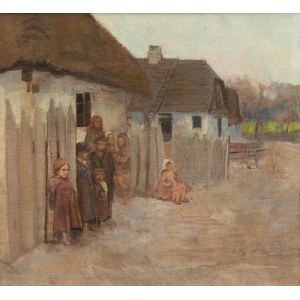
oil, doubled canvas, 40 x 44 cm
Attached to the painting is an opinion by Elzbieta Charazinska dated November 24, 1991 (confirmed November 7, 2016)
Provenance:
- Private collection, Poland
Literature:
- "Władysław Podkowiński" [exhibition catalog], National Museum in Warsaw, compiled by. Elżbieta Charazińska, Warsaw 1990, cat. no. I/27 ("Village", ca. 1890)
" (...) Podkowiński left an artistic output weighty enough to secure a permanent place in the history of Polish painting. He also left a legend; a somewhat ambiguous one, disturbing virtually everyone. Who was he above all: a dashing reporter who filled Warsaw illustrated magazines with brilliantly drawn news stories? A young portraitist of exquisite ladies? A prophet on the ground of bright new painting? A late romantic writing the story of his unhappy love with paintings? A "cursed" artist destroying his greatest work in a pathetic gesture? He was all of these at the same time - for his work reveals almost all the currents, anxieties and fascinations experienced by the art of the early 1820s." W. Wierzchowska, "Władysław Podkowiński," Warsaw 1981, p. 6.
"Warsaw was his "pied a terre", since here he was born and here he had family and many colleagues and friends. Podkowiński's first painting appearances in Warsaw became a straightforward manifestation of Impressionism. Podkowiński, with sincerity and extraordinary enthusiasm for this new painting technique, henceforth creates paintings with great color qualities and great individual strength at the same time. It is astonishing that this twenty-something painter at that time creates works of such maturity and color strength. Podkowiński's painting, which manifested itself so strongly and spontaneously under the influence of Impressionism, contradicts all the boring hypotheses about the harmfulness of "influenceology." Warsaw in Podkowiński's time was not what it is today, a city of parvenues, devoid of taste and artistic passion. Podkowiński (...) made many friendly acquaintances and was often invited to his friends in the countryside. From there he brought back beautiful and high value studies - landscapes and portraits."
T. Czyżewski, "Podkowiński's Drama," [in:] ABC 1932, no. 307, p. 8.










Laatst bekeken
Log in om de kavellijst in te zien
Favorieten
Log in om de kavellijst in te zien