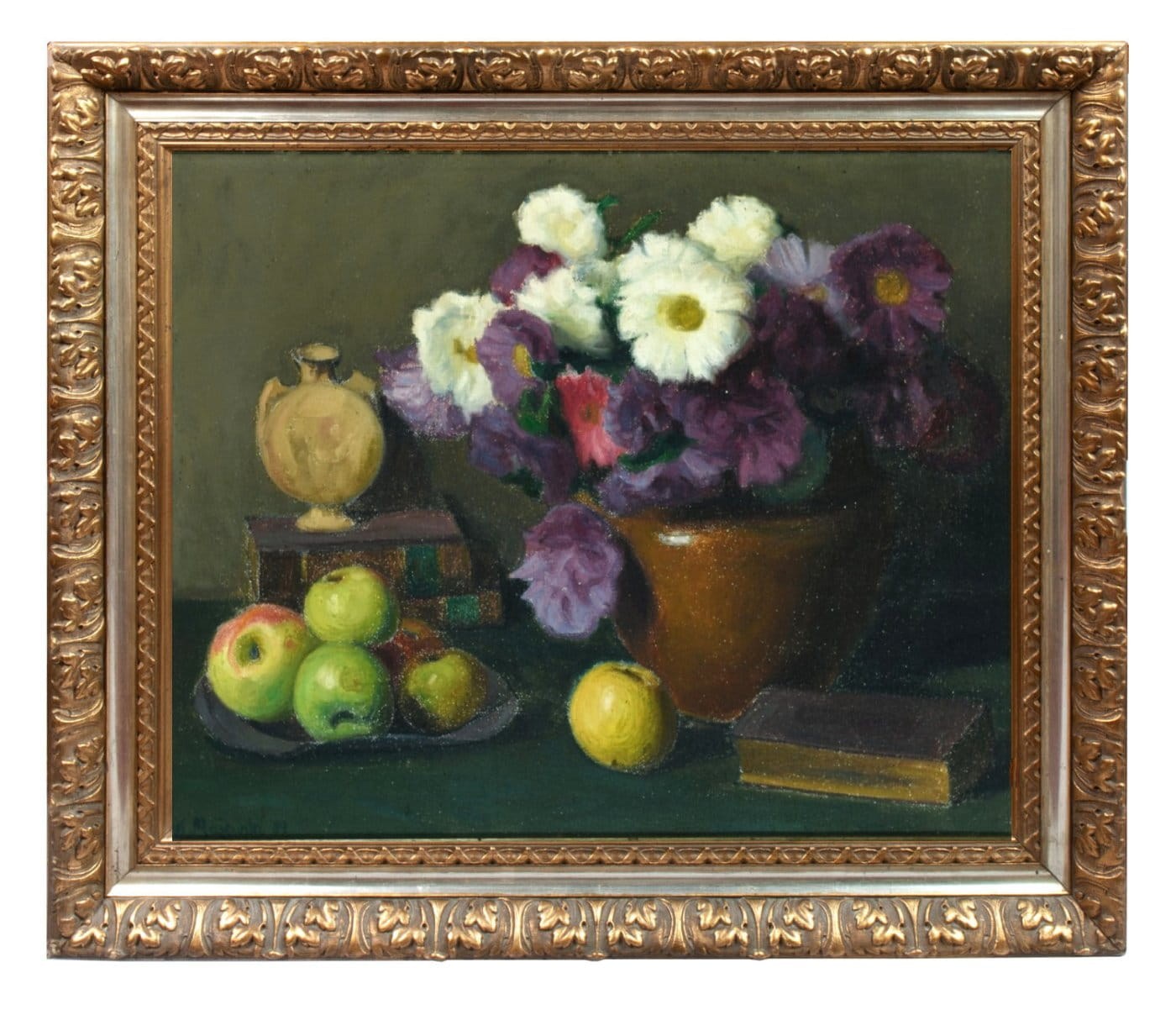
Oil on canvas, signed and dated in the lower left corner “W. Majewski 09”.
Dimensions with frame: 65x76 cm (50x62 cm)
Władysław Majewski (Proszowice 1881 – 1925 Warsaw), Polish painter. He graduated from St. Anne’s Gymnasium in Kraków, after which he likely began his studies at the Kraków School of Fine Arts, although he is not listed in the school’s records. On October 25,1901, he enrolled in Johann Caspar Herterich’s (1843–1905) drawing class at the Royal Academy of Fine Arts in Munich, where he lived and worked presumably until 1914. He was a member of the Munich Society of Fine Arts. From Munich, he traveled to Italy and Paris on several occasions. He spent World War I in Russia, and after the war ended, he settled in Sosnówka near Wołomin, from where he commuted to Warsaw, where he had his own studio. Starting in 1921, he taught painting at the Wojciech Gerson School of Fine Arts in Warsaw. He was a member of the Committee of the Society for the Encouragement of Fine Arts and of Group 12. Majewski painted landscapes, portraits, still lifes, and flowers. His work was influenced by Impressionism and German Art Nouveau. During his stay in Munich, he painted Bavarian landscapes and rural scenes—primarily from the Iser Valley and Tyrol. In Poland, he painted landscapes of the Podhale region around Poronin, and in the 1920s—scenes from the Neman River area. His works are housed in the National Museum in Warsaw.