


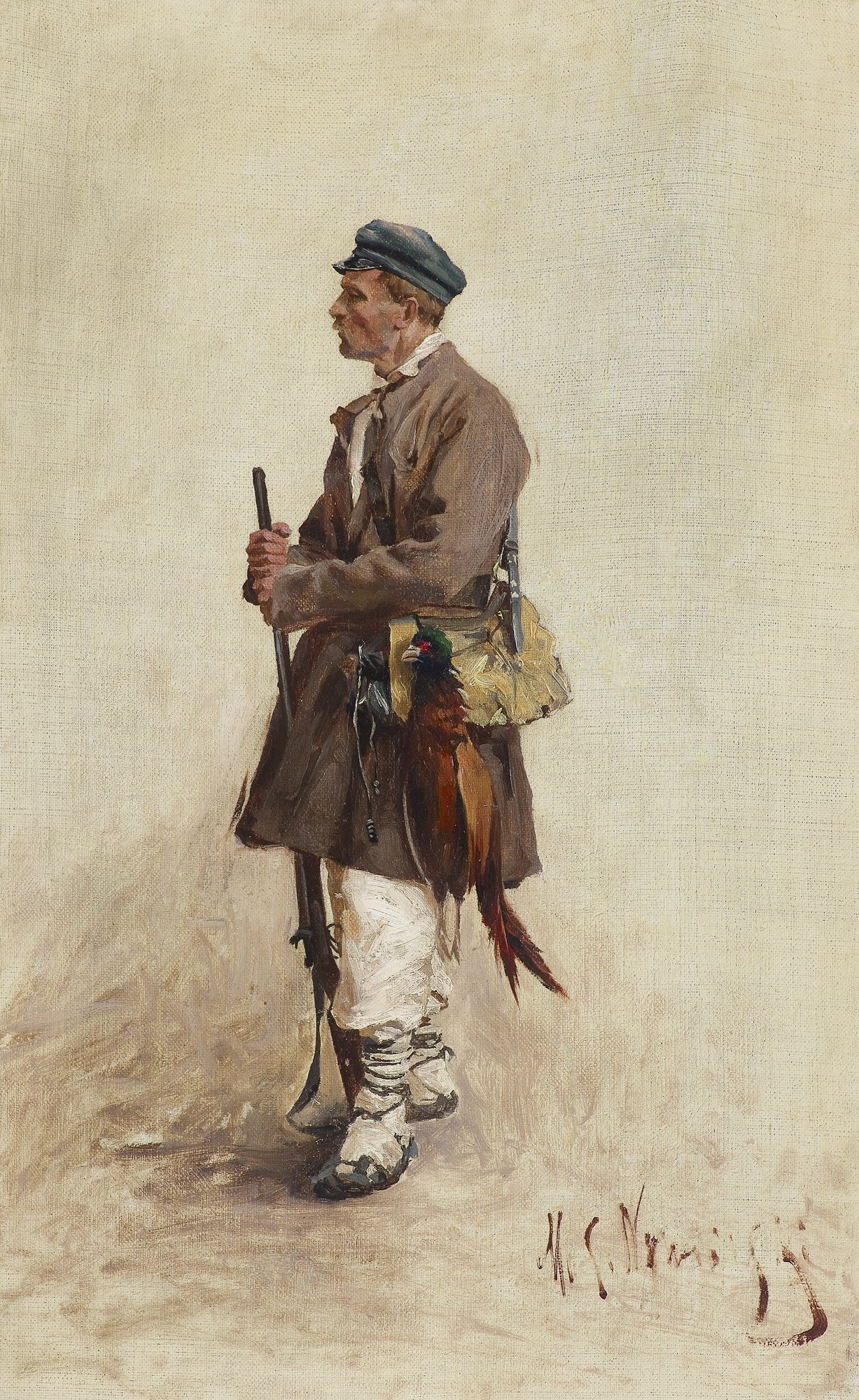

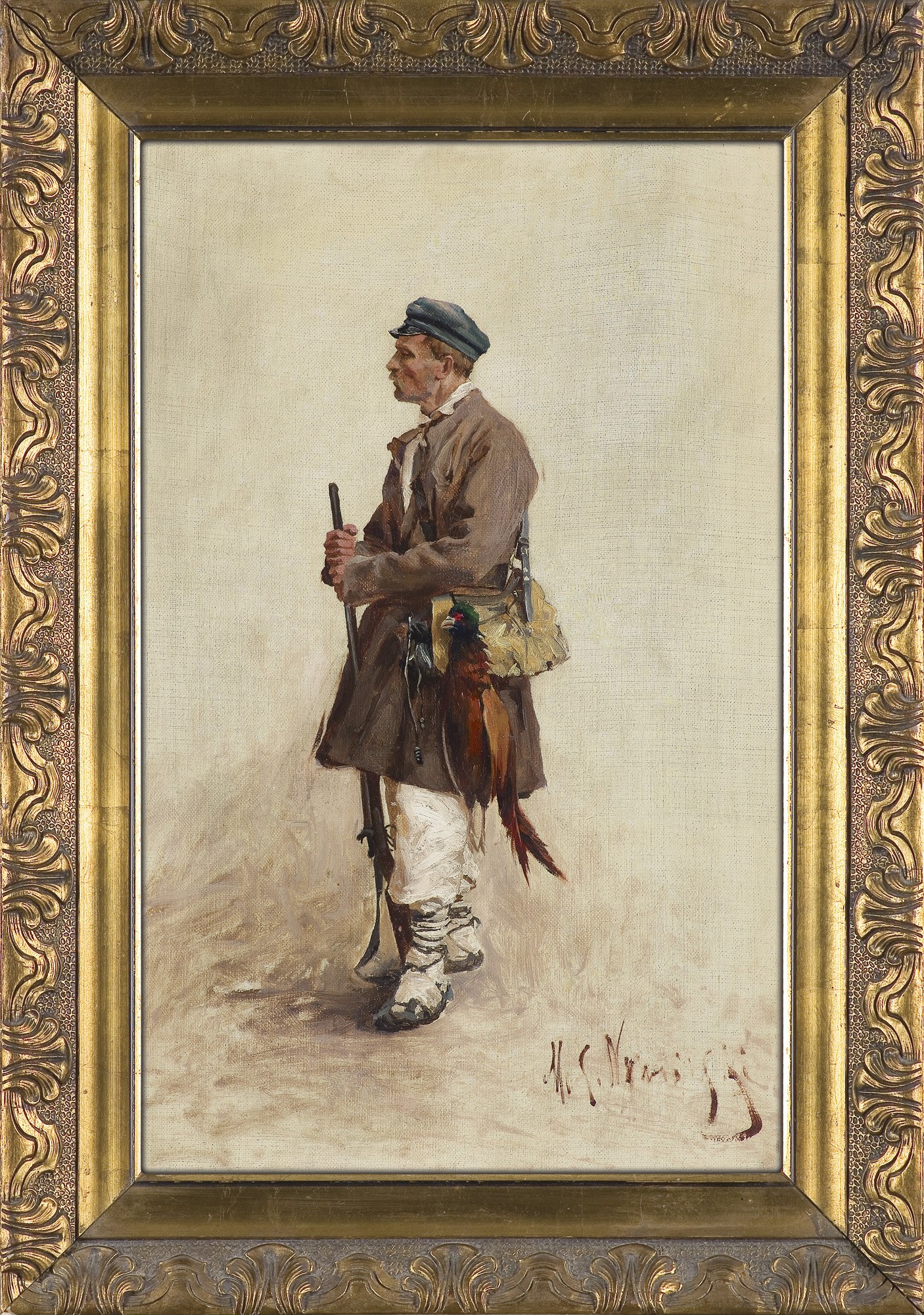
45,5 x 28,5 cm - oil, canvas signed p.d.: M.G. Wywiórski
On the lower bar of the frame stamp: STANISŁAW RĄB. | (...) RELIGIOUS ARTICLES | (...) KRAKÓW SŁAWKOWSKA [4].
Provenance:
The painting comes from the collection of Michal Chylinski (1856-1925), an educator, journalist and political activist, later passed into the possession of his heirs. Chylinski was editor-in-chief of Krakow's conservative daily Czas (1883-1903) and vice-president of Krakow (1903-1906).
Literature:
- Maria Golab, Michal Gorstkin Wywiórski - landscapes. Between Heaven and Earth. [exhibition], 26 II - 21 III 2004, Forum Krasków Foundation, Castle Cultural Center, Poznań 2004.
The 1890s and the beginning of the 20th century until the outbreak of World War I were the best period in the work of Mikhail Gorstkin Wywiórski. An excellent painter, a pupil of professors Karl Raup and Nikolaus Gysis at the Munich Academy, as well as Jozef Brandt and Alfred Wierusz-Kowalski, he painted extensively, took part in numerous exhibitions during this period, and won recognition from both critics and the public. He created under the protection of patrons, while he sold his works to the best collections of Polish art of the time. An important place in his work at the time was occupied by hunting themes. The artist created both multifaceted, complex compositions depicting hunts of the landed gentry, as well as intimate paintings whose protagonists are solitary hunters from the lower classes. These works quickly earned him good press, as exemplified by a review in 1894 in the pages of "Tygodnik Ilustrowany": Among the painters who are uncommonly talented is Wywiórski, an outgrowth of the Munich school, an artist with already established reputation, who in his treatment of landscapes and hunting scenes would have the right to measure himself against the most interesting specialists in this direction in our country (.... The artist also belongs, like Kowalski and Fałat, to avid hunters and enjoys studying nature, chasing game in the fields and forests, and hence recreates hunting scenes and types with great truth (quoted by M. Gołąb, p. 7). Four years later, the magazine's editors described the painter in this way: Wywiórski's peculiarities are hunting scenes, landscapes from Polesia ("Tygodnik Ilustrowany" 1898, no. 38, p. 758). Seeking inspiration for his works, Wywiórski traveled extensively - he visited Lithuania, the Danish island of Sylt, the Baltic coasts of Norway and Sweden, Italy, Spain, the Crimea, the Caucasus, and Egypt. Polesie, where the offered intimate canvas was probably created, was also his destination on many occasions.
Mikhail Gorstkin Wywiórski (Warsaw 1861 - Berlin 1926) studied in Munich from 1883-1887; at the Academy under professors Karl Raup and Nikolaus Gysis, and simultaneously in the private studios of Jozef Brandt and Alfred Wierusz-Kowalski. In 1884 he made his debut at an exhibition at the TPSP in Cracow, and also showed his works in Munich, where in 1894 at the Glaspalast international exhibition he was awarded a medal for his painting From the Lithuanian Forest. In 1895 he moved to Berlin, invited by Wojciech Kossak and Julian Fałat to work on the panorama Berezina (1895-1896). He settled in Berlin for a longer period of time, and then stayed in Greater Poland and Warsaw. He also collaborated with Jan Styka on the panorama Battle of Sibiu (1897), and in 1900, together with Kossak, he traveled to Spain and Egypt to make plein air sketches for the intended panoramas Somosierra (not realized) and Battle of the Pyramids (1901). He also traveled to Lithuania, the island of Sylt, Norway, Sweden, the North Sea and the Baltic Sea, painted in Amsterdam, the Crimea and the Caucasus. In his early works, strongly influenced by Brandt and Wierusz-Smith, he painted hunting and genre scenes and paintings with Tartars, Cossacks or Cherokees, which brought him success in the Munich art market. Over time, pure landscape, perceived and painted sensitively and fondly, became the chief subject of his paintings.








Laatst bekeken
Log in om de kavellijst in te zien
Favorieten
Log in om de kavellijst in te zien