


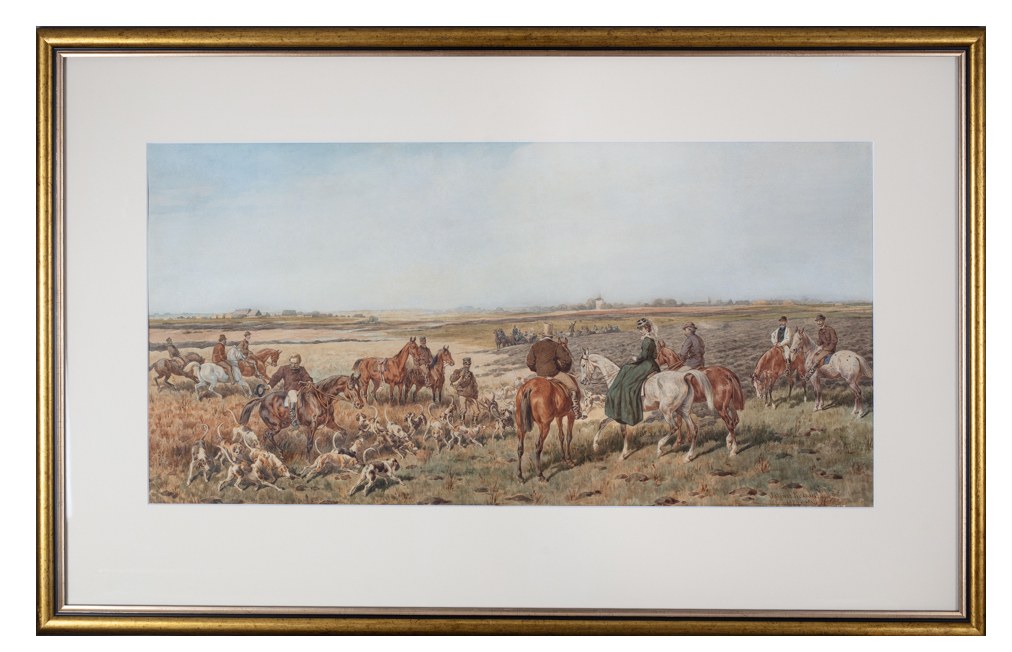



watercolor, paper, 41.3 × 79 cm (composition size), 57 × 92 cm (sheet size), 39 × 77.5 cm (light passe-partout)
Signed and dated p. d.: "Juliusz Kossak 1874"
statement from 1942 by K.Buczkowski and Z. Bocheński confirming the authenticity of the work
"One of those in whose works the character and tribal spirit, racial qualities and long-lived culture and the external world in which the nation lived and acted are reflected most comprehensively, most directly, indirectly - is Juliusz Kossak.
Throughout this area of the earth, where the historical drama of the Polish nation took place, where Polish life, or a memory of it, remains, one encounters Kossak's work everywhere.
He was a painter of the Polish countryside, that village where 'silent pear trees sit' on the bellow, and from which all that was virtue and crime, that was glory and disgrace, that lived in a special way, different from the rest of the world in content and form, that which constituted the core and essence of Polish life, came out." (Stanisław Witkiewicz, "Juliusz Kossak," Warsaw 1912, p. 7)
As Witkiewicz recalled, "Kossak carries all of his painting matter within himself. Please go to his atelier - there is no trace of all those things, so necessary for today's painter. His studio is an ordinary room. A couple of easels with underpainted watercolors, a couple of drawings on the table, an engraving from Smala Vernet on the wall, a chevalier's cap as a souvenir - and that's all. Where are these kostyums, these special illuminations, this space for setting up the model, all that is necessary for today's art, striving to fathom, to endure the tyranny with the help of a multitude of trials and experiments; where is all this multitude and variety of studies, expressing the desire to get rid of school, routine, manners, the desire to turn the canvas into a chewing breath.... Not of this! He has everything in his head reduced, compressed to the size and strength needed in his art. He has one and the same means once and for all and for everything. He, with a quick and sure contour, marks the frightened pony and the furious bear thrashing the dogs acrimoniously that have peed on him and the henchmen running to his aid and the master who stands up valiantly to fight the bear in defense of his favorite female. Everything outlined with a red line, then flooded within the shapes with pale tones of local colors, and also marked with red paint in the shadows - and the painting is ready" (Stanislaw Witkiewicz, "Art and criticism among us: (1884-1898)", Lviv 1899, pp. 473-474.) The presented work is precisely an example of Juliusz's masterful virtuosity in this particular painting technique. The composition bears all the characteristic features of the artist's work. Precise drawing, attention to detail, expressive outline, subdued, warm color palette, giving lightness and grace, used chiaroscuro that gives depth to the representation. The work depicts a hunting scene against the backdrop of a vast lowland landscape, the composition of which is built up from several plans. In the foreground, on the right, a group consisting of two horsemen and a young lady wearing a dark green amazon and a black hat with a veil can be seen. According to the inscription on the back of the painting, this is the daughter of the patriotic activist, collector and philanthropist Piotr Moszyński, Zofia née Moszyńska Cielecka (il. I). sitting on the gray mare "Bagatela." She is accompanied by Mr. Orłowski and Mr. Szawłowski riding "Piwowarka". On the left side of the foreground stands out a rider on a dark bay horse "Druzhba". This is probably Mieczyslaw Włodzimierz Cielecki of Zaremba Coat of Arms, owner of Byczkowiec, husband of Zofia, and participant in the Spring of Nations, the January Uprising and a member of the Galician National Sejm and the Austrian Council of State. In the background, to the right, is a pair of horsemen: Mr. Tuczynski on a tartan "Frou-Frou" and Baron Heydel in a jockey's cap, riding a light horse. In the center of the composition is depicted a commuter in livery with a hunting horn in his hand, standing among a pack of dogs next to a horseman holding his mount. To the left is visible a group of three horsemen - in front is Juliusz Kossak himself on a gray "Hunter" and Wojciech Kossak on a chestnut "Rudka."
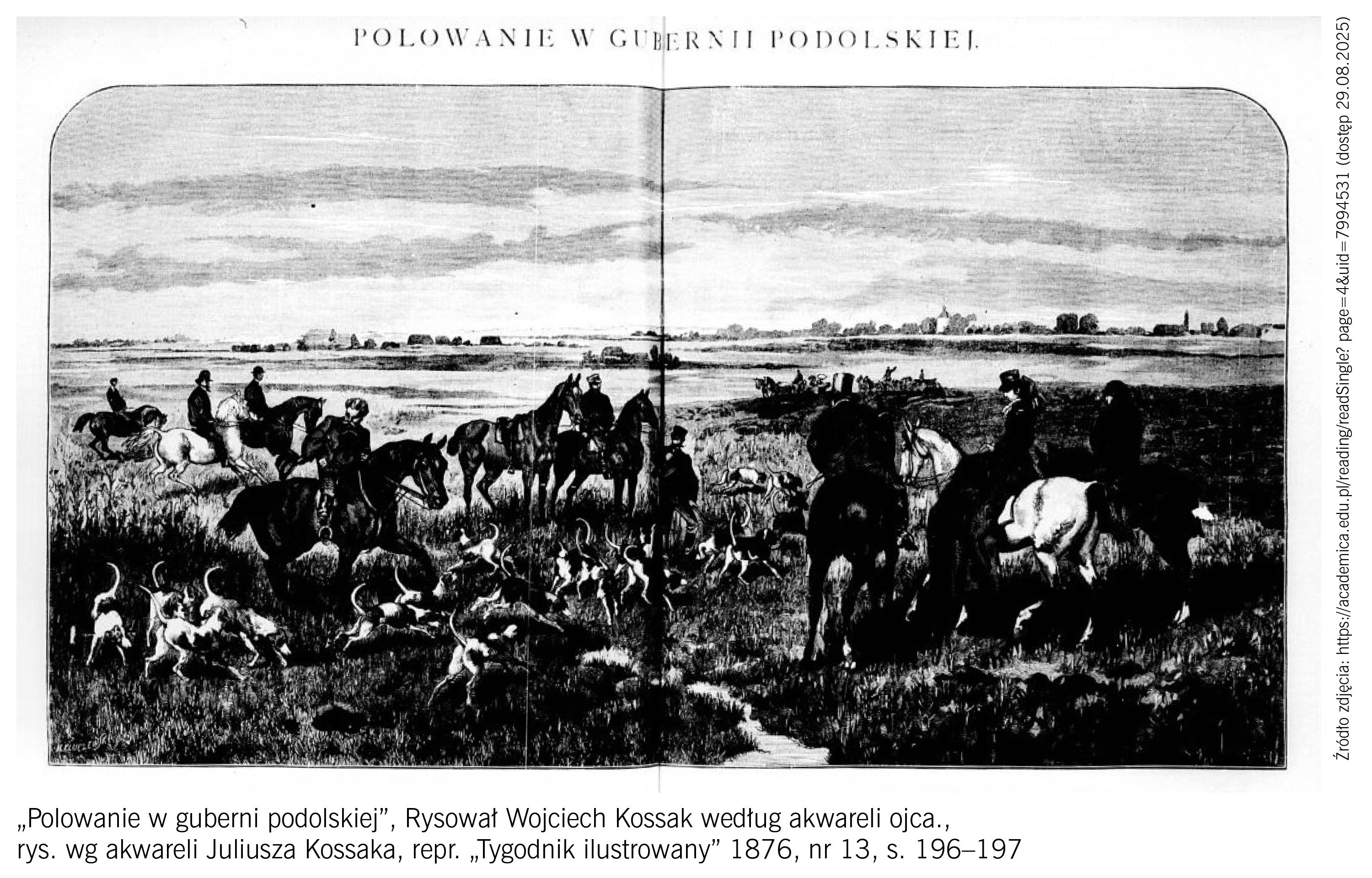
In the background, a hare dodges the hunters in a field. The horizon is complemented by rural buildings, huts, stoops, trees and a church steeple. The artist rendered with great precision both the physiognomy of the animals and the character of the scene full of life, movement and natural dynamics. "Kossak had an extraordinary painterly objectivity in observing nature, that is, at the moment of receiving impressions from it, he gave himself indivisibly to them, allowed himself to be carried away by the personality of phenomena and things - so he felt and understood with precision and accuracy unheard of their essential character." (Stanisław Witkiewicz, "Juliusz Kossak", Warsaw 1912, p. 174). One of the main themes in Juliusz Kossak's work was hunting scenes. The artist reached for hunting motifs as early as the mid-1840s and continuously returned to them until the end of his days. These were scenes painted in both watercolor and oil techniques. These scenes were often elaborate, multi-faceted, at other times they were representational compositions with a portrait depiction of a model on horseback. Hunting subjects were well known to Julius. He himself was repeatedly invited to the courts of the great magnate estates for just organized hunts. There, as an attentive observer, he participated in game expeditions. In the Lviv "Hunter" of 1899, a hunter recalled: "What a nice companion he was, he didn't take his rifle with him, but he belonged to everything, he would scramble to the highest elevation through the virgin forest [...]. Everything was good to him, everything interested him, he saw everything and noted everything in that noble and loving head of his. And that humor of gold! Woe to the shooter who shot a goat or missed a bear. It is better to get with the sheriffs than to perform similarly at Kossak. In a moment the thing immortalized ad aeternam rei memoriam to the joy of all and the delinquent also, because for him the drawing" (quoted by K. Olszanski, op.cit. p. 46.) The artistic value of the presented painting is enhanced by portraits of people for whom separate studies were most likely made. An example is the portrait of Zofia Cielecka (il. II). This very composition was repeated by Wojciech Kossak (il.III) (il. IV).
"As when painting a war horse, he showed at the same time the history of man's attitude to it, - similarly, when painting the life of our countryside, he reproduces, with fabulous clarity and purity, all those past and present ways of human life and being." (Stanisław Witkiewicz, "Juliusz Kossak", Warsaw 1912, p. 182) Juliusz Kossak was an undisputed master of watercolor. Using this technique, he created magnificent historical scenes, from hunting and horseback rides, genre scenes. "It was his watercolors - small but numerous forms - that found their way into the salons of the courts of the great aristocrats and the manors of the petty nobility, but it is no exaggeration to say that thanks to the reproductions of the time they reached almost "under the thatches." (Juliusz Kossak (1824-1899) on the 100th anniversary of his death, (exhibition catalog), Cracow 1999, p. 21.)











Laatst bekeken
Log in om de kavellijst in te zien
Favorieten
Log in om de kavellijst in te zien