


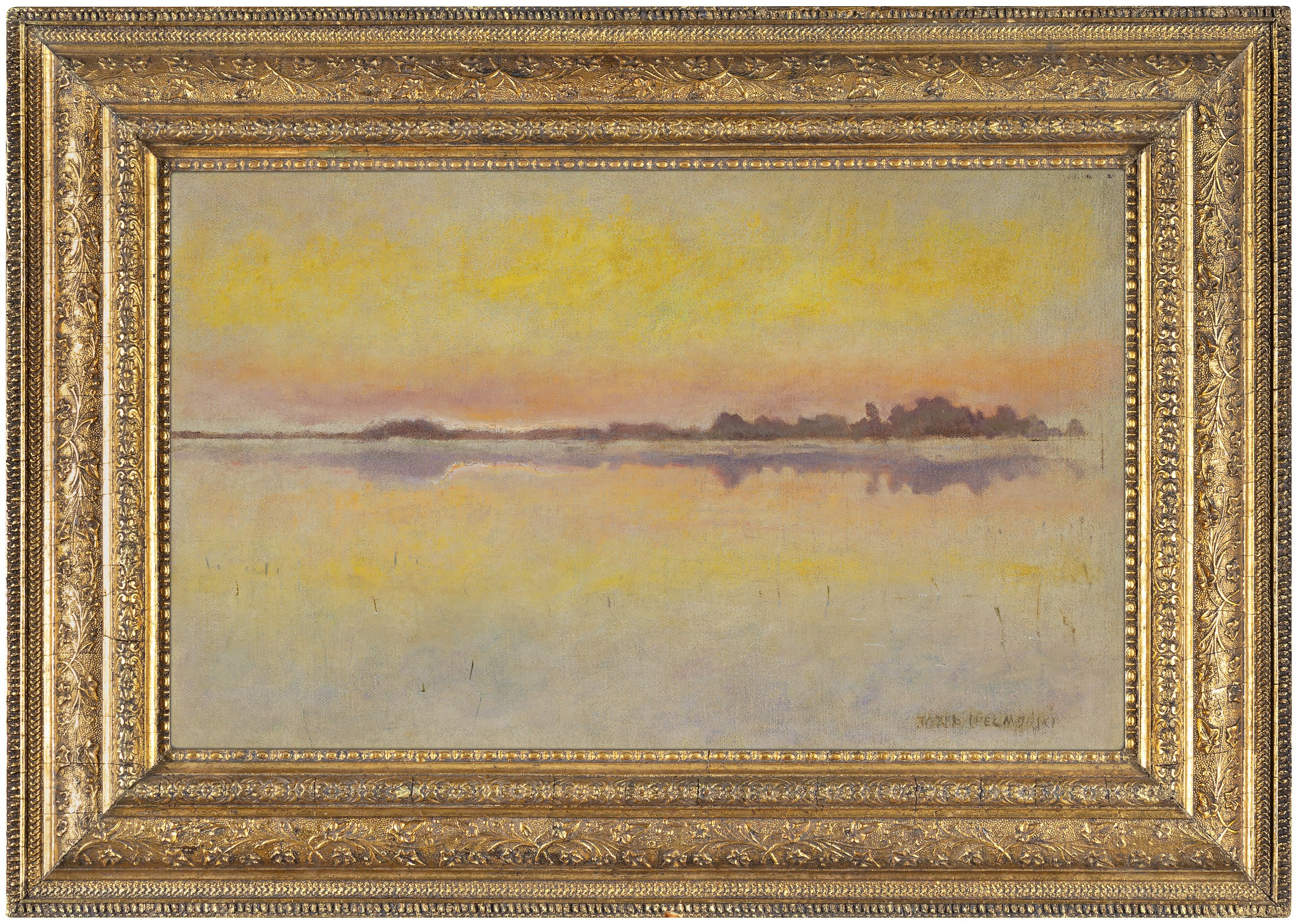
28.20 x 45.70 cm - oil, canvas
Signed p.d.: JÓZEF CHEŁMOŃSKI
Painting after conservation.
The painting is accompanied by an expert opinion of Mr. Tadeusz Matuszczak dated February 2026.
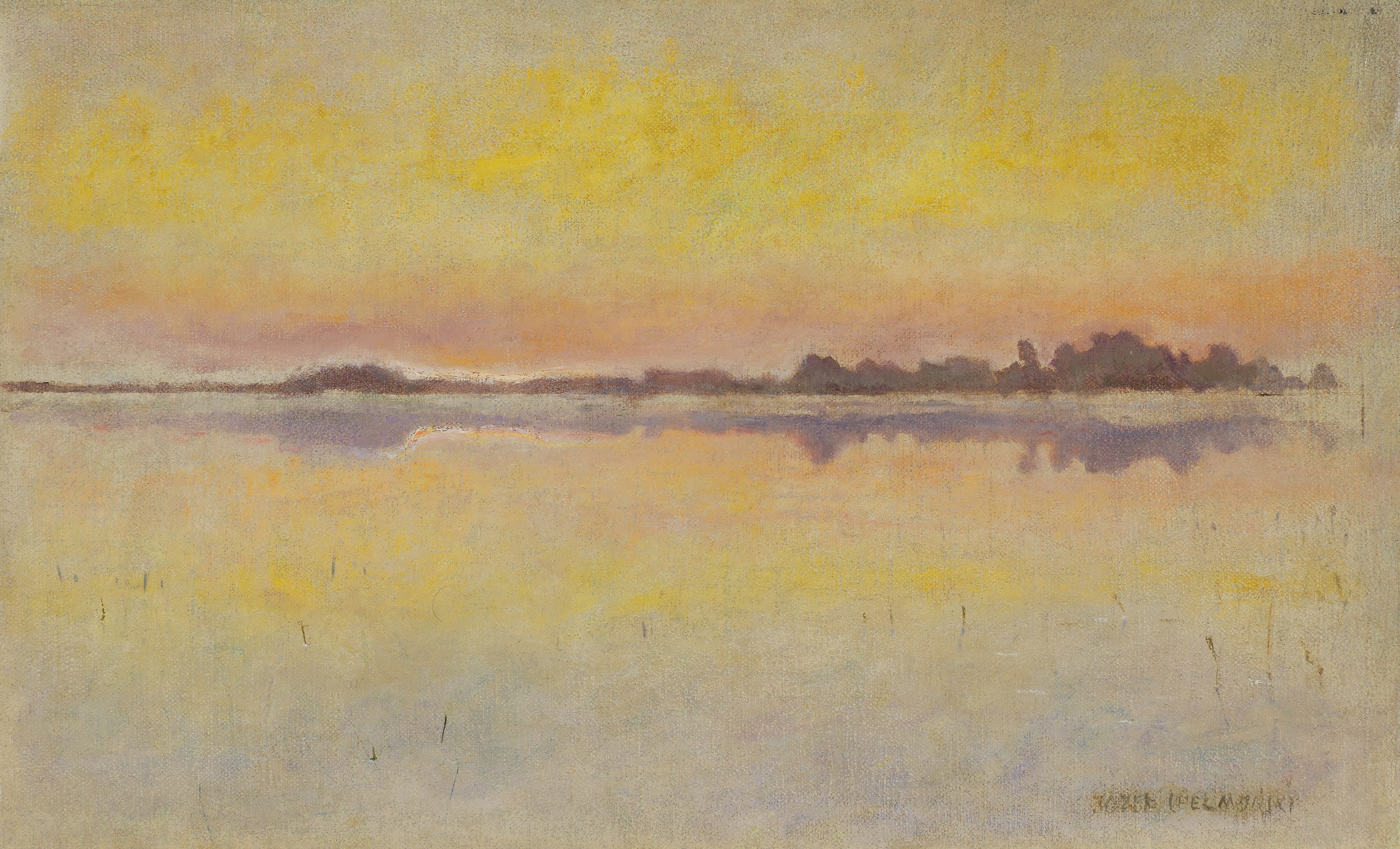
The work in question is an excellent example of Chelmonski's fascination with the flat Mazovian landscape. A seemingly, mundane motif of a narrow band of rural landscape enlivened by batches of clustered trees. The landscape forms a thin horizon line, dividing the composition into two almost equal parts. Into the space of the sky and the space of the earth, in our case water. Above it is the dominant expanse of the waking sky. This is a favorite motif of Chelmonski. A pale orangish dawn interspersed with delicate streaks of purple and gray haze above the horizon line. The horizon line is reflected in the sheet of water and here the reflection of the sky's yellows is a delicate veil. So are the subtle oranges, purples, muted whites and soft blues of the water. The syntheticity of the shot of the landscape strand on the horizon is fully worthy of the master. The artist's painterly vision gives the work a dimension of poetic nostalgia. It is known, from the preserved memories of the painter, that he could often be found somewhere among the fields and meadows, most often at the early hours of daybreak or at dusk shimmered by the setting sun.
The work fascinates, typical of Chelmonski's sketches, with the virtuosity of the painter's technique, as well as the truth and simplicity of the depicted scene, imbued with a strong sympathy with nature and a poetic, nostalgic mood, and at the same time soothing tranquility. Savor the colors of this valorously played canvas, based on a wide range of soft blues, oranges, yellows, purples, muted whites and browns. The composition of the work is based on a dichotomous division into a monumental part of the sky and a dominated sheet of water. One should admire the realism and spatiality and openness of the composition, based on clear horizontal divisions of the canvas plane. For, he is Chełmoński a master of drawing and observation, which is what makes his painting based on drawing bones and precision of perception so fascinatingly faithful to nature.
Janina Orynżyna wrote: In Chełmoński's work, this melding with nature takes on the characteristics of a semi-mystical pantheism, a love lost. ("South" [Vilnius] 1922 z. 4, p. 47)
The work impresses with its painterly freedom. One gets the impression that it is just a dozen color patches and a few broad brushstrokes, sometimes almost dry, with a visible duct, and sometimes thick, with a clear texture of paint. Values are particularly revealed in the treatment of the horizon line. The refined simplicity of the composition and painterly qualities of the work, reinforces my conviction that it comes from the summary period of painterly achievements at the end of the painter's life, around 1900-1910.
from an expert opinion of Mr. Tadeusz Matuszczak
Józef Chełmoński (Boczki near Łowicz 1849 - Kuklówka near Grodzisk Mazowiecki 1914) was one of the most famous representatives of Polish realist painting, the creator of vast landscapes from Ukraine and Podolia, speeding horse-drawn carriages - the well-known Trojek and Four - as well as rural genre scenes and atmospheric landscapes of Mazovia. The artist - in 1867-1871 - studied under Wojciech Gerson at the Warsaw Drawing Class. From 1871 to 1874 he stayed in Munich, where he briefly studied at the Academy with Hermann Anschütz and Alexander Strähuber, and where his work was significantly influenced by his encounter with Polish "Munichists," mainly Jozef Brandt and Maksymilian Gierymski. He spent the next twelve years in Paris. His stay there brought him fame and recognition - he exhibited at the official Paris Salons, and many of his works found buyers among European and American collectors. He returned to Poland in 1887, lived in Warsaw for two years and then settled permanently in the Kuklówka estate in Mazovia. The paintings he painted at the time were mainly atmospheric landscapes often with bird or animal motifs, in which the artist expressed his emotional and admiring attitude to nature. In addition to his painting work, Chelmonski was also involved in graphic art and illustration - between 1884 and 1892 he collaborated, for example, with the Parisian "Le Monde Illustré."













Laatst bekeken
Log in om de kavellijst in te zien
Favorieten
Log in om de kavellijst in te zien