


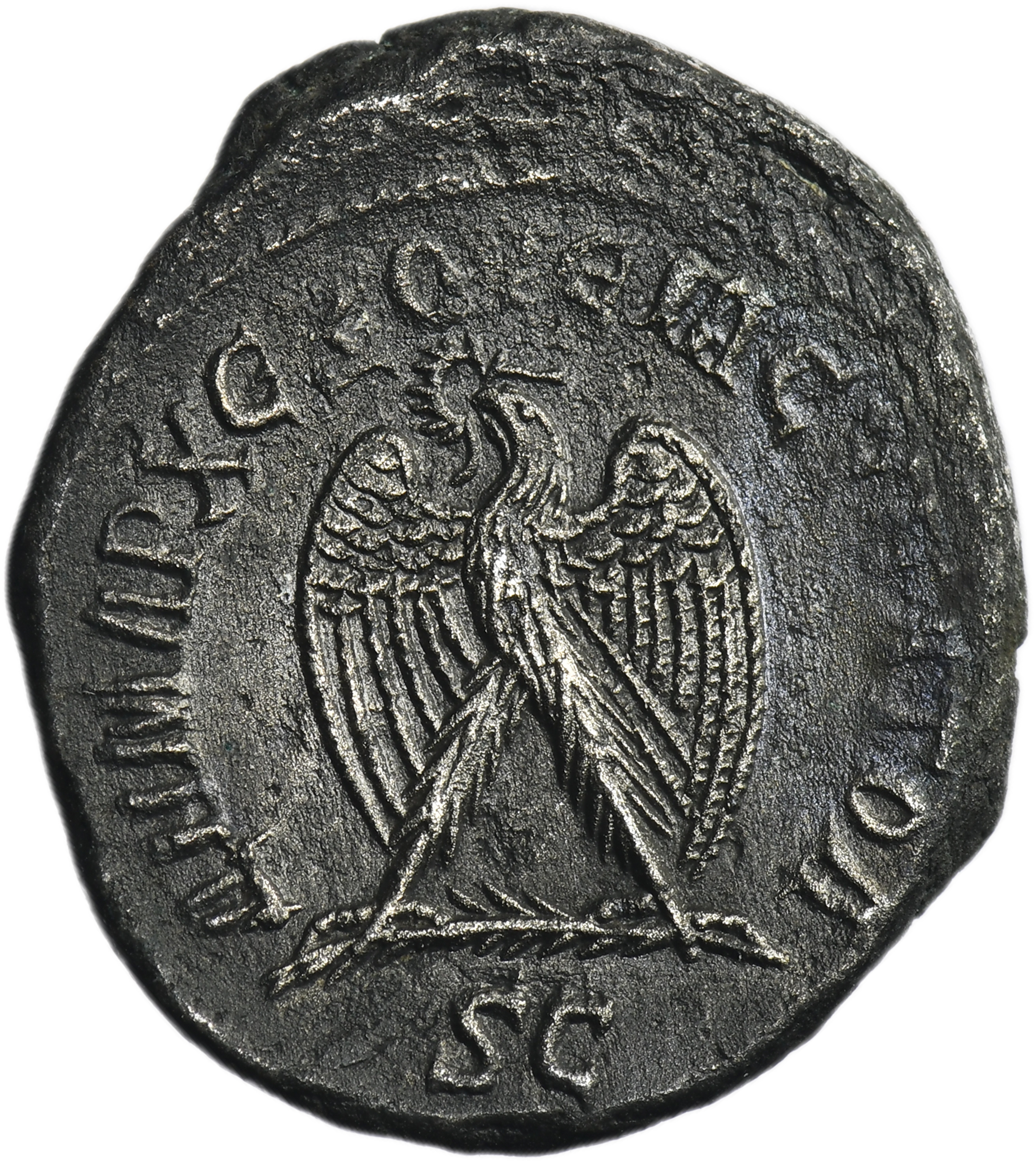


Billon tetradrachm of Philip II (AD 244–249 as Caesar), struck at Antioch in Syria between AD 244–245, belongs to the earliest phase of his political career, immediately following his elevation to Caesar by Philip I. Antiochene issues of this period provide key evidence for the initial stage of the dynasty’s succession policy.
The obverse features a laureate, draped and cuirassed bust of the young heir facing right, with the Greek legend MAP IOYΛI ΦIΛIΠΠOC KЄCAP, clearly identifying him as Caesar.
The reverse depicts an eagle standing left, holding a wreath in its beak, with the legend ΔΗΜΑΡΧ ƐΞΟΥϹΙΑϹ ΥΠΑ ΤΟ A and SC in the exergue. The eagle (aquila) serves as a principal symbol of imperial authority and the Roman army, while the wreath signifies victory and favor. This type follows the established iconographic tradition of Antiochene tetradrachms, consistently employed throughout the eastern provinces.
The reverse legend refers to the emperor’s tribunician power (tribunicia potestas) and his first consulship (ὕπατος Α), allowing precise dating to AD 244–245, the initial period of his activity as Caesar. The inclusion of SC, derived from senatus consulto, is conventional in provincial coinage and does not indicate direct senatorial involvement in the issue.
Roman Provincial
Syria, Seleucia and Pieria, Philip II (247-249), Tetradrachm 244-245, Antioch mint
Obverse: laureate, draped and cuirassed bust right
MAP IOYΛI ΦIΛIΠΠOC KЄCAP
Reverse: eagle standing left, with wreath in beak, SC in exerque
ΔΗΜΑΡΧ ƐΞΟΥϹΙΑϹ ΥΠΑ ΤΟ A
Diameter 30 mm, weight 11.91 g











