


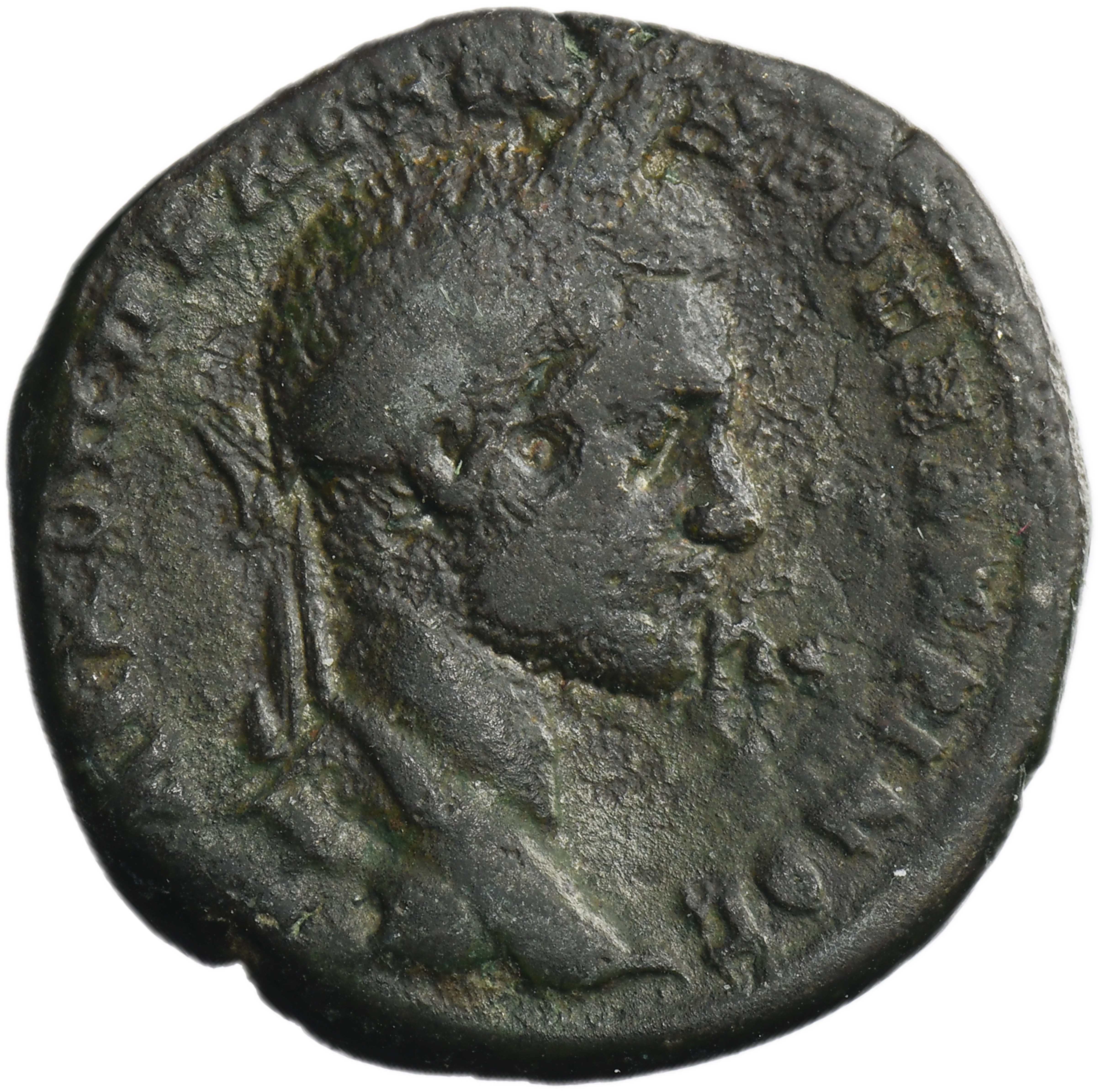
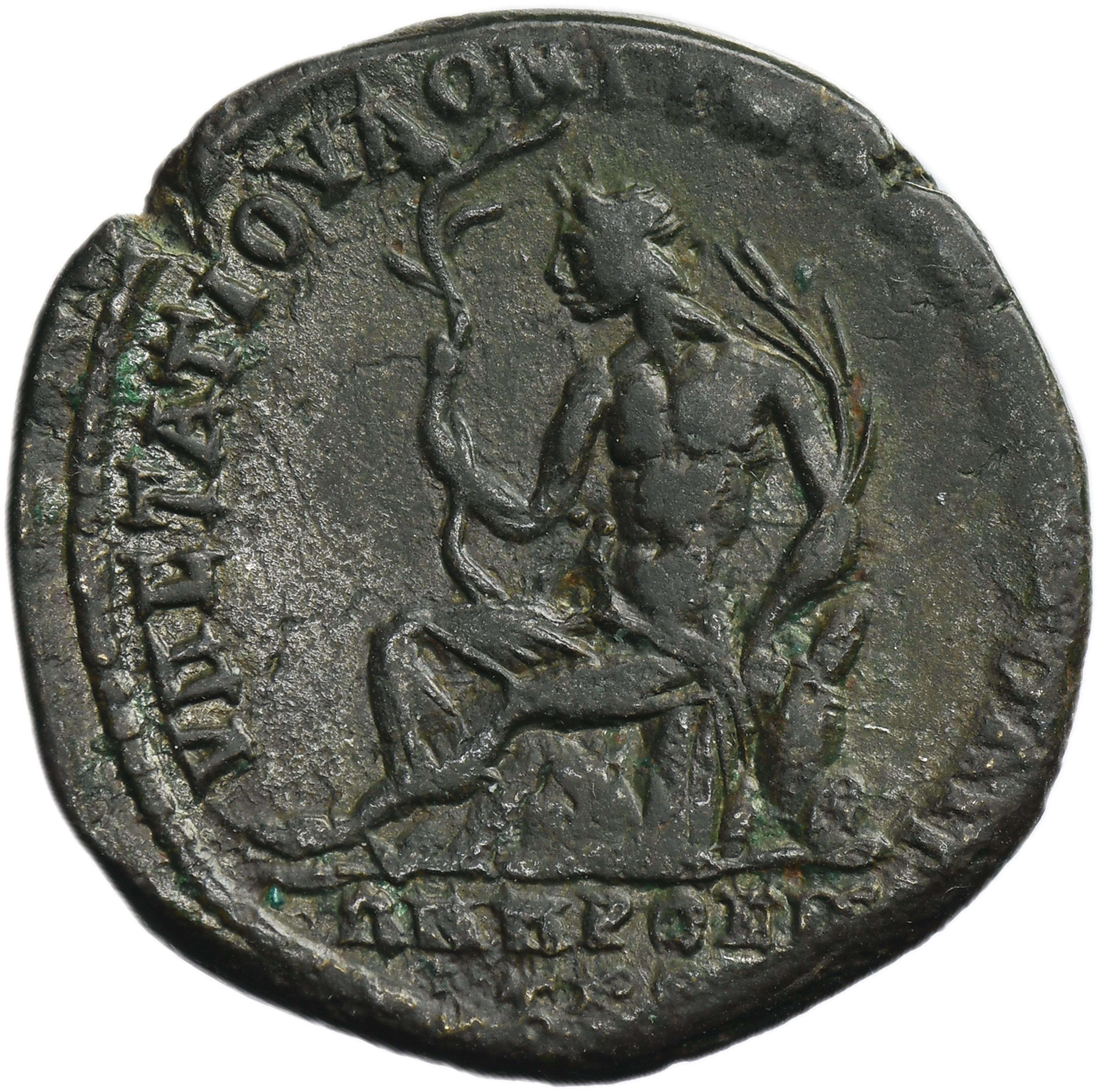


Provincial bronze issue of Macrinus (AD 217–218), struck at Nicopolis ad Istrum in Moesia Inferior, belongs to a well-documented series of civic coinage in which the name of the supervising official is regularly recorded, providing valuable evidence for the organization of provincial minting in the early 3rd century.
The obverse displays a laureate head of the emperor facing right, with the Greek legend AV K OΠΠEΛΛ CEVHPOC MAKΡEINOC, presenting his full titulature as autokrator and augustus.
The reverse depicts the personification of Ister, representing the Danube, shown as a seated river god facing left, holding a branch and a reed, with the legend VΠ CTATIOV ΛONΓINOY NIKOΠOΛITΩN ΠΡOC ICTΡON. This imagery directly reflects the geographical and economic importance of the river Ister as a major communication and trade artery of the region. The depiction of the Danube as a river deity is well attested in provincial coinage and relief sculpture from the Danubian provinces.
A particularly significant feature is the formula VΠ CTATIOV ΛONΓINOY, referring to the governor (Statius Longinus) under whose authority the coin was struck. This practice is characteristic of Nicopolis ad Istrum and allows for precise linkage between coin issues and specific administrative tenures.
Founded by Trajan after the Dacian Wars, Nicopolis ad Istrum functioned as a major administrative and economic center in Moesia Inferior, and its coinage reflects both imperial authority and strong regional identity.
Roman Provincial
Moesia Inferior, Nikopolis, Macrinus (217–218), AE
Obverse: laureate head right
AV K OΠΠEΛΛ CEVHPOC MAKΡEINOC
Reverse: Ister, God of Mount Haimos, seated left, holding a branch and a reed
VΠ CTATIOV ΛONΓINOY NIKOΠOΛITΩN ΠΡOC ICTΡON
Diameter 26 mm, weight 11.03 g











