


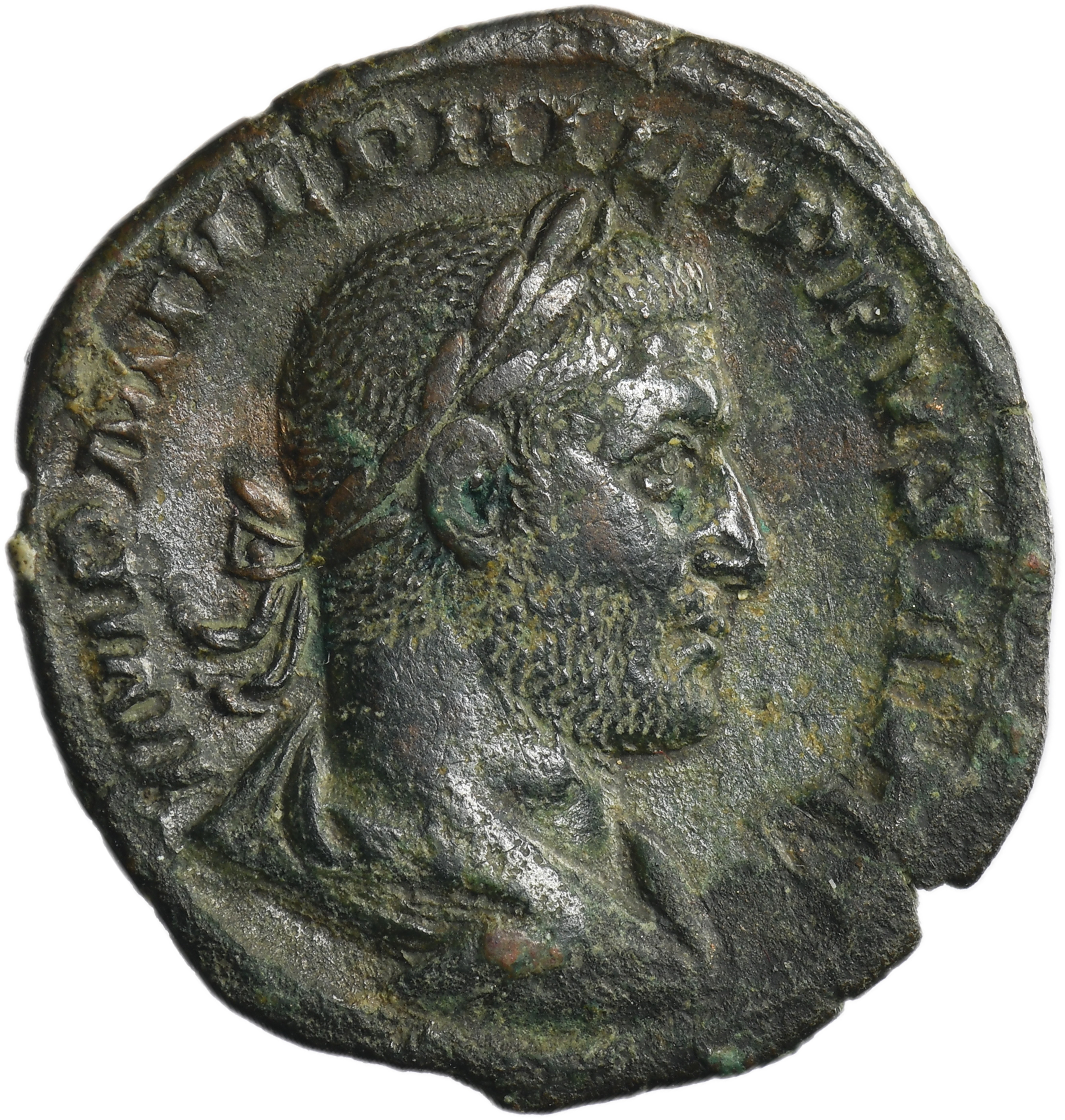
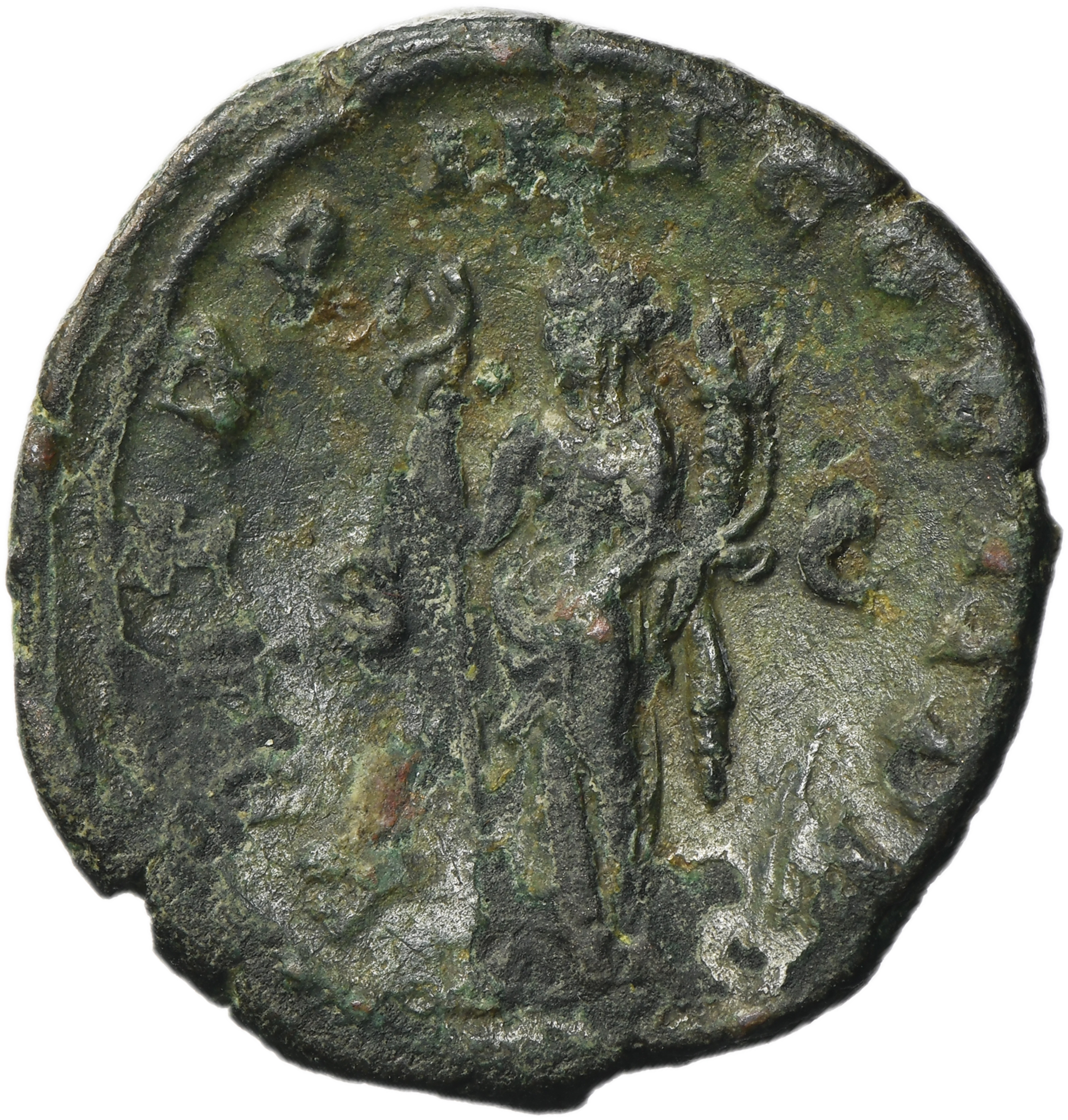


Sestertius of Philip I “the Arab” (AD 244–249), struck at the Rome mint in AD 247, belongs to a precisely datable issue, as confirmed by the reverse titulature referring to the fourth tribunician power (TR P IIII) and the second consulship (COS II). This period corresponds to the consolidation phase of his reign, immediately preceding the celebrations of Rome’s millennium.
The obverse presents a laureate, draped and cuirassed bust of the emperor facing right, with the legend IMP M IVL PHILIPPVS AVG, giving his official titulature as imperator and augustus.
The reverse depicts Felicitas standing left, holding a caduceus and a cornucopia, with the legend P M TR P IIII COS II P P and the mark S–C in the fields, indicating a senatorial issue. Felicitas personifies prosperity and well-being of the state, and her attributes the caduceus, associated with harmony and balance, and the cornucopia, symbolizing abundance form a coherent message emphasizing the restoration of stability within the empire.
Roman Imperial
Philip I (244-249), Sestertius 247, Rome mint
Obverse: laureate, draped and cuirassed bust right
IMP M IVL PHILIPPVS AVG
Reverse: Felicitas standing left, holding caduceus and cornucopiae, S-C across fields
P M TR P IIII COS II P P
Diameter 30 mm, weight 16.47 g











