


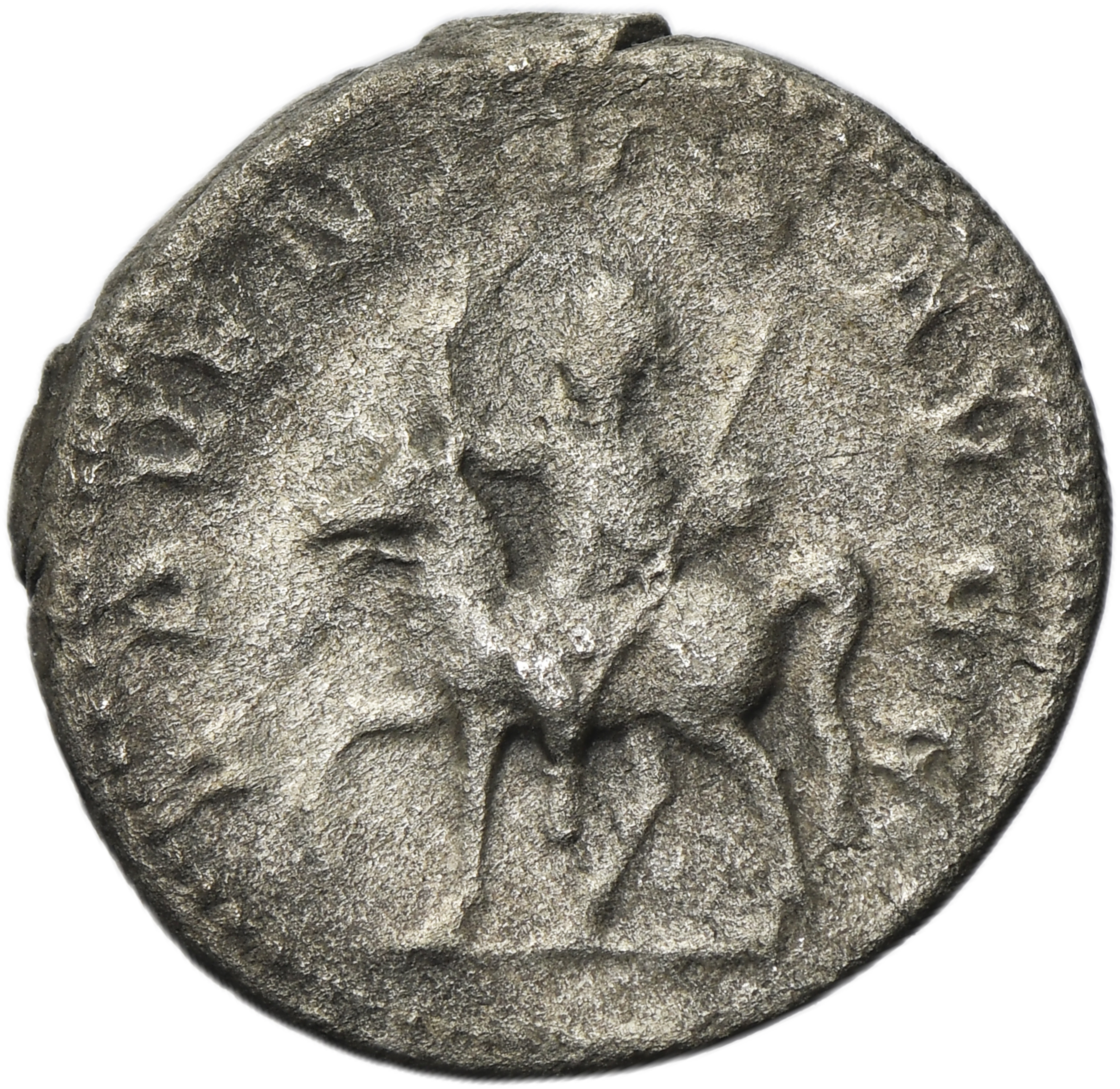


Antoninianus of Philip I “the Arab” (AD 244–249), struck at the Rome mint between AD 244–247, belongs to issues from the initial phase of his reign, immediately following his accession after the death of Gordian III in AD 244. Coin production of this period reflects efforts to legitimize the new ruler’s authority and stabilize the political situation after the eastern campaign against the Sasanian Empire.
The obverse presents a radiate bust of the emperor facing right, with the legend IMP M IVL PHILIPPVS AVG, giving his full imperial titulature. The radiate crown clearly identifies the denomination as an antoninianus, which by the mid-3rd century functioned as the principal silver coin, despite the well-documented reduction in silver content confirmed by metallurgical studies.
The reverse depicts the emperor on horseback advancing left, directly referring to the motif of adventus, the ceremonial arrival of the ruler. The legend ADVENTVS AVGG belongs to a well-defined iconographic group within Roman coinage and is firmly attested both numismatically and in epigraphic sources commemorating imperial arrivals. In the case of Philip, the type is associated with his return from the eastern front and the consolidation of imperial power.
The plural form AVGG has clear chronological significance, referring to shared imperial authority. In this context, it relates to the elevation of Philip II to the rank of Caesar in AD 244 and subsequently Augustus in AD 247. The legend thus serves as an important dating criterion, placing the issue firmly within the period of joint rule.
Roman Imperial
Philip I (244-249), Antoninianus 244-247, Rome mint
Obverse: radiate, draped and cuirassed bust right
IMP M IVL PHILIPPVS AVG
Reverse: emperor on horseback left
ADVENTVS AVGG
Diameter 23 mm, weight 4.41 g











