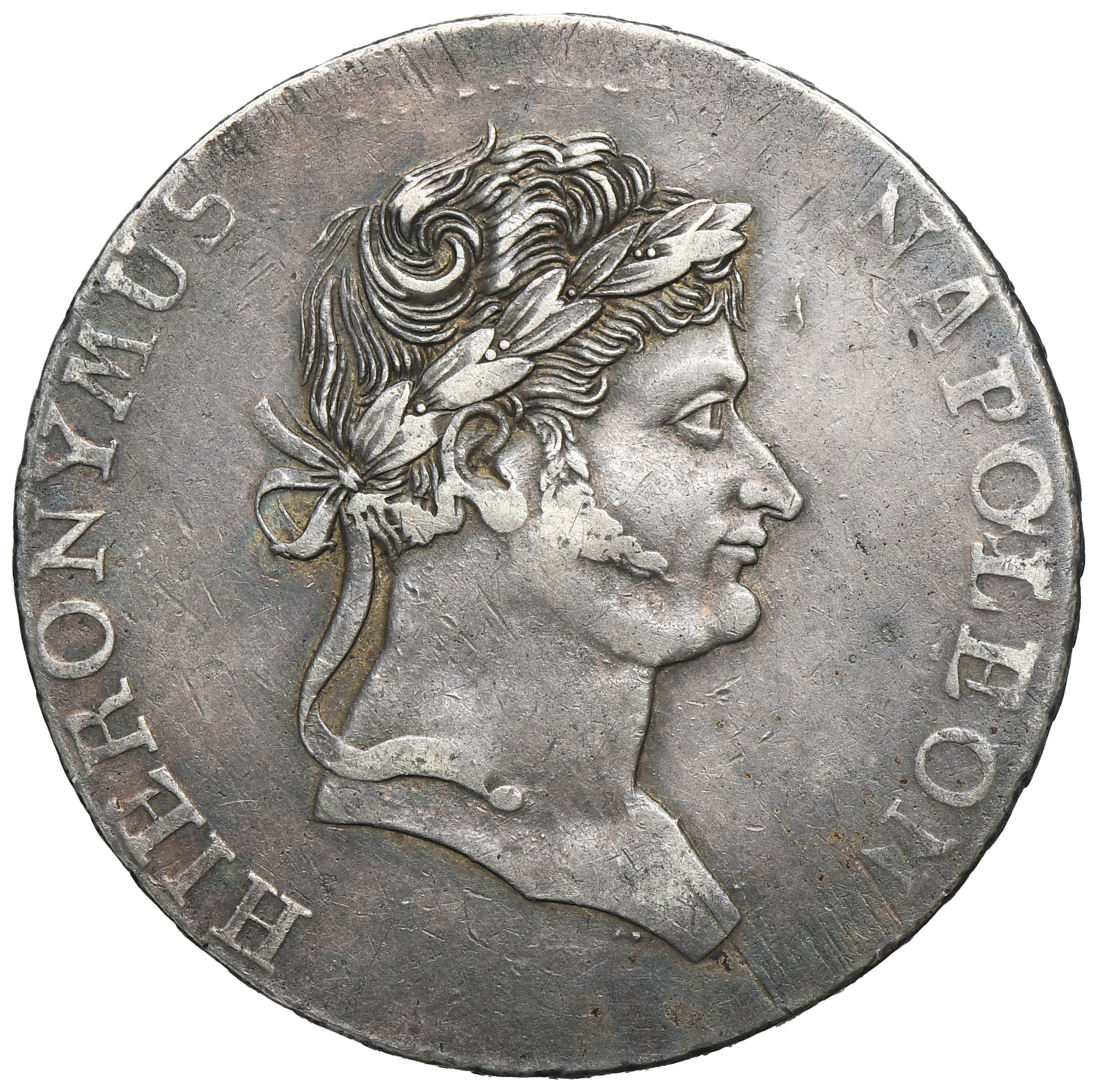
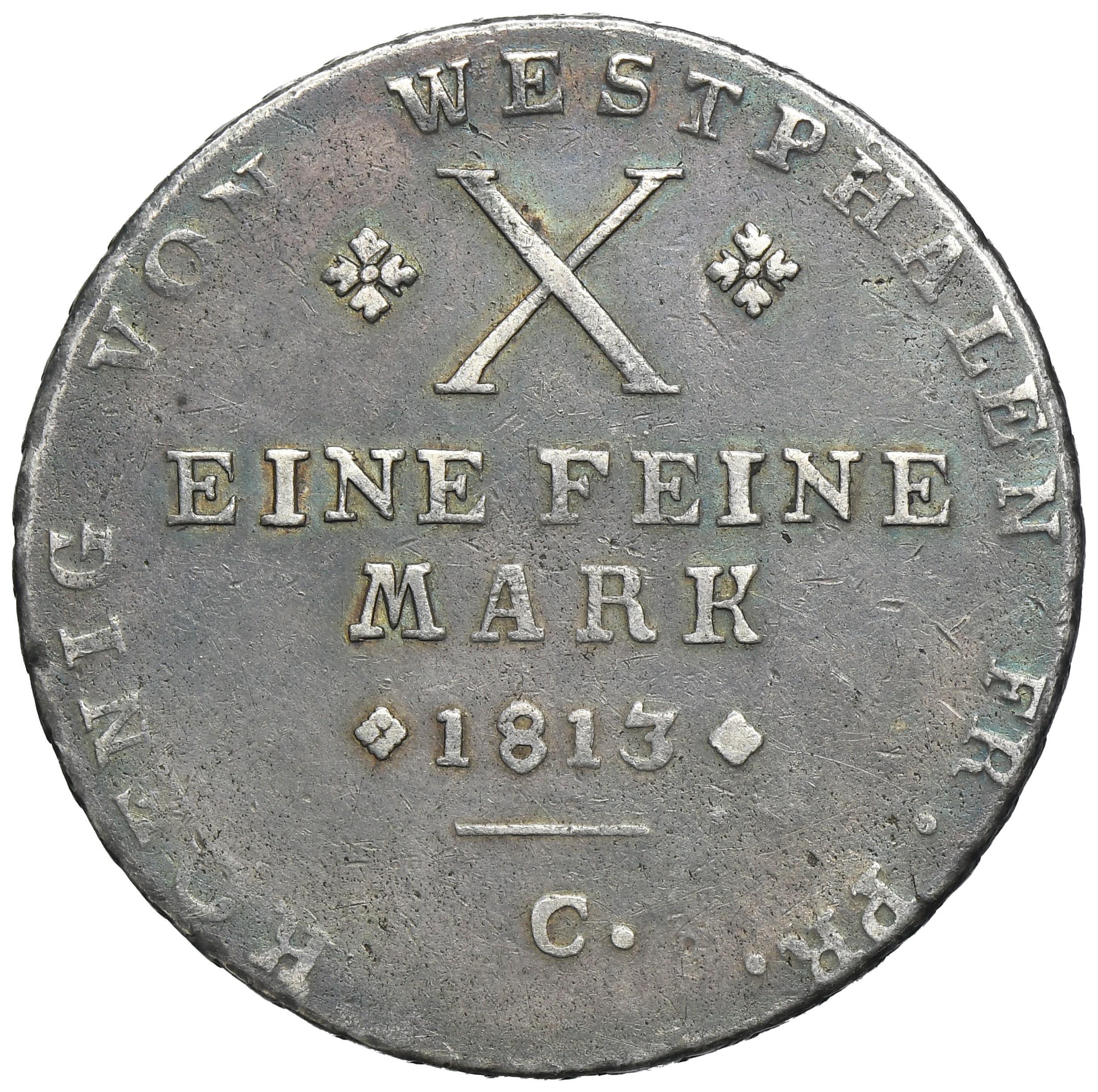
A thaler struck in the final year of the Kingdom of Westphalia, one of the states created by Napoleon Bonaparte during the political reorganisation of the German territories.
The Kingdom of Westphalia was established in 1807, with Napoleon’s youngest brother, Jérôme Bonaparte, installed as its ruler under the official name Hieronymus Napoleon. With its capital at Kassel, the state was intended to serve as a model Napoleonic kingdom. The Napoleonic Code was introduced, certain feudal privileges were abolished and administrative reforms were implemented. However, heavy taxation, financial contributions and military conscription generated growing opposition among the population.
The year 1813 brought the collapse of the Napoleonic order in Germany. Following Napoleon’s defeat at the Battle of Leipzig, coalition forces occupied Westphalian territory and Jérôme abandoned Kassel. The kingdom was dissolved after only six years of existence, making this thaler an issue from the final year of his reign.
The reverse bears the monetary standard X EINE FEINE MARK, indicating that ten thalers were struck from one mark of fine silver. The letter C denotes the Clausthal mint. The surrounding title KOENIG VON WESTPHALEN FR. PR. identifies Jérôme as King of Westphalia and Prince of France.
A historically significant thaler from the final year of the Kingdom of Westphalia, a short-lived Napoleonic state ruled by the youngest brother of the Emperor of the French.
Germany, Kingdom of Westphalia, Jérôme Bonaparte (1807–1813), Convention thaler, 1813, Clausthal mint
Obverse: laureate head of Hieronymus Napoleon right
HIERONYMUS NAPOLEON
Reverse: monetary standard, date and mintmark
KOENIG VON WESTPHALEN FR. PR. / X / EINE FEINE / MARK / 1813 / C
Diameter 37 mm, weight 27.87 g