


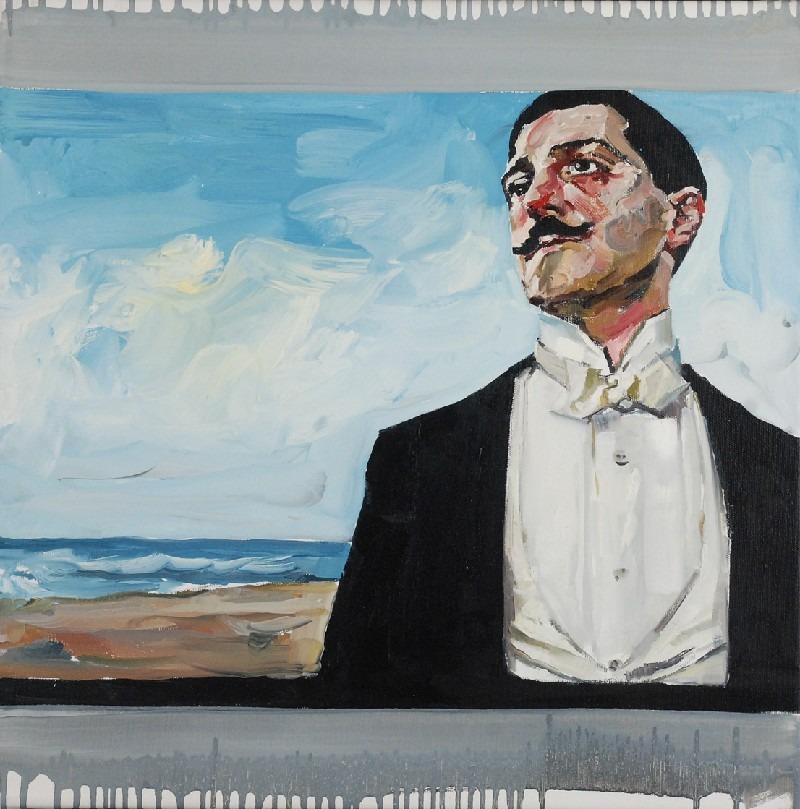

oil, canvas; 50 x 50 cm;
Signed, dated and described on the back: Jews / "Marcel Proust / Marcello Mazarella / Time Regained" / 2016 / The Krasnals.
Image exhibited in the exhibition:
- The Krasnals, Jews / Jews, Fibak Gallery, Warsaw 13.05. - 06.06 2016.
Anonymous group of artists critical of current phenomena in contemporary art, of political correctness in the social, political sphere, including within art itself. Humor sometimes hard to swallow and ambiguity that does not allow to strictly define the options they support, cause controversy in many circles. The main place of activity of The Krasnals is their blogs (Polish and English), where they regularly publish posts, usually with their images and texts commenting on phenomena that bother, fascinate or measure them. Works in the collections of, among others: MOCAK - Museum of Contemporary Art in Krakow, Silesian Museum in Katowice, Museum of Warmia and Mazury in Olsztyn.
"Jews, The Kranals project is a collection of dozens of paintings of equal size, depicting famous Jews. All the scenes in the paintings come from European and American cinema films of the last 80 years. So - the project emerging as a natural consequence of Uklański's famous Nazis - shows the faces of famous figures known quite widely - but through the big screen. This creates a peculiar quality, debatable when it comes to combining historical truth, authenticity with carrying a message of knowledge, emotion, different kinds of values that we can't exactly specify here. In the end, it's all about the visual message - which, when thrust into a new context, opens up a surprising new field for mental improvisations. The dressing with film faces carries a certain note of perverse therefore confusion, an attachment reconciled with the displacement of authenticity, realistic truth to the background, at the expense of a fascinating story, given before our eyes, with the tools of pop culture (...).
Naturally, a very large part of the characters are related to the Holocaust, the theme of the Holocaust, the theme of evil, the theme of humanism and history. But at the other extreme there are also controversial characters, where the hero is judged not always positively - like the Wolf of Wall Street or the Jewish banker in The Perfect Plan. And then there is the key chapter - famous figures. Scientists, people of culture, art, madmen, enthusiasts, unbridled enthusiasts... to whom we owe this and that at our stage of civilizational development (...). Piotr Uklański, on a similar basis, created and studied his Nazis - accumulating their faces from film frames. He is said to be a master of plagiarism.
The same is alleged of The Krasnals, who in this case create plagiarism, as it were, from the plagiarism of the master. The Krasnals uphold the theory that throwing the old into a new context opens up new and fascinating areas. Endless recycling. Paradoxically, alluding to Uklański's Nazis and introducing a certain analogy in terms of equal-sized, cinematic heroes, The Krasnals' works land at the same time at the opposite pole. While in the depictions of the Nazis the characters are as if unified, as if cloned according to a single pattern, the Jews painted by The Krasnals present a wide, one might say unlimited, spectrum of personalities, fates, characters, content, as well as a variety of pure fascinating visual aesthetics (...).
A diversity of stories, fates, characters, a wealth of emotions and values runs through the images. Connected only by origin. In a sense, this is the reverse of the Nazis - where the characters were subject to unification, equal to the glare of the flesh. It is known that the slogan "Jews" automatically directs the mind into the vortex of controversy, a whole lot of stereotypes related to anti-Semitism, dislike of Jews, who play leading roles in all conspiracy theories. The Krasnals have no intention here to play the role of judges and hold anyone accountable for anything, rather they act as an observer or ethnologist analyzing some extremely fascinating phenomenon, running it through the filter of film and artistic improvisation."
(source: press materials, The Krasnals, galleryfibak.com)
"(...) On what basis did the law come into effect, which could be described as: "Art that doesn't please the public is controversial, and art that doesn't please the critics is bad art" (The Krasnals) If artists were to be concerned about such definitions, art history would be poorer by more than one name. Such as Andy Warhol, for example....
"I broadcast a message to the masses. My paintings appeal to ordinary people. Intelligent people only appreciated the school of abstract expressionism years later, so I suppose it is difficult for intellectuals to consider what I do as art." (...) This is why we invite everyone to the land forbidden to contemporary art.
To a land where serious artists are forbidden to enter. (...) The business card of the current elite does not convince us, so at this point we are leaning once again in history towards a form of pop art, a message for all, for ordinary people, for the masses. (...)"
(source: krasnals2.rssing.com)










Laatst bekeken
Log in om de kavellijst in te zien
Favorieten
Log in om de kavellijst in te zien