



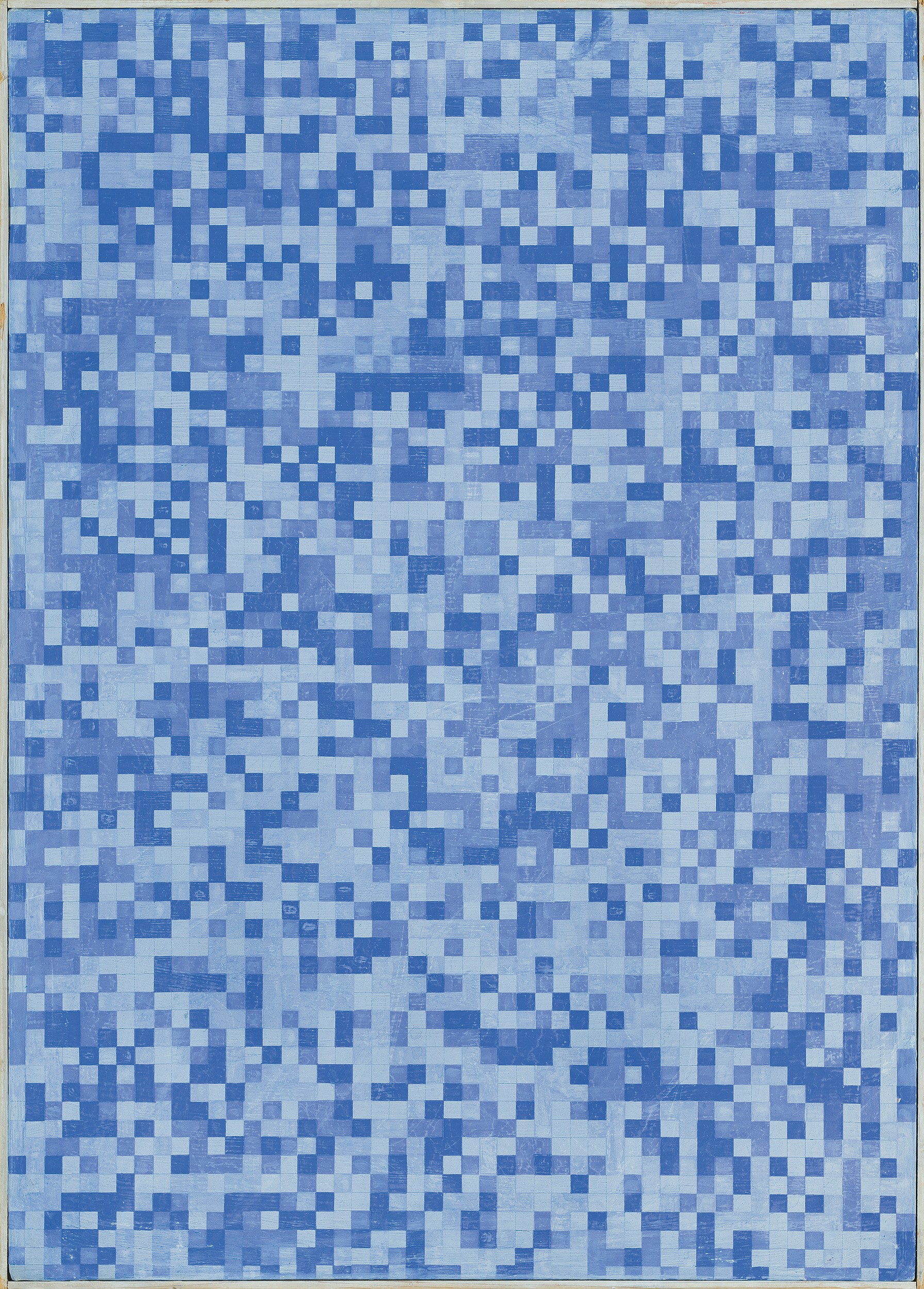
70,0 x 50,0cm - gouache, acrylic, pencil, canvas
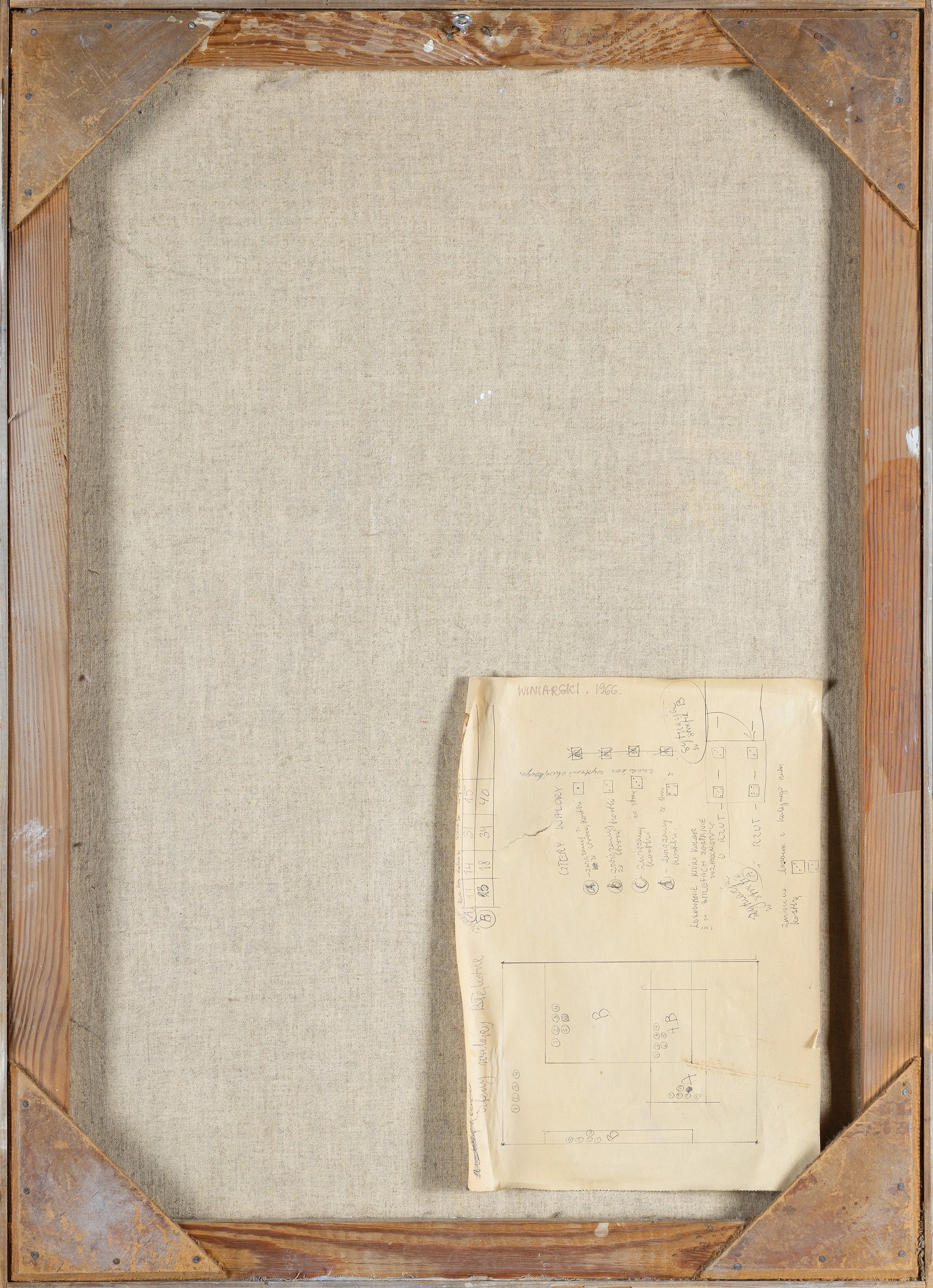
on the back pasted sheet with a description of the rules of the game of dice, deciding the distribution and strength of the values; handwriting long.
in p.g. corner signed vertically in pencil: WINIARSKI. 1966.
on the g. strip of the loom signed in pencil: RYSZARD WINIARSKI.
The presented painting comes from 1966, a breakthrough year in the artistic biography of Ryszard Winiarski. In that year, the artist gained notoriety by winning the Grand Prize at the Symposium of Artists and Scientists in Puławy, one of the most important events of the Polish avant-garde. There he presented works inspired by probability calculus using the module of black and white squares. At that time, the artist also made attempts with other colors, as exemplified by the painting featured in our auction. The composition played out in blues is a rarity on the auction market.
In the following years, Winiarski developed the idea of compositions based on an accepted principle, and paintings that are the result of the combined elements of chance and programming became his trademark.
An integral part of the painting presented at our auction, is the record of the creative process placed on the back (on an attached sheet), which on the one hand is based on order (described rules, grid structure), on the other - on chance (throw of the dice). The throw determines not only the color, but also its amplification. In her texts on Winiarski's work, Bożena Kowalska points out that his art contains elements of conceptualism, with which it is ahead of its time. As Kowalska notes, the artist's intention was to reject the outdated norms of traditional aesthetics, all the principles of painting that were previously in force and taught in schools, including the rules of composition construction or color and chiaroscuro solutions. Winiarski negated the very idea of a painting as a work of art shaped consciously by the artist and bearing the characteristics of his creative individuality. The painter's aspiration was to create an impersonal art, devoid of any emotion; an art that cannot be judged from the point of view of aesthetic values, but whose meaning can be explained rationally, logically and precisely. (B. Kowalska, Ryszard Winiarski. On the borderland of mathematics and art, in Ryszard Winiarski. Works from 1973-1974, Cracow 2002, pp. 8-9)
♣ a fee will be added to the auctioned price, in addition to other costs, resulting from the right of the creator and his heirs to receive remuneration in accordance with the Law of February 4, 1994 - on Copyright and Related Rights (droit de suite).
Ryszard Winiarski (Lviv 1936 - Warsaw 2006) graduated from Lviv Polytechnic in 1959 and took up painting studies at the Academy of Fine Arts in Warsaw (1960-1966). At the end of his studies, in 1965, he formulated his own artistic program and realized his first works in a series entitled. "Attempts at visual presentation of statistical distributions". He received the first prize for them at the Symposium of Artists and Scientists in Pulawy in 1966. He adopted squares in black and white as the permanent modules of his works, the order and arrangement of which are governed by chance - the throw of a dice, drawing lots or the selection of random numbers. In 1970 he introduced the third dimension to his works in the form of spatial images or as an illusion of space obtained by plotting linear perspective. In 1971, the first paintings with incorporated mirrors were created. Since 1972, the artist also arranged "games" with the participation of viewers, who, using his means and method, filled a plane or room with their own "exhibition." From around 1983 Winiarski incorporated meaningful, symbolic and emotionally appealing elements into his works, such as the shape of the cross, natural materials and treatments on them, such as bending (installations: Geometry in a state of tension, 1984, Black Square or Flying Geometry, 1984, Hommage for Henryk Stażewski, 1989). At the same time, since 1960 the artist practiced stage design, being the author of dozens of realizations in this field in theaters throughout Poland. He participated in a great number of exhibitions in Poland and abroad, including: Sao Paulo Biennale 1969, I and II Biennale des Konstruktivismus, Nuremberg 1969 and 1971, Construction in Process, Lodz 1981 and Munich 1985. He died on December 4, 2006 in Warsaw.













Laatst bekeken
Log in om de kavellijst in te zien
Favorieten
Log in om de kavellijst in te zien