


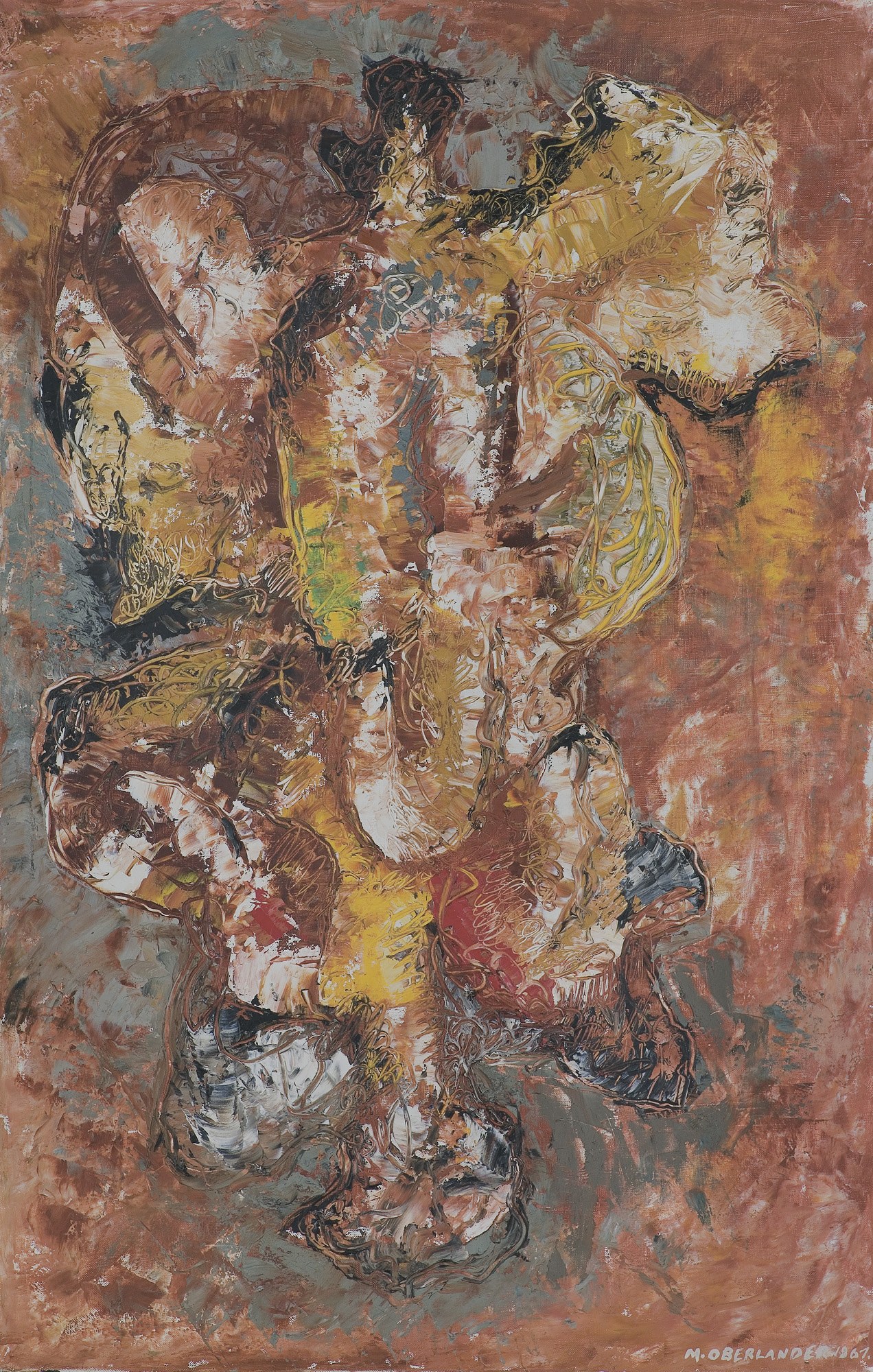
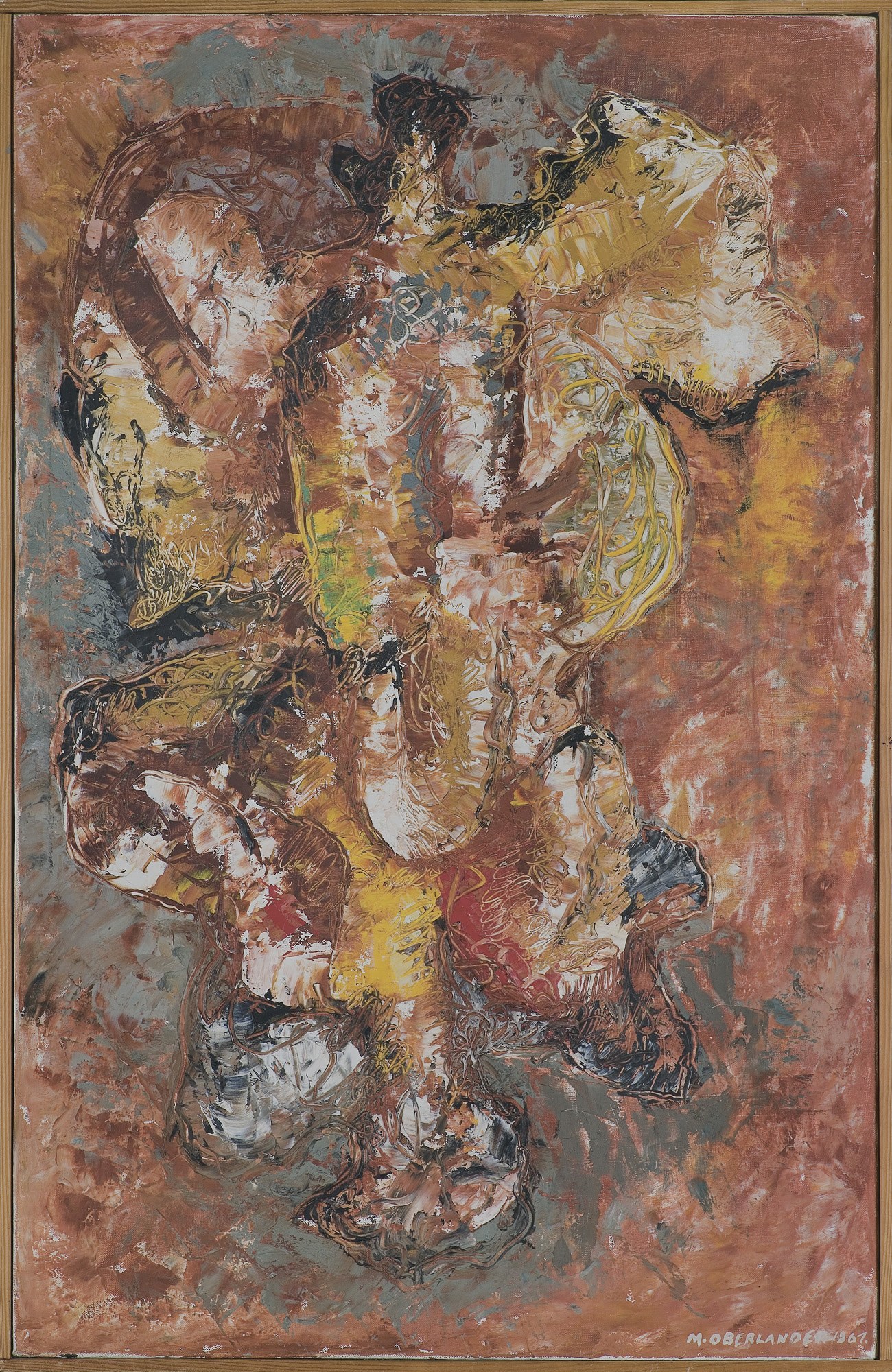
100.0 x 65.0 cm - oil, canvas signed p.d.: M. OBERLANDER 1961.
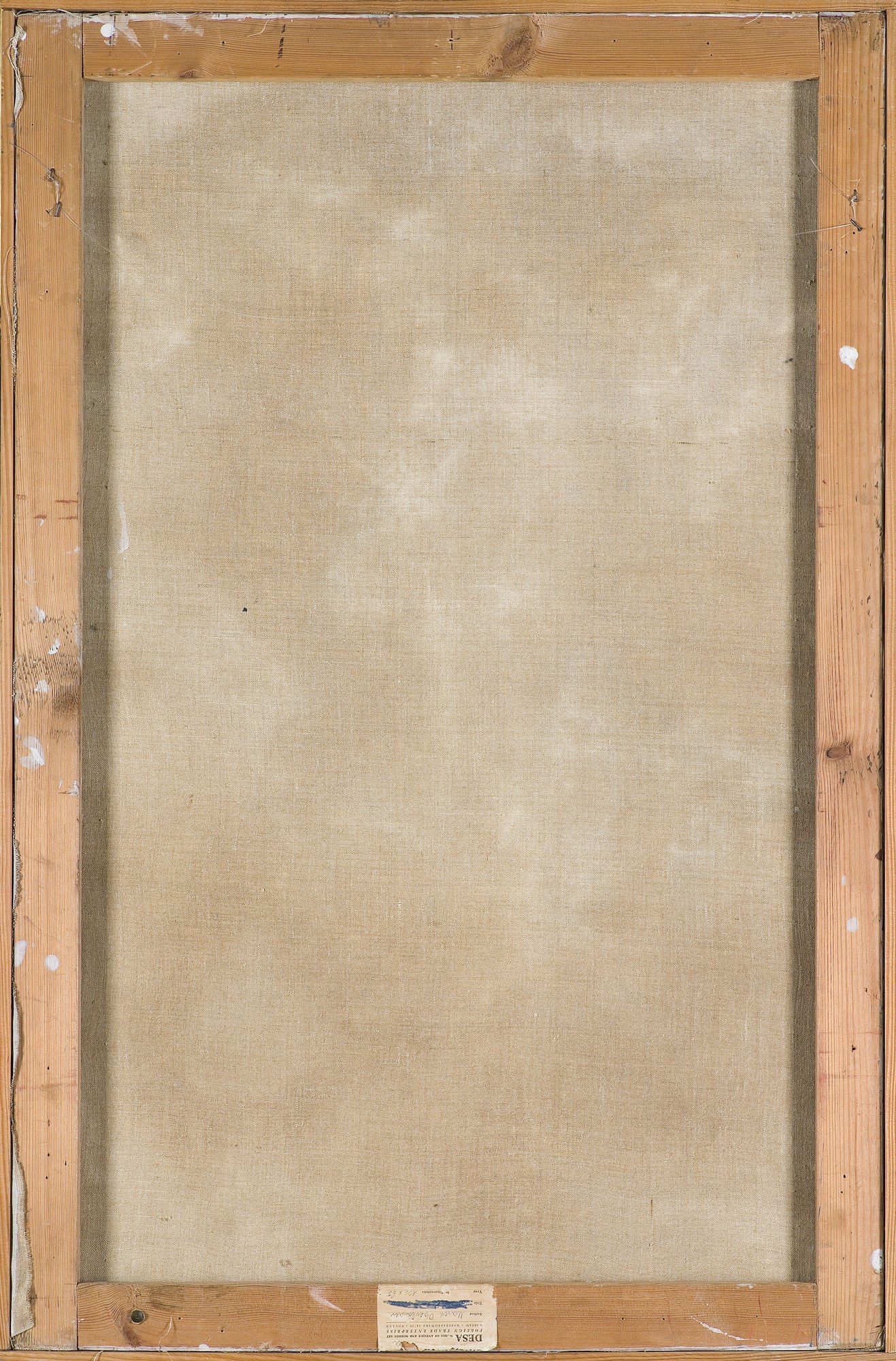
on the bottom of the loom strip a sticker from Desy Works of Antique and Modern Art with details of the painting
Painting exhibited:
- Hommage à Marek Oberlander, Galerie Municipale Renoir, Nice, 10 - 31 I 1984.
Marek Oberländer's oeuvre was marked by the distinct stigma of traumatic experiences related to wartime and the Holocaust. While in his early works (e.g. the series Never Again the Ghetto, 1953), these experiences were depicted in a realistic and unambiguously literal manner through poignantly portrayed human figures, in his later years the artist gradually moved away from this literalness towards painterly synthesis and symbolic forms. As Magdalena Szafkowska wrote: By the end of the 1950s, Oberländer's figures ceased to be strictly images of human-like beings - filled with a strong psychological charge, they began to undergo further organic transformations, expressing extreme emotional states. The artist began to gradually transform the human figure into a silhouette of a human-insect, a human-bird (...) Black and white or maintained in dark color tones - less often in lighter or even bright colors - Mark Oberländer's silhouettes in 1961-1963 began to resemble menacing praying mantises with almost triangular, disproportionately small heads (....) A nervous, jittery outline passes into their interior and, like a network of red-hot blood vessels in the likeness of a spider's thread, entwines the outline of the shaft, the spine - the axis of the entire composition. (...) With his painterly visions of 1956/7-1968, the artist sought to express the omnipresent human and, above all, his own suffering, which he shared in an attempt to understand it and, at the same time, to help those similar to himself cope with it. By tracing his transformation, he inquired into the meaning and meaninglessness of human fate. He wanted to explore, to understand the mysterious nature of the world, and within it, himself, and above all his art, so strongly connected with the nightmare of his war experiences. (Magdalena Szafkowska, Marek Oberländer and Jan Lebenstein. The Mysterious Sign of the Human Figure, Wroclaw 2020)
♣ An additional fee will be added to the Purchase Price based on the right of the creator and his heirs to receive remuneration in accordance with the Law of February 4, 1994 - on Copyright and Related Rights (droit de suite).
Marek Oberländer (Szczerzec near Lviv 1922 - Nice 1978) served in the Red Army during the war. In 1946-48 he studied at the High School of Fine Arts in Warsaw. Then in 1948-53 he studied at the Warsaw Academy of Fine Arts. In 1955, together with Elżbieta Grabska, Jan Dziędziora and Jacek Sienicki, he was co-organizer of the National Exhibition of Young Visual Arts, which under the name "Arsenal" entered the legend of Polish contemporary art. One of the symbols of the "Arsenal" attitude and style became Oberländer's painting Stigmatized, shown at this exhibition. In 1956-61, the artist managed a gallery operating under the auspices of cultural and social weeklies, successively: "Po Prostu", "Nowa Kultura" and "Współ-czesność". In 1963 he left for Sweden, and in 1964 settled in France. He lived in Paris and Nice, where he died prematurely of a heart attack. He donated a selection of the best works from his artistic output to the National Museum in Wroclaw in 1977. In the 1950s he created figural compositions













Laatst bekeken
Log in om de kavellijst in te zien
Favorieten
Log in om de kavellijst in te zien