


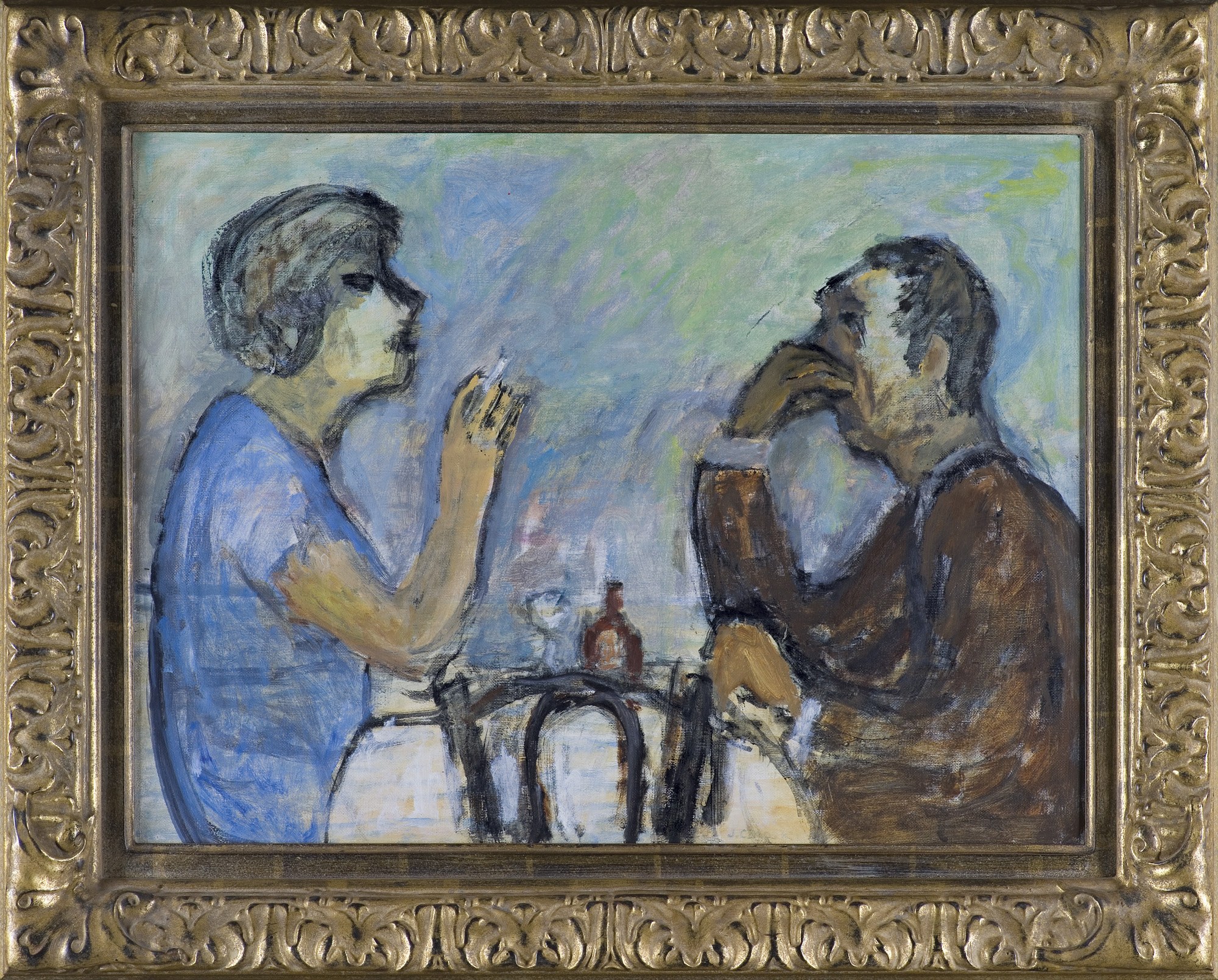
46.0 x 61.0 cm - oil, canvas signed p.d.: J. CZAPSKI
Image exhibited, described and reproduced:
- Józef Czapski seeing life (exhibition catalog edited by Wojciech Zmorzyński), National Museum in Gdansk, Gdansk III - VI 2000, cat. 30, il. b. 33, s. 69.
Czapski's life filled with the experience of war, death and suffering caused the artist to focus his work on the everyday and the simplest things. In his notebooks, he sketched ordinary scenes in earnest: a couple in a café, a lonely man at a subway station, a couple on a bridge. He wrote in his diaries: My discovery of the world is the discovery of forms or arrangements existing in the world, which surround us and which we mostly do not notice.
Czapski's painting, Zmorzyński writes, in a bizarre way combines at the same time delight in the world with extraordinary existential truth. This touching of fundamental matters, speaking simply and convincingly about man, speaking without pathos and exaltation, without dramatic shouting and anecdote, without insistent "I", constitutes the strength and, above all, the timeliness of Józef Czapski's work.
The drawing (cat. 143) and painting exhibited at the auction indicate the working method of the artist, for whom drawing was not just an exercise of the hand, but a way of recording the first vision, the beginning of a mental process leading through deepening experience to oil painting. (W. Zmorzyński, Seeing Life, Gdansk 2000, pp. 8-9)
♣ An additional fee will be added to the Purchase Price based on the right of the artist and his heirs to receive remuneration in accordance with the Act of February 4, 1994 - on Copyright and Related Rights (droit de suite).
Józef Czapski (Prague 1896 - Maisons-Laffitte 1993) - painter, draughtsman, writer and publicist; initially studied law, later trained at the Warsaw School of Fine Arts in 1918. He interrupted his studies to go to Russia to search for missing Polish officers, at the behest of Polish military authorities.
In 1920 he participated in the Polish-Bolshevik war. In 1923-1924 he studied at the Academy of Fine Arts in Cracow. In 1924, together with a group of students of Jozef Pankiewicz, forming the so-called Paris Committee, he went to Paris for further studies, where he stayed until 1931. After returning to Poland, he participated in exhibitions of the Capists, including at the Warsaw Institute of Art Propaganda. A participant in the September campaign, a prisoner of, among others, the Starobielsk camp; freed from captivity, he joined the Anders Army and in 1941-1942 led the search for officers and soldiers imprisoned and missing in the USSR.
After 1944, he lived permanently in Maisons-Laffitte near Paris. He was one of the founders of the monthly magazine "Culture." As a writer, he published, among others, Oldobiel Memories, On Inhuman Earth and numerous essays on art. He painted landscapes, still lifes, interiors and, less frequently, portraits. In the 1980s and 1990s, the artist's paintings and drawings were exhibited several times in Krakow, Warsaw, and Poznan.
His painting - initially close to the Pankiewicz school, later very individual and expressive - is more widely presented in an album by Joanna Pollakówna (Czapski, Warsaw 1993).













Laatst bekeken
Log in om de kavellijst in te zien
Favorieten
Log in om de kavellijst in te zien