


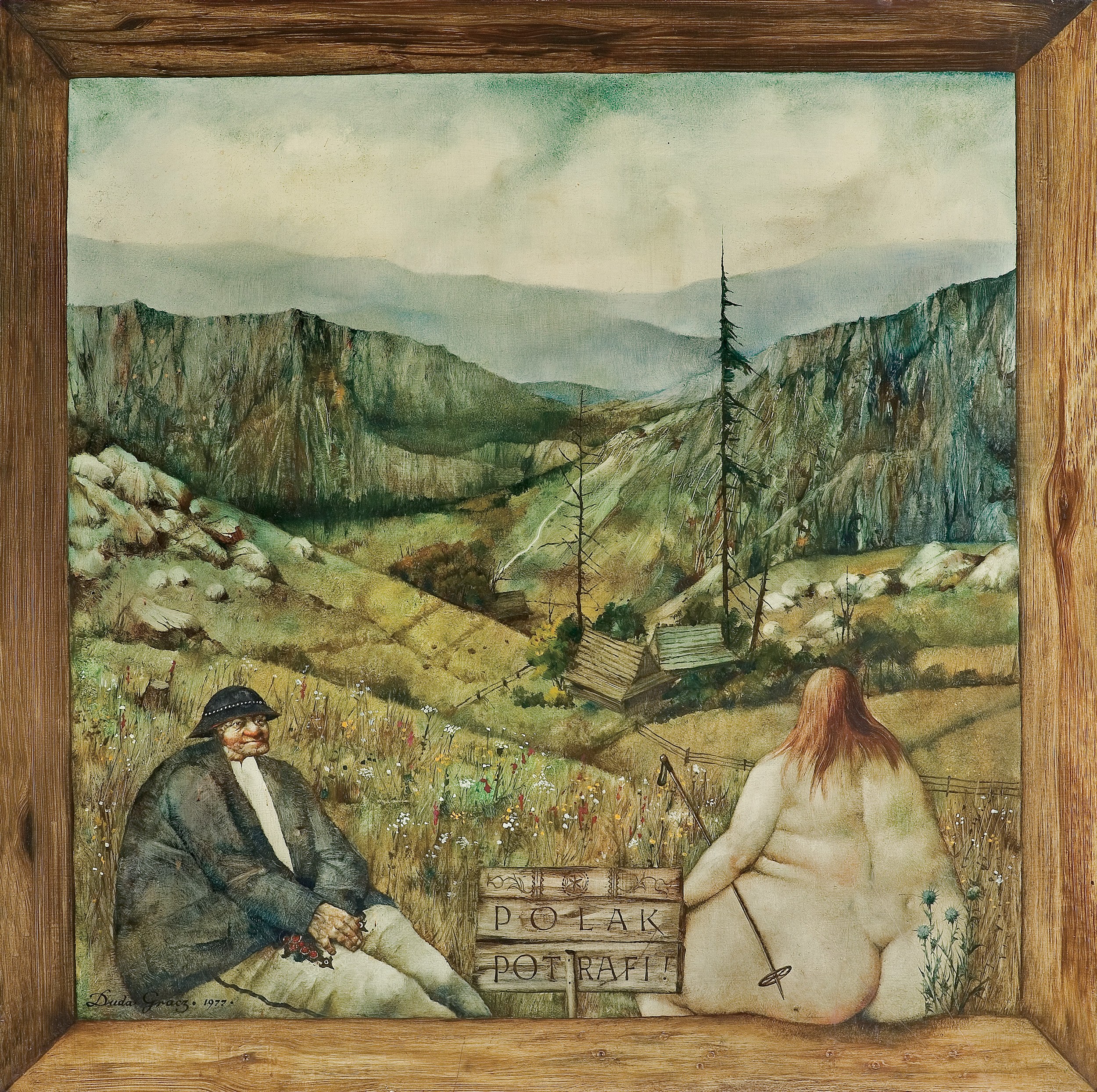
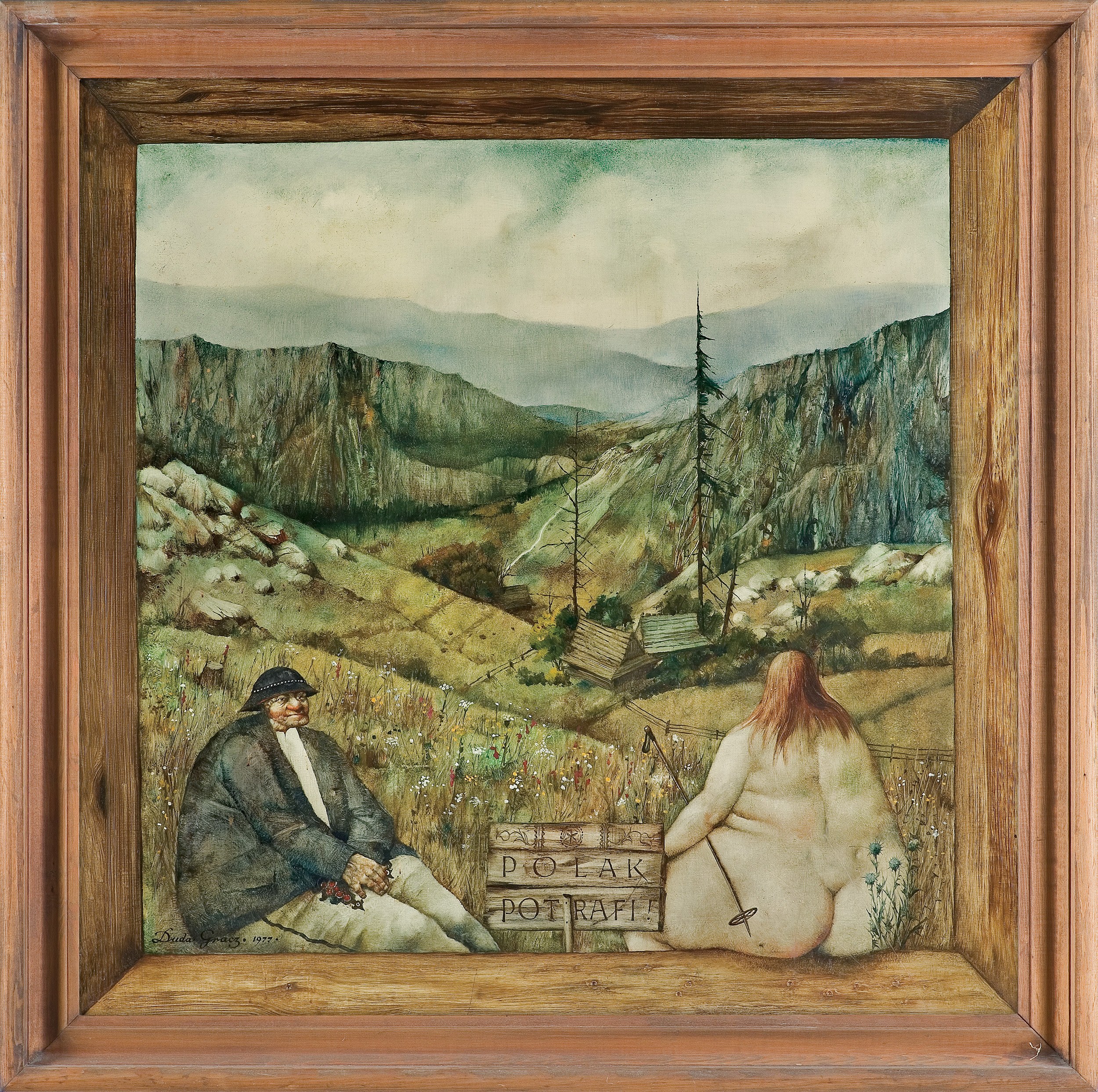
80,0 x 80,0cm - oil, fiberboard
Signed l.d.: Duda Gracz. 1977, middle: POLAK POTRAFI!
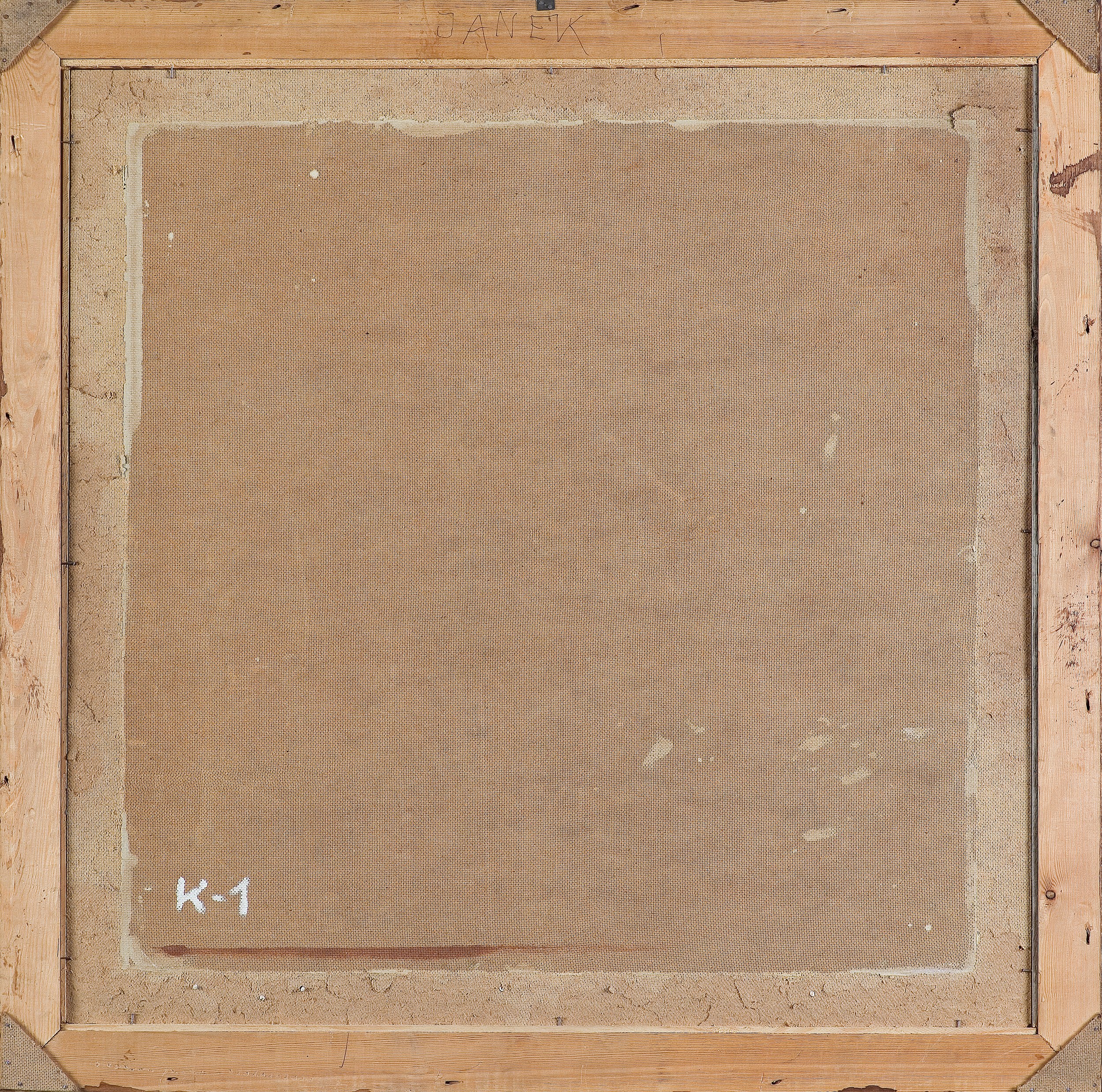
on the reverse on the board in white paint: K-1
In 1977, the time when the painting Polak potrafi! was created, Jerzy Duda Gracz was widely respected as a publicist performing in his works - with a not inconsiderable dose of bitter humor and irony - a vivisection of the Polish reality of the communist period. A respite from his demanding role as a documentalist of low mores were plein air trips, usually organized in the village of Brzegi near Bukovina. Most of the landscapes sketched during the trips were tucked away in the proverbial drawer - the artist felt they were too intimate a sphere of creativity to show in public. An additional reluctance to exhibit them was exacerbated by the fact that, as they were devoid of narrative, they could serve neither as a source of ludic entertainment nor as an instructive morality play. An attempt to break the resistance to granting full autonomy to the mountain landscape is - situated on the borderline between the two genres cultivated by Duda Gracz - the eloquently titled depiction of a mountain man and woman against the background of a picturesque valley. The lower slat of the illusionistically painted frame is a kind of audience from which the couple watches the majestic spectacle of nature. However, they are not insignificant staffage. Both the naked woman, representing the ideal of dudagraha beauty, and the accompanying shepherd, jovially smiling at the viewer, are relaxing in nature, not caring at all about the placard standing between them with the slogan of communist propaganda inscribed on it: "Polak potrafi!". The call of the builders of the Katowice Steelworks, one of the flagship investments of the Edward Gierek era (1970-1980), transports the viewer to the industrial reality of making the standard, the first triggers of pig iron and rampant production rates, which has nothing to do with the carefree attitude of the portrayed. As Tadeusz Nyczek, an expert in the artist's oeuvre, emphasized, Duda Gracz is hardly interested in "pure" worlds of customs, behavior, appearance. Something must always be juxtaposed with something, even if only by simple juxtaposition. The masterful concept of combining separate worlds in the painting Pole Can! has become not only an opportunity to mock the loss-making big metal combine, but also a pretext to show the beauty of the beloved Tatra Mountains, where, as you can see, a Pole can relax.
♣ to the auctioned price, in addition to other costs, will be added a fee resulting from the right of the creator and his heirs to receive remuneration in accordance with the Act of February 4, 1994 - on Copyright and Related Rights (droit de suite).
Jerzy Duda Gracz (Częstochowa 1941 - Łagów 2004) - painter, illustrator, stage designer, educator. He received his diploma from the Academy of Fine Arts in Cracow at the Department of Graphics in Katowice in 1968. In 1976-82 he was a lecturer at the academy, then a professor at the Silesian University in Katowice. He also taught at the European Academy of Arts in Warsaw (1992-2001).
His paintings are characterized by technical virtuosity and attention to detail. He practiced art in the broadly defined realist convention with dominant figure deformation and grotesque. He created a world of unmasking, using the language of journalism and allegory. He is the author of several major projects, including the "Transfiguration" plafond in the church in Toporovo (1995) and the "Golgotha of Jasna Gora" series in the Monastery of the Pauline Fathers in Czestochowa (2000/2001).
The artist has had more than 180 solo exhibitions at home and abroad (including Berlin, London, Paris, Moscow, Rome, Vienna, Florence, Düsseldorf, Chicago, New Delhi, Munich, New York and others). He participated in about 300 national exhibitions and international presentations of Polish art. He represented Poland, among others, at the XLI Art Biennale in Venice in 1984, at the XX and XXI World Art Fairs in Cologne in 1986 and 1987, and at EXPO '92 in Seville.
Jerzy Duda Player's paintings are in the collections of the National Museums in Warsaw, Cracow, Poznan, Wroclaw and Gdansk, the Jagiellonian University Museum in Collegium Maius in Cracow, the Museum of the Earth of the Polish Academy of Sciences in Warsaw, the art collections at Jasna Gora in Czestochowa and other district and city museums, and in private collections, including those of W. Ochman and W. Fibak; abroad - in the collections of the Uffizi in Florence, the Pushkin Museum in Moscow, the Ghent City Museum, the "BAWAG" Foundation in Vienna and the Vatican Collection, as well as in the galleries and collections of Austria, Belgium, the Czech Republic, Denmark, France, the Netherlands, Israel, Japan, Canada, Mexico, Norway, Russia, Sweden, Switzerland, the USA, Venezuela, the UK, Italy and Hungary.







![Jerzy DUDA-GRACZ (1941-2004), Bez tytułu [Błazen i klaun, autoportret utajony]](https://img1.one.bid/img/10574/3329975_1w.webp?1790930919)
![Jerzy DUDA-GRACZ (1941-2004), Bez tytułu [Staropolska para]](https://img1.one.bid/img/10574/3329976_1w.webp?1790930924)








Laatst bekeken
Log in om de kavellijst in te zien
Favorieten
Log in om de kavellijst in te zien