


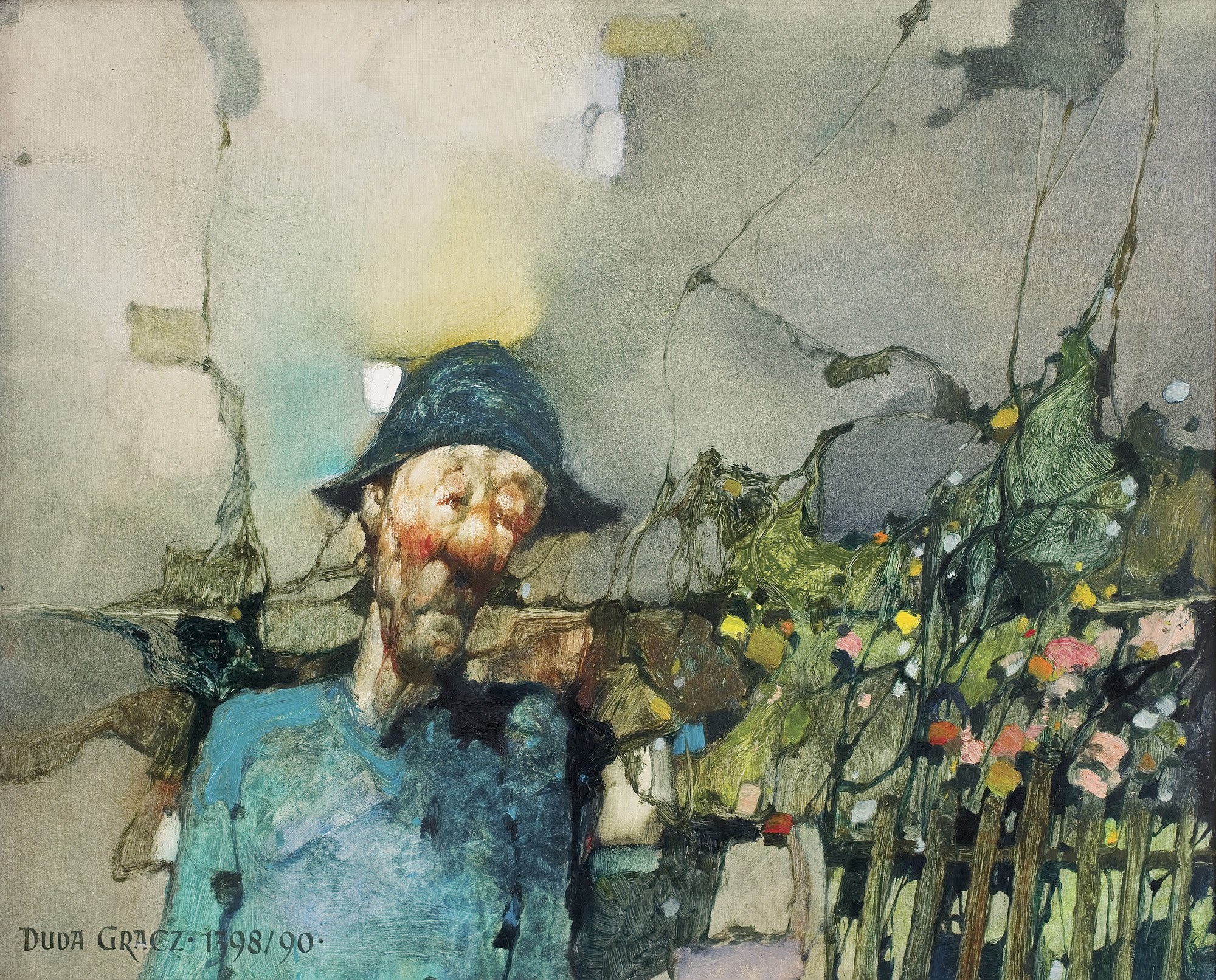
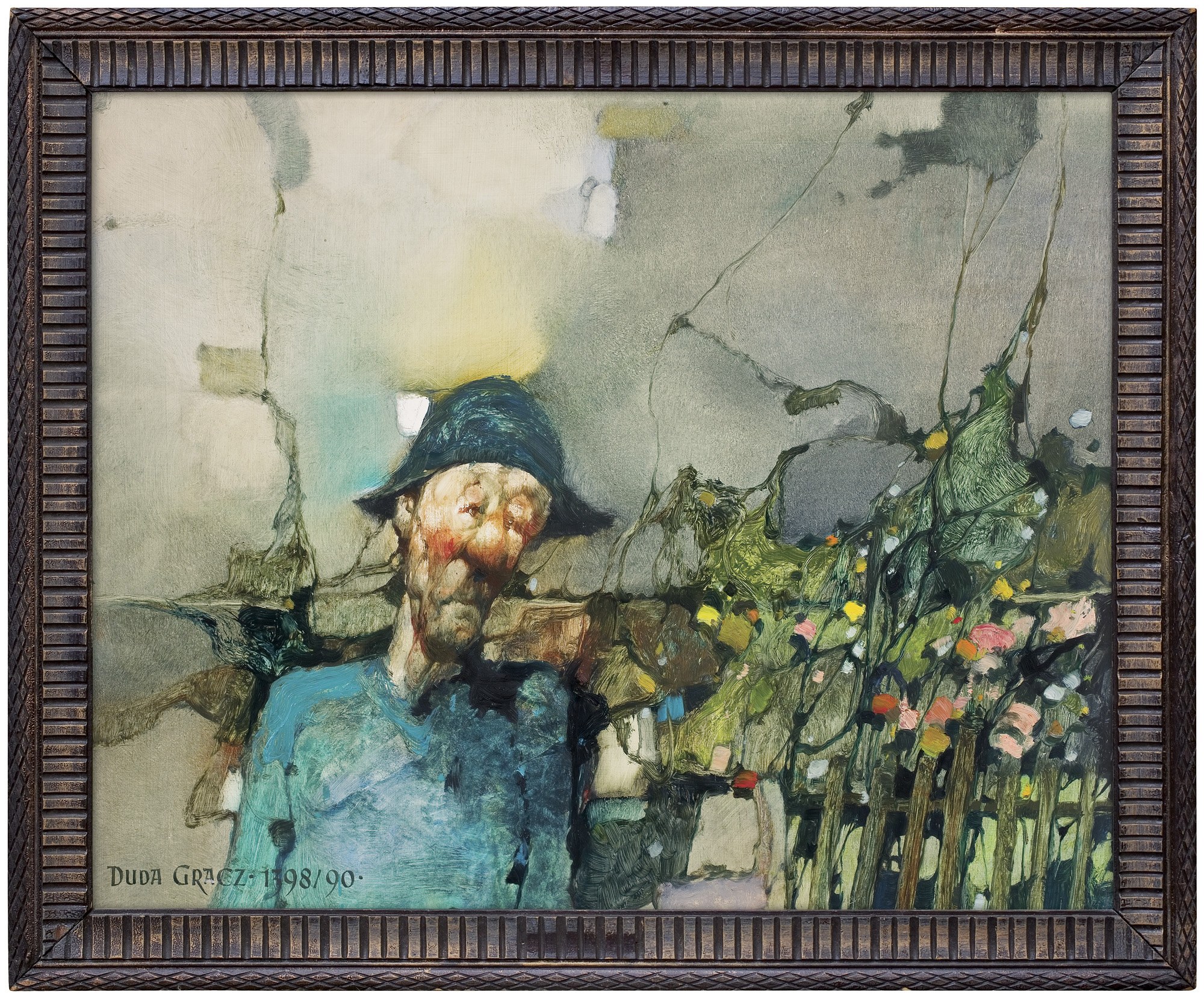
52.0 x 62.5cm - oil, fiberboard signed l.d.: DUDA GRACZ. 1398/90.
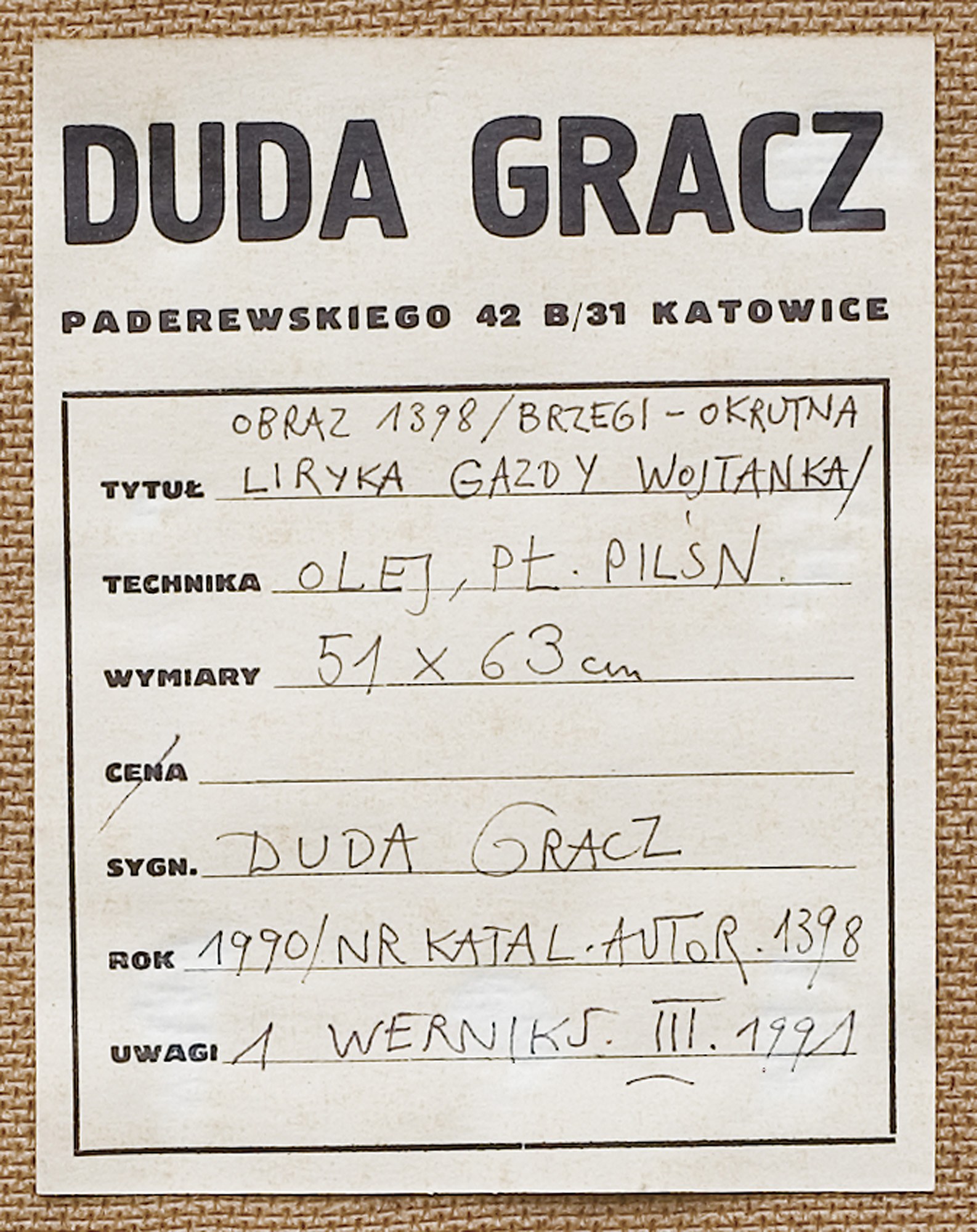
on the reverse on the board an author's sticker with the details of the painting
Among the places to which Jerzy Duda Gracz liked to travel and which inspired his painterly imagination, the most significant were five small towns. Seemingly - peripheral, yet possessing a special charm for the painter, who saw this peripherality as unique, valuable phenomena worthy of recording. In the north - Beech near Szczecin, in the east - Nadrzecze in Zamojszczyzna, in central Poland - Kamion on the Warta River, in the west - Lagow Lubuski, and in the south, in the Tatra Mountains - Brzegi. It was a village in the Podhale region that became the place where the artist began work on an extensive series of provincial-commune paintings in 1986. In it, he tried to save from oblivion the world of passing old Poland, with "old cottages, crooked houses and mossy fences."
In P o ł u d n i a, where I've been going for a quarter of a century, is the village of Brzegi in the Tatra Mountains. Not far from Bukovina, Jurgów, Białka, to Głodówka with a panorama of the Tatra Mountains - a piece, and when the fogs fall, the Gorce Mountains can be seen as if on your hand. In the village there are a couple of old cottages and more new, but ugly, and the carved faces of Wojtanek, Skowyr, grandfather Dyrcon of sacred memory and Jozef Nowobilski, the "purring harnass". In Kucowka, though not a highlander, gasps with his wife Gizela Jan Kubarek, who has a weakness for artists. I used to go there for open-air workshops with my students (...) A little way from Brzegi there is Zakopane and a loner close to my heart, Andrzej Dziuk, with his Stanislaw Ignacy Witkiewicz theater, which diligently fulfills Gombrowicz's testament in the "backwoods".
Jerzy Duda Gracz, Notes on Life and the Art of Passing [in:] Duda Gracz. Provincial and Municipal Images. Kresy polskie 2000, ed. Monika Branicka, Silesian Library, Katowice 2000, p. 10.
♣ An additional fee will be added to the Purchase Price resulting from the right of the creator and his heirs to receive remuneration in accordance with the Law of February 4, 1994 - on Copyright and Related Rights (droit de suite).
Jerzy Duda Gracz (Częstochowa 1941 - Łagów 2004) - painter, illustrator, stage designer, educator. He received his diploma from the Academy of Fine Arts in Cracow at the Department of Graphics in Katowice in 1968. In 1976-82 he was a lecturer at the academy, then a professor at the Silesian University in Katowice. He also taught at the European Academy of Arts in Warsaw (1992-2001).
His paintings are characterized by technical virtuosity and attention to detail. He practiced art in the broadly defined realist convention with dominant figure deformation and grotesque. He created a world of unmasking, using the language of journalism and allegory. He is the author of several major projects, including the "Transfiguration" plafond in the church in Toporovo (1995) and the "Golgotha of Jasna Gora" series in the Monastery of the Pauline Fathers in Czestochowa (2000/2001).
The artist has had more than 180 solo exhibitions at home and abroad (including Berlin, London, Paris, Moscow, Rome, Vienna, Florence, Düsseldorf, Chicago, New Delhi, Munich, New York and others). He participated in about 300 national exhibitions and international presentations of Polish art. He represented Poland, among others, at the XLI Art Biennale in Venice in 1984, at the XX and XXI World Art Fairs in Cologne in 1986 and 1987, and at EXPO '92 in Seville.
Jerzy Duda Player's paintings are in the collections of the National Museums in Warsaw, Cracow, Poznan, Wroclaw and Gdansk, the Jagiellonian University Museum in Collegium Maius in Cracow, the Museum of the Earth of the Polish Academy of Sciences in Warsaw, the art collection at Jasna Gora in Czestochowa and other district and city museums, and in private collections, including those of W. Ochman and W. Fibak; abroad - in the collections of the Uffizi in Florence, the Pushkin Museum in Moscow, the Ghent City Museum, the "BAWAG" Foundation in Vienna and the Vatican Collection, as well as in the galleries and collections of Austria, Belgium, the Czech Republic, Denmark, France, the Netherlands, Israel, Japan, Canada, Mexico, Norway, Russia, Sweden, Switzerland, the USA, Venezuela, the UK, Italy and Hungary.







![Jerzy DUDA-GRACZ (1941-2004), Bez tytułu [Staropolska para]](https://img1.one.bid/img/10574/3329976_1w.webp?1791476938)
![Jerzy DUDA-GRACZ (1941-2004), Bez tytułu [Błazen i klaun, autoportret utajony]](https://img1.one.bid/img/10574/3329975_1w.webp?1791476857)








Laatst bekeken
Log in om de kavellijst in te zien
Favorieten
Log in om de kavellijst in te zien