


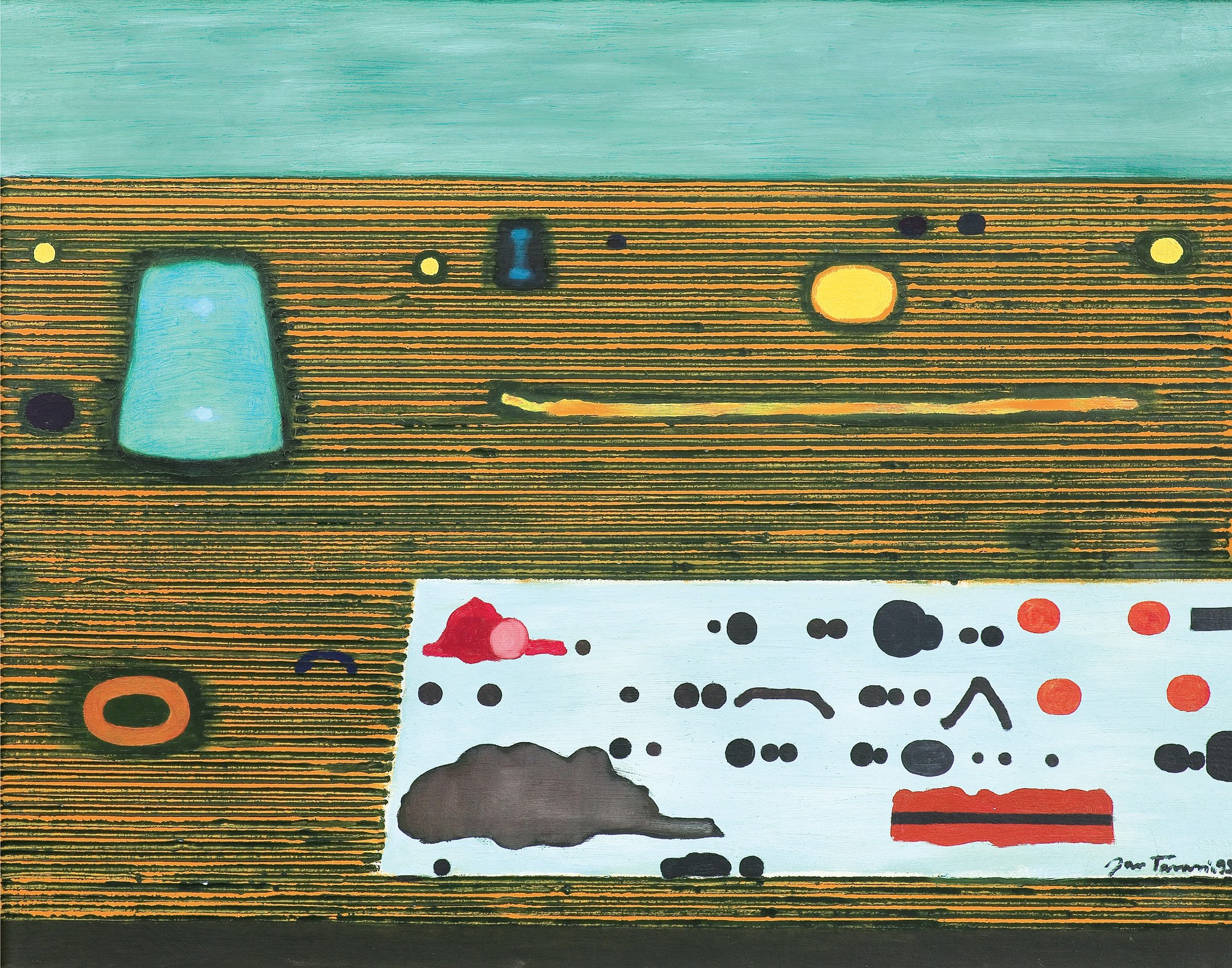
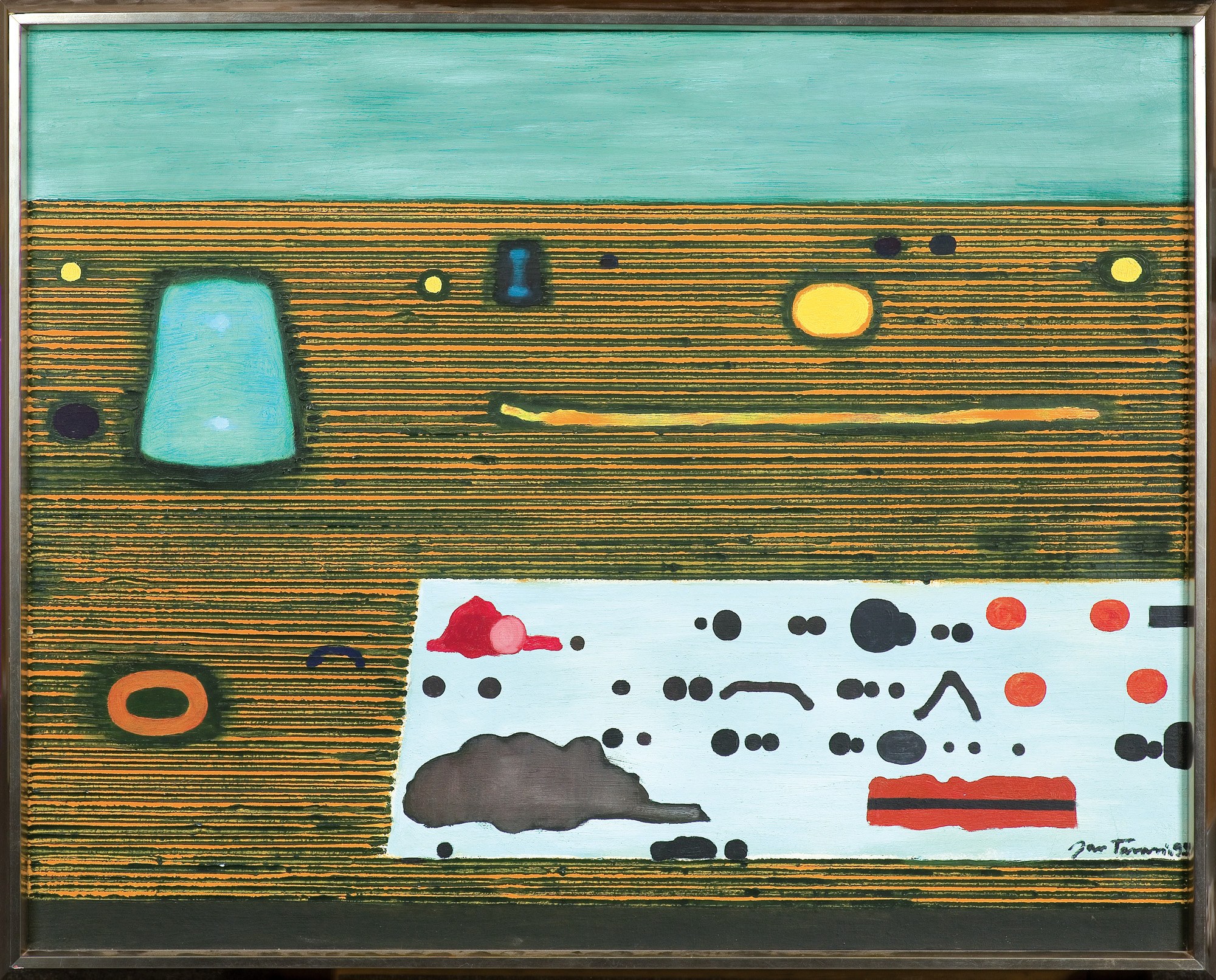
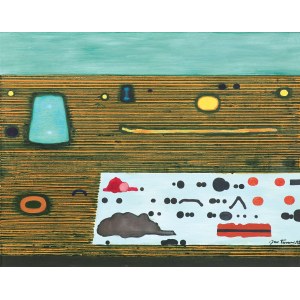
73 x 92 cm - oil on canvas
signed lower right: Jan Tarasin 95
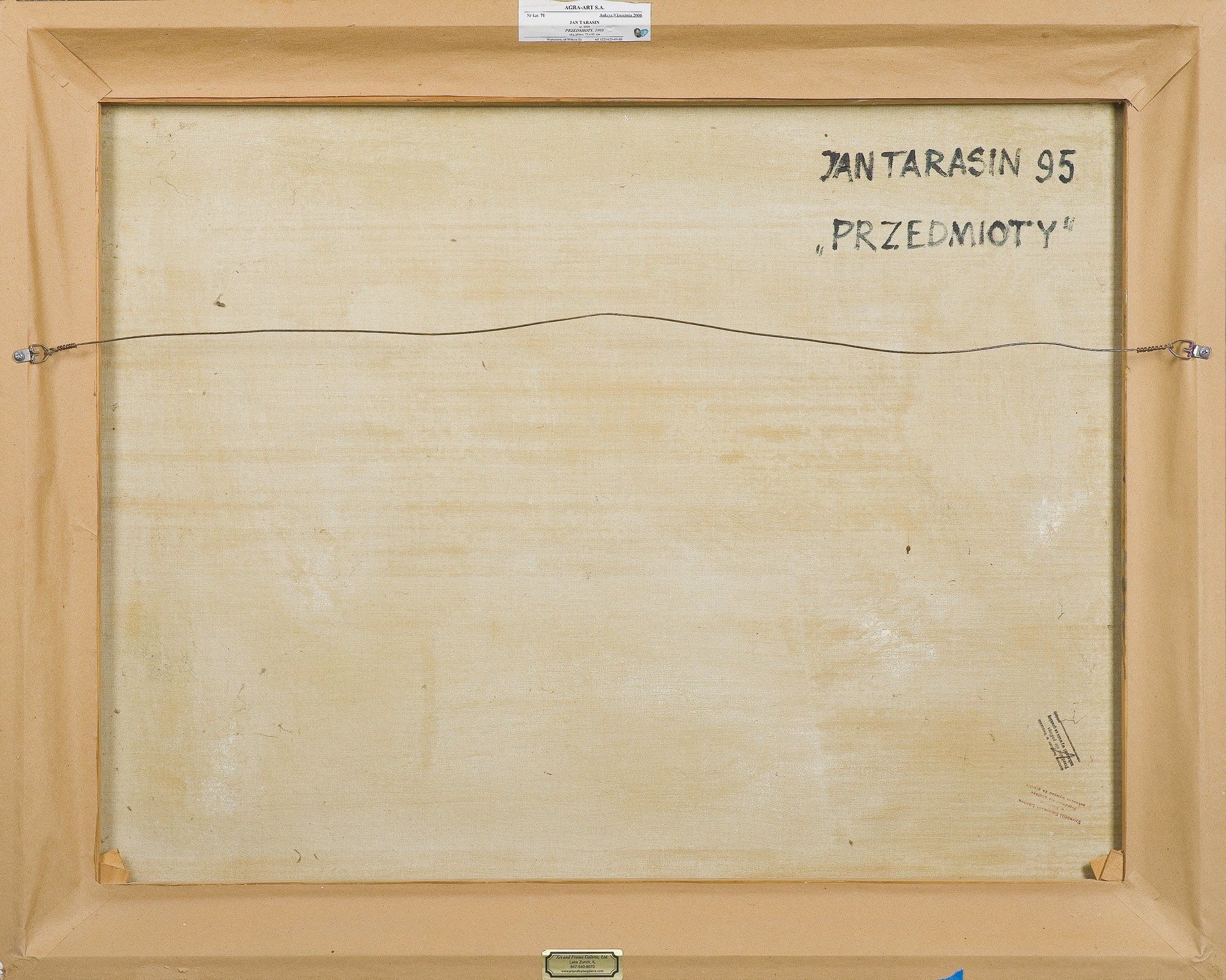
On the reverse side, on the canvas: JAN TARASIN 95 | “OBJECTS,” along with an oblong stamp from the Provincial Conservator of Monuments and an export stamp.
Throughout nearly his entire career, Jan Tarasin consistently explored the relationships between a real object and its painterly synthesis—the sign. As he himself used to say, he was interested in “a certain type of objectivity taken to the extreme of abstraction.” In the 1995 painting *Objects*, Tarasin abandons classical convergent perspective in favor of a striped, rhythmic arrangement of planes. The space of the canvas is divided into zones: the upper part is dominated by a flat patch of cool blue; the center is filled with a textured, brownish-gold plane densely covered with horizontal grooves, into which simplified signs have been incorporated. In the lower part of the composition, the artist has placed a white “section”—characteristic of his work and resembling a card, a tabletop, or a game board—on which he has meticulously arranged black, red, and gray dots, dashes, and amorphous patches.
Despite using abstract symbols, Jan Tarasin often referred in his paintings to forms associated with landscapes or still lifes. In a conversation with Elżbieta Dzikowska, the artist spoke about his inspirations drawn from nature, emphasizing that this was not simply a matter of being inspired by nature’s external aesthetics: “I am interested in living nature and the mechanisms it employs. Nature creates different things from the same materials. Movement and dynamism are important in my paintings; I am excited by the interplay of the infinite possibilities that nature creates. A brilliant synthesis is rare, as it can degenerate into a lifeless formula or stylization. (...) Signs unfold, scatter… I’m interested not so much in their shapes as in what happens between them. (...) I have learned to look intently at everything around me. These are my ways of dealing with myself, with my own imagination (Elżbieta Dzikowska, Jan Tarasin. Ways of Dealing with Oneself, in: Polish Artists in the World of Art. Conversations with Elżbieta Dzikowska, Rosikon Press 2005, p. 290).
♣ Droit de suite: ♣ An additional fee will be added to the Purchase Price, resulting from the right of the artist and his heirs to receive remuneration in accordance with the Act of February 4, 1994, on Copyright and Related Rights (droit de suite).
Jan Tarasin (Kalisz, September 11, 1926 – Warsaw, August 8, 2009) studied painting at the Academy of Fine Arts in Kraków under the guidance of Prof. Zbigniew Pronaszka (1946–1951). While still a student, he made his debut at the First Exhibition of Modern Art in Kraków in 1948–49. In the mid-1950s, he created a series of lithographs: “Nowa Huta and Its Residents,” 1954, “Home,” 1955). In the former, he challenged the official optimism; in the latter, using the symbolism of still life, he incorporated existential themes and references to the recent tragedy of war. After 1956, he began painting non-figurative works. The artist arranged isolated elements (referred to as “objects”) on a plane (the series “Interior,” 1957) or in an allusive space (the series “Feast,” 1957, “The Shore,” 1962–1964, “Counted Objects,” from 1968, and “Antiquarian Shop,” 1968). This principle persisted in his painting in subsequent years; the differences between creative periods concern the manner in which the “objects” are rendered and their placement within the pictorial space or in relation to the background. Since the 1970s, the “objects” have evolved into graphic, usually black symbols on light backgrounds (the “Kolekcja” series, from 1971). The backgrounds, in turn, are sometimes illusively three-dimensional, varied in tone, and soft. In the 1990s, the artist returned to a colorful, more painterly approach to both the symbols and the backgrounds, which are often dark or blend into the “objects” (the “Hatchery of Objects” series, 1992). Tarasin has been a member of the “Krakow Group” since 1962. From 1963 to 1967, he taught at the Department of Interior Architecture at the Academy of Fine Arts in Kraków. In 1967, he moved to Warsaw, and in 1974, he began teaching at the Department of Painting at the Academy of Fine Arts in Warsaw. From 1987 to 1990, he served as rector of the academy. In 1976, he received the Cyprian Kamil Norwid Art Critics’ Award, and in 1984, the Jan Cybis Award; Award at the San Marino Art Biennale in 1965. Alongside painting, he engaged in drawing and printmaking—lithography until the 1960s and silkscreen printing from 1974 onward. From 1974 to 1981, he published eight self-produced “Notebooks” featuring silkscreen prints and his own texts. In 1995, the Zachęta Gallery hosted an exhibition of the artist’s work, accompanied by a monographic catalog.













Laatst bekeken
Log in om de kavellijst in te zien
Favorieten
Log in om de kavellijst in te zien