


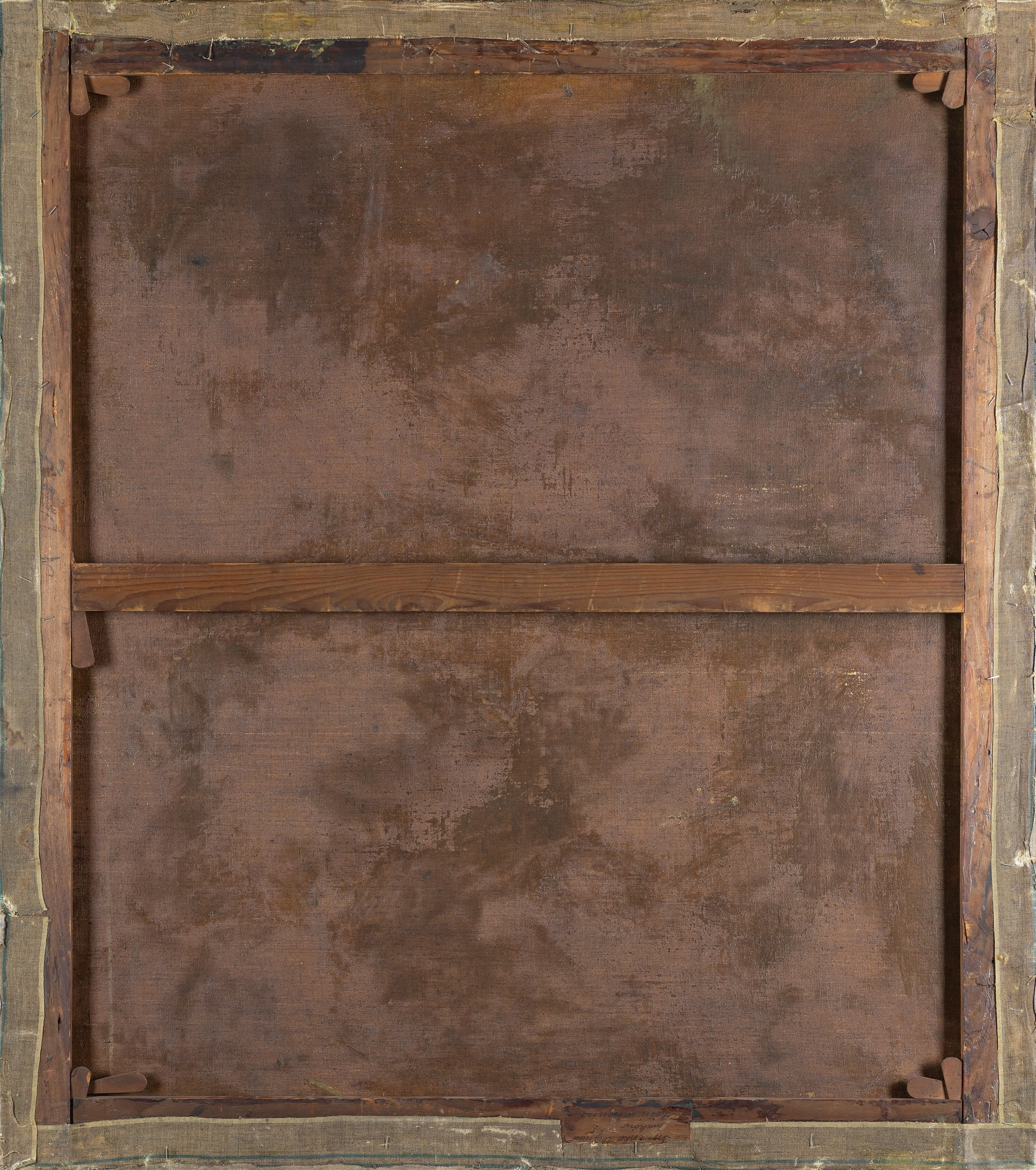
107,5 x 95,5cm - oil, doubled canvas
On the lower strip of the painting loom opposite to the direction of the composition, partially removed sticker of TPSP in Krakow (print, black ink): Author Pronaszko Zbigniew | Address Cracow | Work Spring Song.
Image exhibited and mentioned:
- Report of the Directorate of the TPSP in Cracow on Activities for the Year 1909, Cracow 1910, p. 19;
- A. Wierzbicka, Zbigniew Pronaszko, Słownik artystów polskich i obcych w Polsce działających. Painters, Sculptors, Architects, Volume 7, Warsaw 2003, Institute of Art of the Polish Academy of Sciences, Warsaw, p. 41.
Spring Song comes from the early, pre-formist period of Zbigniew Pronaszko's work. The work presents a deeply symbolic vision, which is part of the Young Poland trend and draws on ancient tradition and Slavic mythology, with the main themes of love, art and rebirth. The scene is set in a birch grove, which symbolizes spring - a time of awakening life, fertility and renewal; in Slavic mythology, the birch is a symbol of strength, nature, health and femininity. The naked figures of a man and a woman represent the primordial state of nature and the purity of the relationship, free from the constraints of civilization. The figure of a man with a wreath on his head and a flute alludes to Faun, a forest deity, personifying the wild, fertile side of nature and sensual music. The Spring Song is thus a song sung by nature itself, of which the man is the messenger. The woman is his Echo or Nymph - waiting for the music, ready to receive the life energy. The painting is filled with a mood of contemplative tranquility. There is no violent expression, instead there is a silence that precedes the music. The man is focused on creation, on making a sound to bring the world to life. He represents the active, creative force of spring. The woman's gaze directed at the man is full of attention, symbolizing readiness to receive love, life and beauty.
The soft modeling of the bodies and the light, harmonious color palette - beiges, olive greens - emphasize the idyllic, dreamlike character of the scene. The painting is a visual hymn to the harmony between man and the cycle of nature and creation and art. It is a painterly meditation on eros, vitality and the return of life, expressed through archetypal figures of forest deities and symbolic scenery, representing a joyful welcome to spring. It is worth relating this work to Autumn (Painted Leaves, ca. 1910), a well-known canvas by Pronaszko, exhibited at Agra-Art in 2007. Both paintings share a similar treatment of color, light and matter. The pastel, cool color palette, soft modeling of forms and muted dramaturgy of space situate these works in the aesthetics of new nature.
Spring Song also has a notable documentary value - as a testimony to a transitional moment in the artist's work, in which modernist sensibility was already clearly present, but the formist analysis of construction had not yet been fully developed. The work remains a rare example of this period of painting by Zbigniew Pronaszko, one of Jacek Malczewski's best-known disciples.
♣ A fee will be added to the auctioned price, in addition to other costs, based on the right of the artist and his heirs to receive remuneration in accordance with the Law of February 4, 1994 - on Copyright and Related Rights (droit de suite).
Zbigniew Pronaszko (Derebczyn near Yampol (Zychlin in Podolia ?) 1885 - Krakow 1958) - painter, graphic artist, sculptor and stage designer - began his artistic studies in Kyiv, from where he soon moved to Krakow to study with Teodor Axentowicz and Jacek Malczewski at the local Academy of Fine Arts from 1906 to 1911. During his studies he traveled to Vienna, Munich, Florence and Paris. He spent the years of World War I in Zakopane. In 1917 he was a co-founder of the Polish Expressionist group (renamed Formists in 1919). After the war, from 1923 to 1925, he taught at the Faculty of Fine Arts of Stefan Batory University in Vilnius. He then lived in Cracow, teaching at the Free School of Painting of L. Mehofferowa, and from 1945 also at the Academy of Fine Arts. He painted landscapes, still lifes, figural compositions and portraits. In his early period, influenced by Jacek Malczewski, he created symbolist compositions, such as Brzemię, Pan, Złoty cielec, Bajka o śmierci (National Museum in Warsaw) or Wspomnienie and Portret matki (National Museum in Krakow), which are well known from their titles in catalogs. In his later, formist period, he drew inspiration from Cezane painting, Cubism and Polish folk art. Around 1925 he became interested in Colorism. In addition to easel painting, he was involved in stage design, sculpture (monument to A. Mickiewicz in Vilnius, 1922-24) and wall painting (Wawel plafonds, 1933-1934). He was an accomplished caricaturist, as well as an illustrator. He exhibited from 1907; including in Krakow, Lviv, Warsaw, Poznan and also in Pittsburgh (1931), Venice (1932), Paris (1922, 1928, 1937) and Vienna (1928), Brussels (1935). He was a member of the Society. Polish artists "Art" and participated in its exhibitions. He also exhibited with the groups "Zero" (1909), "New Generation" (1932), and belonged to the "Zwornik" group.













Laatst bekeken
Log in om de kavellijst in te zien
Favorieten
Log in om de kavellijst in te zien