


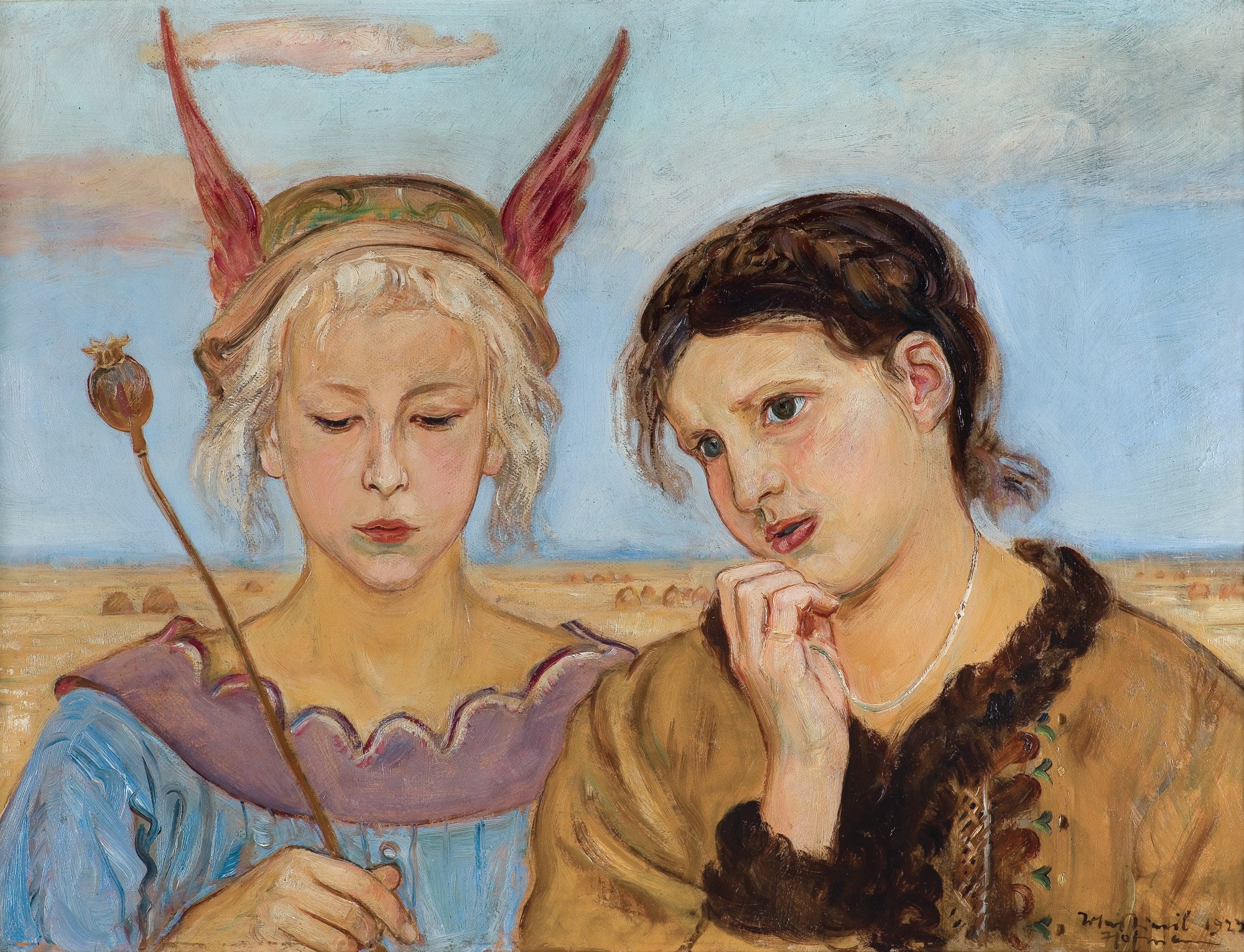
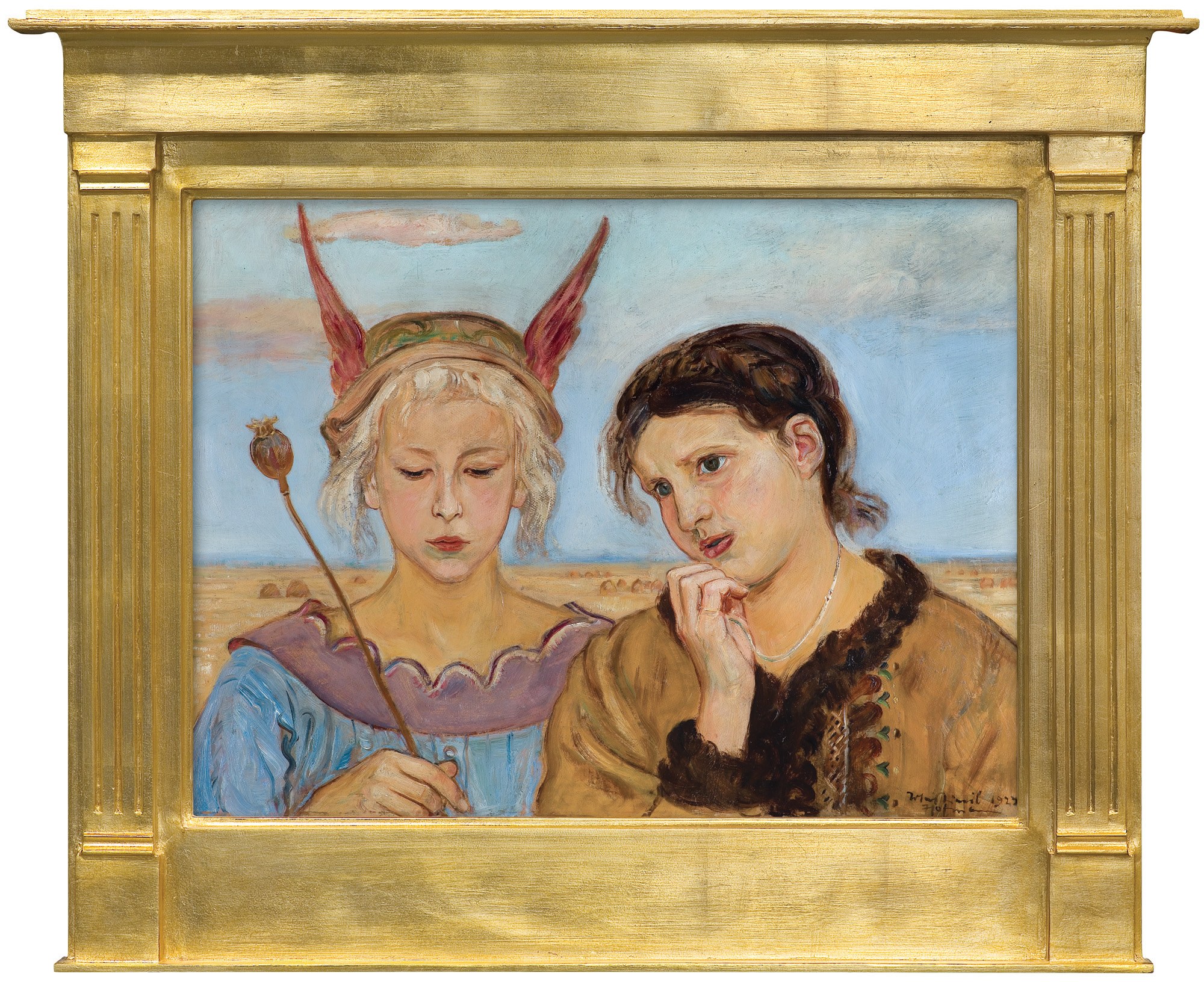
49.2 x 65.4 cm - oil on cardboard
signed lower right: Wlastimil 1923 | Hofman
On the reverse, lower left, an illegible inscription in pencil.
This painting dates from the artist’s early, most creative period. The influence of Jacek Malczewski’s Symbolist painting is clearly evident in it. Hofman, however, developed his own, easily recognizable artistic language, in which everyday life intertwines with poetry, religion, folk tradition, and reflections on the human condition. He was particularly fond of using motifs drawn from the lives of ordinary people. The countryside, its inhabitants—children, the elderly, or travelers—depicted in everyday situations, become in his paintings the protagonists of stories about universal themes. A seemingly simple scene could be transformed by him into an allegory rich in meaning.
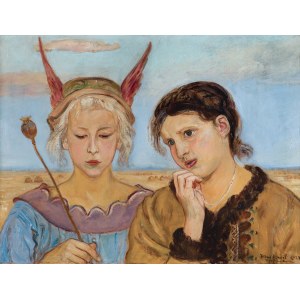
*Into Adulthood* is an excellent example of the idyllic-symbolic composition characteristic of his work, in which the everyday world subtly intertwines with mythological elements. The models have calm, pensive faces, and their gazes seem to reach beyond the reality surrounding them. A girl in a sheepskin coat adorned with folk embroidery is accompanied by a fair-haired, fantastical figure with wings and a poppy head in her hand. Through the figure of the winged maiden, the artist evokes the mythological Hermes—the god of travel and transition, messenger of the gods, and guide. Her presence suggests crossing the boundaries between different worlds and stages of life. She can be interpreted as a symbol of guidance and companionship for a person at a moment of significant life transition. The poppy head, on the other hand, may evoke associations with sleep, peace, and solace. In this context, the poppy motif takes on special significance—it may symbolize stillness, but also a moment of pause before entering a new stage of life.
Given the rural girl’s age, Hermes can thus be interpreted as a guide leading her toward the unknown, across the symbolic boundary between the world of childhood and adulthood. However, this does not necessarily mean a definitive farewell to carefree days. On the contrary, the scene can be understood as a peaceful and natural transition toward new experiences, knowledge, and independence. In this context, the poppy may symbolize the gentle fading of childhood memories, while preserving them as an important part of her own history. The girl thus sets out into adulthood not alone—she is accompanied by a symbolic guide, and with him comes the hope of discovering a new world and beginning the next stage of her life.
Vlastimil Hofman / Vlastimil Hofmann (Prague 1881 – Szklarska Poręba 1970) studied at the Kraków School of Fine Arts—initially under Florian Cynk, and later also under Jan Stanisławski, Leon Wyczółkowski, and Jacek Malczewski. From 1899 to 1902, he also studied under Jean Léon Gérôme at the École des Beaux-Arts in Paris. During World War I, he stayed in Prague and Paris; from 1920 onward, he lived permanently in Kraków. He exhibited frequently and belonged to numerous artistic associations—he was a co-founder of the “Group of Five” (1905) and the “Group Zero” (1908), a member of the Czech Artists’ Union “Manes,” and, from 1911, a member of the Polish Artists’ Society “Sztuka.” During World War II, he made his way to Jerusalem via the USSR and Turkey, from where he returned to Kraków in 1946. From 1947 onward, he lived permanently in Szklarska Poręba. Hofman primarily painted fantastical and symbolic compositions with folk motifs, as well as genre scenes, portraits, and landscapes. Despite close analogies and connections to Malczewski’s art, his paintings are always distinguished by their individual character, style, and mood.













Laatst bekeken
Log in om de kavellijst in te zien
Favorieten
Log in om de kavellijst in te zien