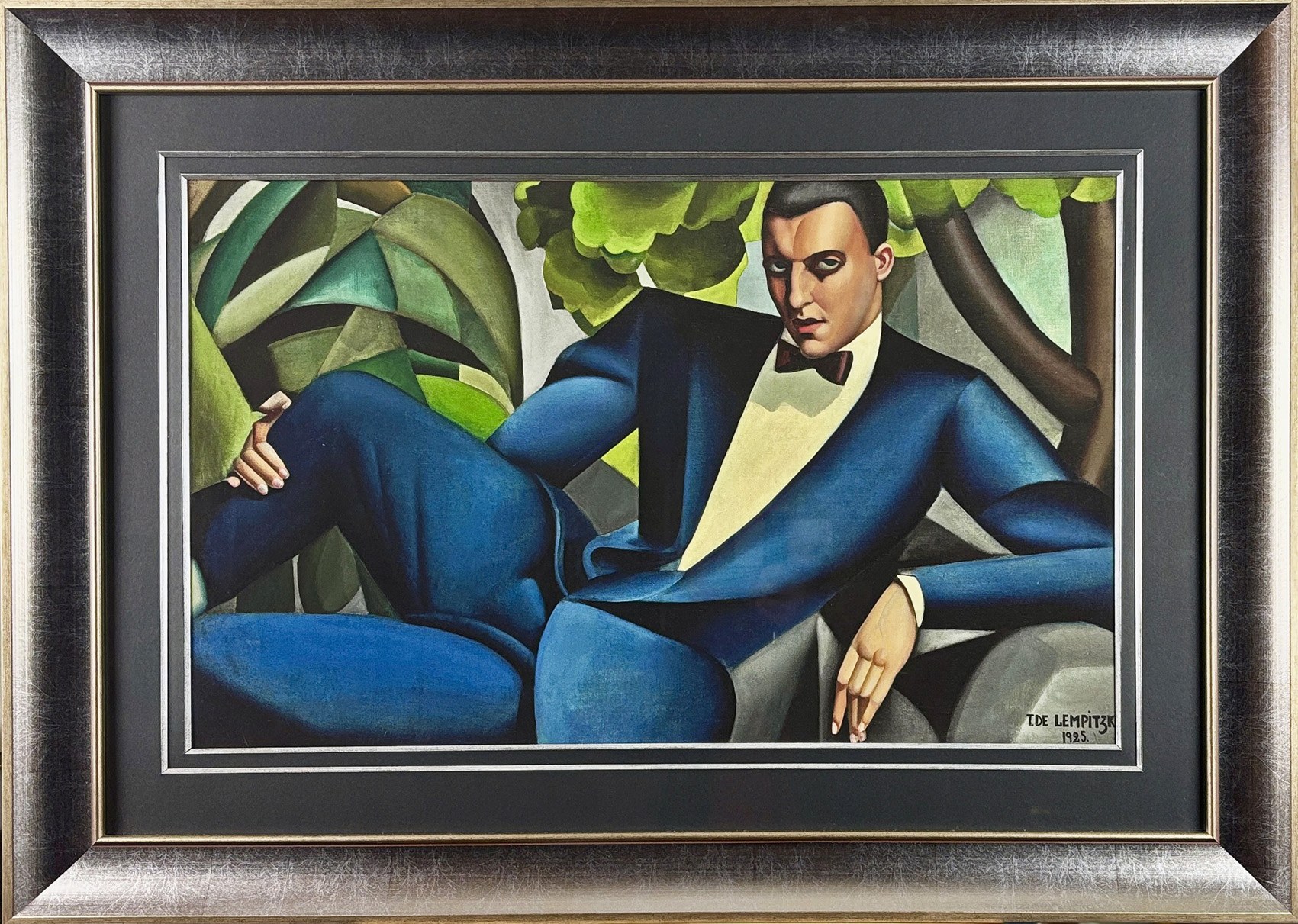

Giclee, Arches velin paper, 65 x 91 cm, framed in frame and double passe - partout with gold slips ;
signed from plate p.d. "DE LEMPICKA 1925".
Publisher - Felix Rosenstiel's Widow & Son.
References - A. Blondel, Tamara de Lempicka, Catalogue raisonné, 1921-1979, Lausanne, 1999, no. B.93, illustration p. 171
Tamara de Lempicka was a Polish-born painter known for her distinctive Art Deco style, which combined elements of Cubism and Neoclassicism with a modern sensibility. She gained notoriety in the 1920s and 1930s, particularly in Paris, where she became part of bohemian and aristocratic circles. Lempicka's works are characterized by elegant lines, bold forms and a focus on glamour, luxury and sensuality, making her one of the most iconic artists of the Art Deco movement.
Her paintings often feature elegant, stylized portraits of wealthy and fashionable people, as well as nude figures executed with a high gloss, almost sculptural quality. Lempicka's characters, mostly women, are portrayed with strength and sensuality, which helped her gain recognition at a time when female artists were often marginalized. Her work epitomized the wealth and hedonism of the interwar period, and she earned the nickname "Baroness with a Paintbrush" due to her aristocratic connections and lavish lifestyle.
Marquis Guido Sommi Picenardi was an Italian aristocrat, an extremely educated man, a literary man and a well-known dandy at the time. Lempicka depicted him in an extremely modern way for those years - the marquis has heavily emphasized, almost makeup eyes, which gives him the appearance of a "fallen angel" or a silent movie hero. His pose is impish, but full of pride and masculine magnetism.
The relationship between Tamara and the Marquis Sommi was multifaceted and typical of the artist's tumultuous life in 1920s Paris: the Marquis Sommi was one of Tamara's lovers. Their romance was fiery and set in the world of international socialite, whom they both adored. For Lempicka, he was the epitome of the modern man of that era - elegant, somewhat decadent and aware of his attractiveness.
Thanks to her acquaintances with such figures as Sommi, Lempicka (who came from Poland as an émigré) instantly established herself as a "portraitist of the elite."
Literature:
T. de Lempicka, Annotated Photo Albums, Houston, 1923, no. 63 (illustrated).
K. de Lempicka-Foxhall & C.L. Phillips, Passion by Design, the Arts and Times of Tamara de Lempicka, New York, 1987.
E. Thormann, Tamara de Lempicka, Kunstkritik und Künstlerinnen in Paris, Berlin, 1993, no. 59.
Catalog of the retrospective exhibition Tamara de Lempicka / Tra eleganza e trasgressione (Villa Medici, Rome 1994).