


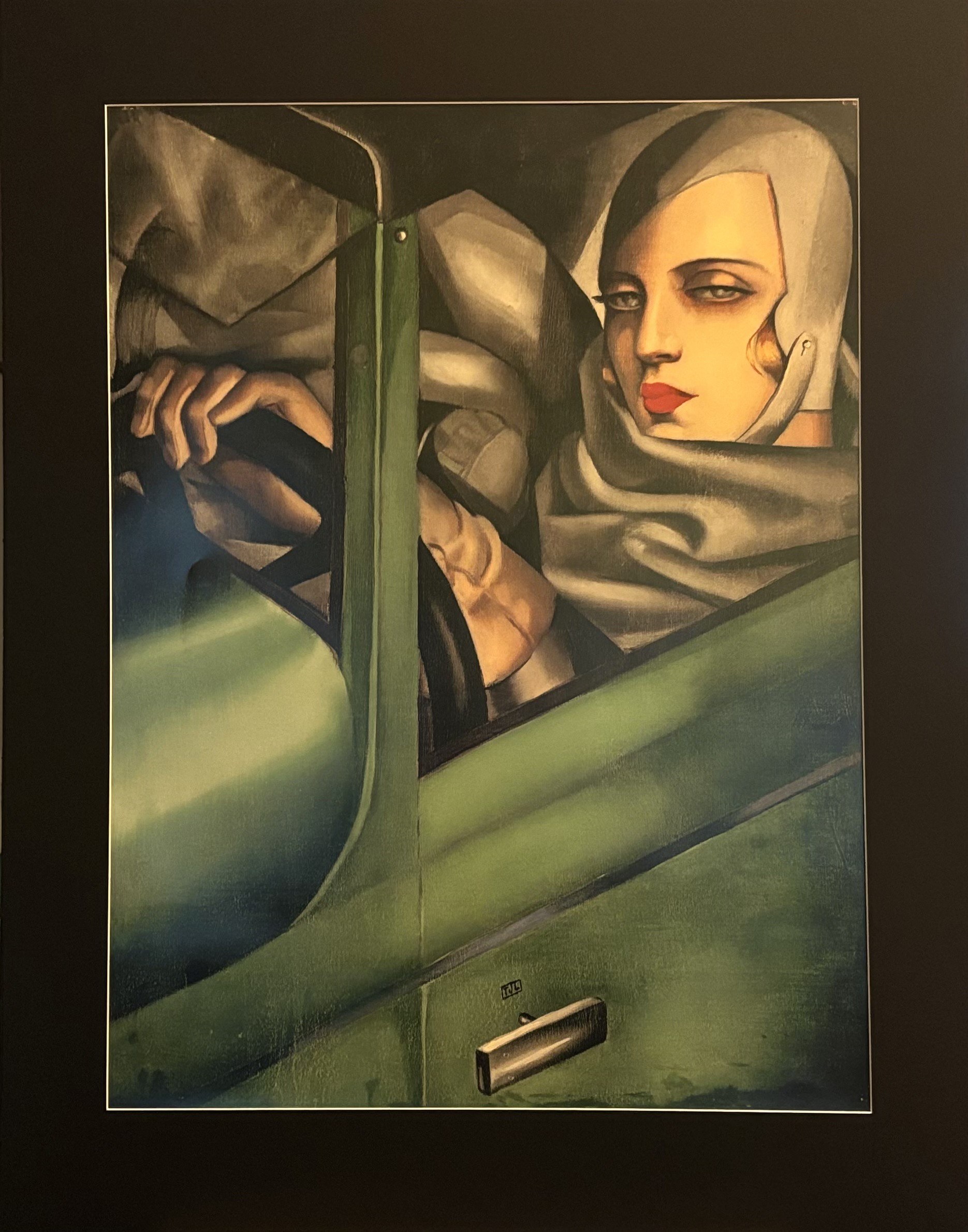
Offset lithograph, heavy satin paper, 78x58cmpasse-partout , 85x65cm framed published in Italy (2015) under license of Victoria de Lempicka.
Lempicka painted herself behind the wheel of a sports car. Regular facial features, alabaster complexion and statuesque profile make the artist resemble ancient Greek sculptures. Such an association is reinforced by the accumulation of bright, almost monochromatic, elements: a flesh-colored glove, a small gray-beige helmet-pilot and a disheveled scarf of the same color encircling the painter's neck. The lower part of the canvas is occupied by a fragment of a shiny car body. Above the handle one can see the artist's signature stylized as a modern, geometrized logo. Enclosed in a rectangle, the letters TJL are the abbreviated signatureTamara Junosza Lempicka.
By depicting herself precisely in a car - a fast, elegant, modern vehicle - Lempicka was clearly referring to Futurism, for which a fascination with speed, technology or urban life was typical. It is possible that Lempicka was inspired by André Kertész's photograph from 1927, in which the Hungarian photographer immortalized a young woman in a pilot, driving a sports car. Thus, the motif in Lempicka's painting, on the one hand, is part of the cult of the machine, and on the other, presents the car as a tool for women's emancipation. A woman driving a car, especially in the 1920s, enters a male-dominated sphere. She is a modern-day amazon who has exchanged the horse for a mechanical means of transportation.
Tamara Lempicka (1898 Warsaw- 1980 Cuernavaca)World-renowned Polish artist, icon of art deco and the interwar period. She spent her early youth in Warsaw (where she was born), Switzerland (where she attended boarding school) and St. Petersburg (where she met her first husband Tadeusz Lempicki). During this period she became acquainted with Italy and with it Renaissance masters who were an inexhaustible source of inspiration. In 1918, she moved to Paris. In the French capital she began to study painting and discovered Cubism which became the flagship of her work. With the outbreak of World War II, she moved to the United States to then spend the rest of her life in Mexico. There she was also "buried", according to the artist's last will her ashes were scattered at the Popocatepetl volcano.
"I painted kings and prostitutes. I paint those who are inspiring to me and make me feel vibrations."










