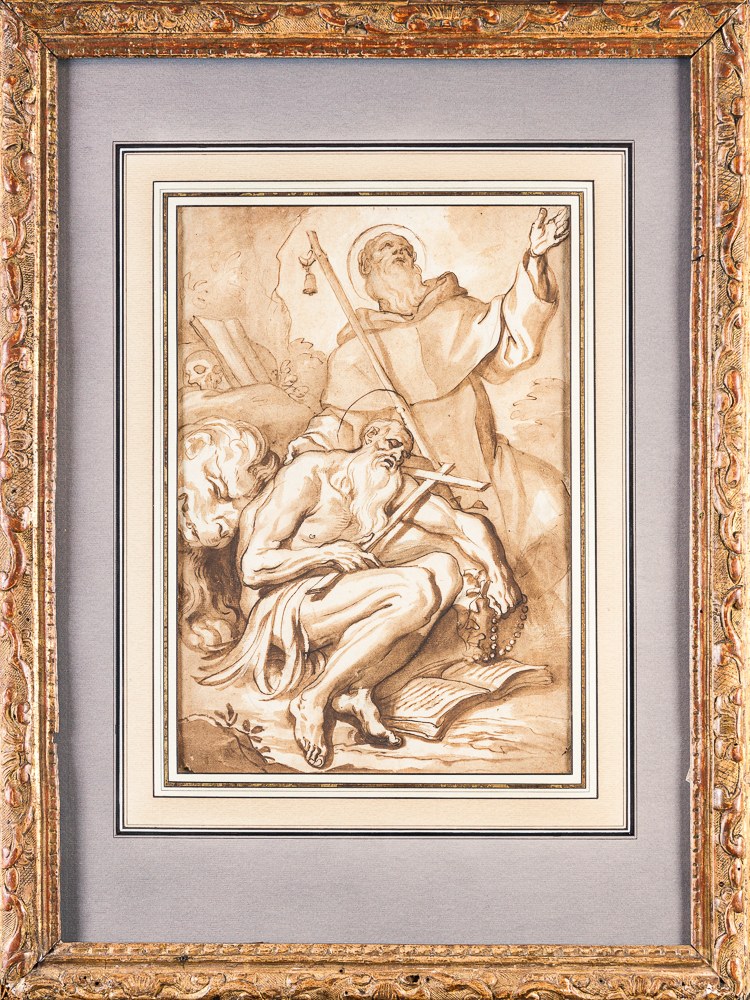
pen and brown ink drawing lavaged on black chalk / handmade paper
63 x 24,6 cm
43 x 32 cm in light passe-partout
37.5 x 33.4 cm dimension with frame
Original period frame
Certificate of authenticity issued by an antique shop in Paris
Domenico Piola (1627-1703 )
Italian painter of the late Baroque era, leading artist of Genoa of the second half of the 17th century. He left behind frescoes in many of his hometown's churches and palaces, as well as a substantial collection of drawings (over 4,000).
Domenico Piola at the age of 7 learned painting from his brother. He was formed as an artist in his family environment, but soon came under the influence of Valeria Castello, Rubens and Giovanni Benedetto Castiglione, through whom he developed his own fully Baroque artistic language.
He reached artistic maturity around 1650. Working almost exclusively in his native Genoa, he is counted among the most important and influential artists active in Liguria in the second half of the 17th century. He was a leading member of a local artistic dynasty and one of the most sought-after painters of frescoes in his hometown, adorning numerous churches (Santissima Annunziata, Santa Maria delle Vigne, San Siro, San Luca) and palaces and others) of his hometown and palaces (Rosso, De Mari, Sauli, Negrone, Balbi, Palazzo Pantaleo Spinola). Domenico Piola occasionally collaborated with Valerio Castello (in the churches of Santa Maria della Passione and Santa Marta), and later often worked with his son-in-law Gregorio De Ferrari. He also collaborated with his brother-in-law Stefano Camogli, painting flowers, fruits, foliage and arabesques. In the 1670s and 1780s he reached the peak of his activity as a fresco painter (San Luca Church, a series of allegorical frescoes Autumn and Winter on the vaults of Palazzo Rosso, executed between 1687 and 1688). At the height of his activity, Piola became the undisputed leader of the Genoese school, heading his large studio, known as Casa Piola, which included his three sons Paolo Gerolamo, Giovanni Battista and Anton Maria. His works, and the significant output of his studio, continued to exert a dominant influence on artistic activity in Genoa for many years after his death as well. After 1685, he left with his sons Anton Maria and Paolo Girolamo for Milan, and later for Bologna, Piacenza and Asti.
Domenic Pioli's oil paintings are eclectic, with reminiscences of Correggio and Castiglione. His works are characterized by extraordinary simplicity of composition, idyllic concepts, perfect knowledge of craftsmanship and excellent stylistic form. Among his sons, only Paolo Girolamo stood out. Antonio Maria imitated his father's style by being a skilled copyist.
Domenico Piola was also one of the most active Genoese draftsmen of the 17th century. Although many of his drawings were destroyed during a fire in his studio caused by the bombardment of the city by the French in 1684, the number of those preserved exceeds 4,000. A large and representative collection of drawings by Pioli and his circle, from the collection of the Genoese diplomat Jacop Durazz, is now at the Staatsgalerie in Stuttgart, and another important collection is at the Palazzo Rosso.