


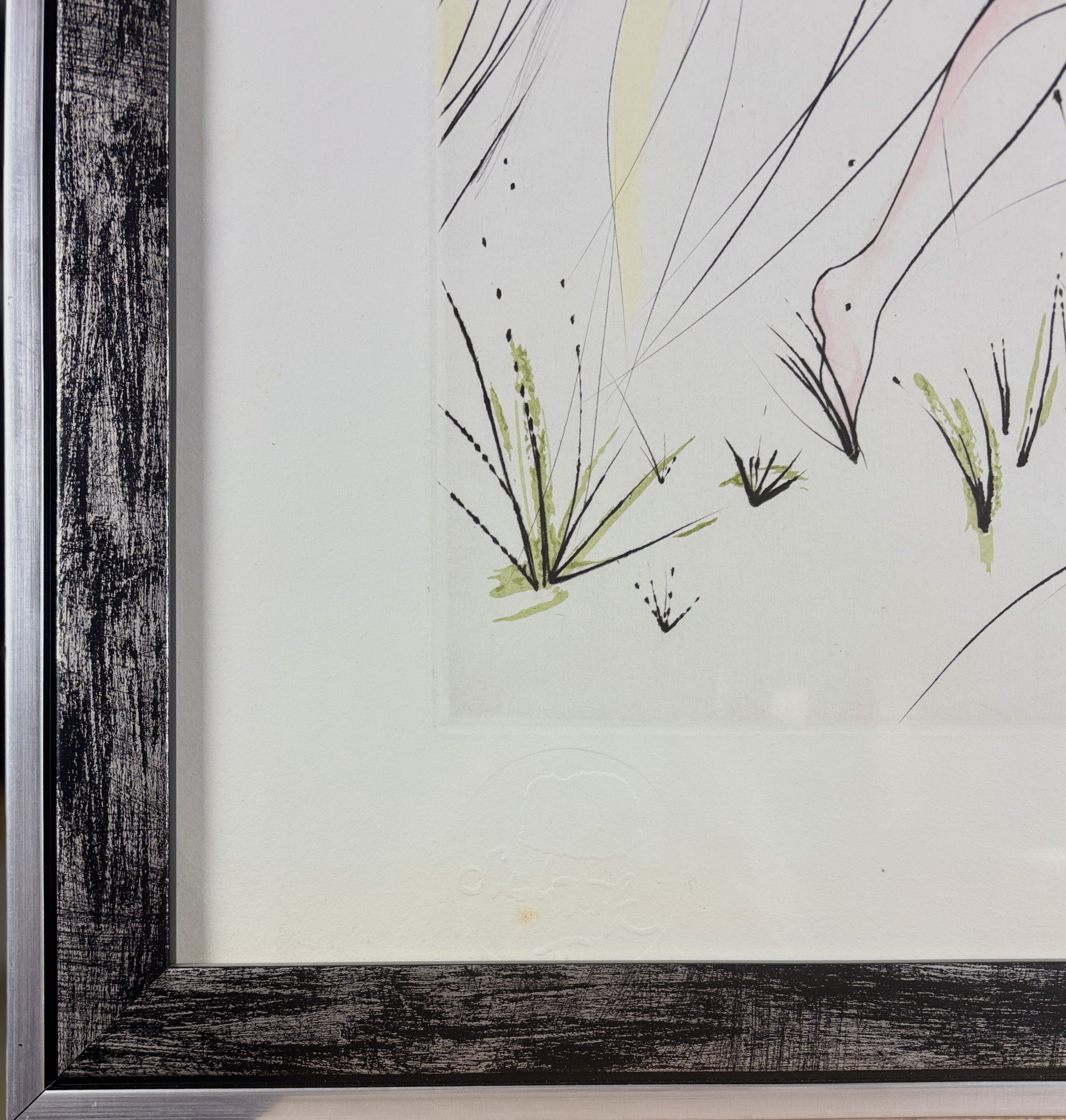
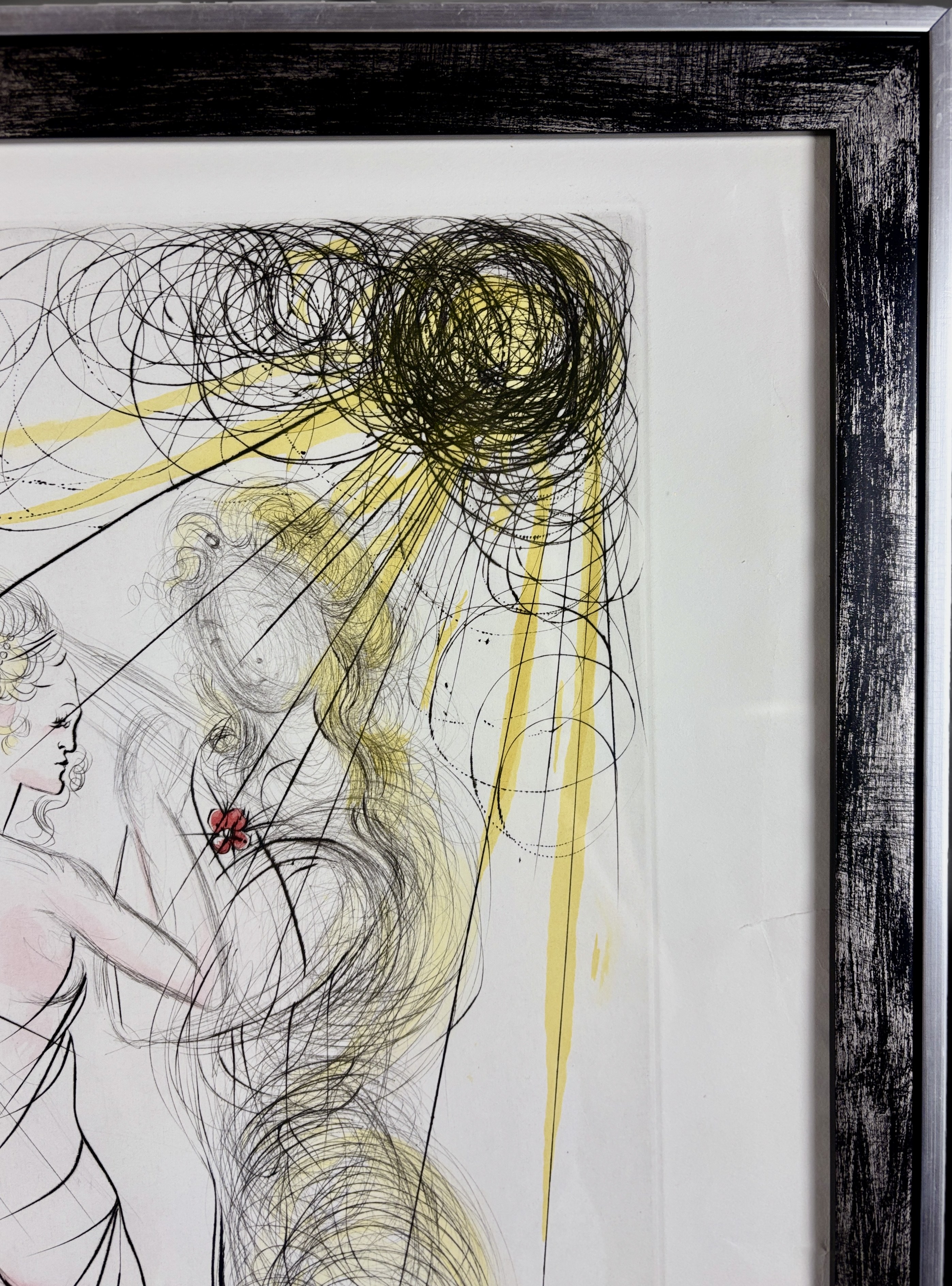
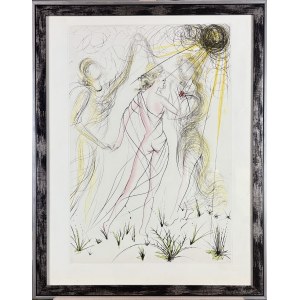
Drypoint, etching, and pochoir on B.F.K. Rives paper,
Dimensions: print 58 × 39 cm; mounted in a frame measuring 72 × 56 cm;
A workshop piece from the studio of Maurice Beaufumé,(Maurice Beaufumé was an outstanding French master of the artistic crafts from the Atelier Rigal Paris, who became world-renowned for his mastery of the traditional hand-stencil technique known as pochoir.
Unsigned by the artist; a blindstamp featuring a tree motif and the signature “S. Dali” is visible in the lower margin.
The prints were published by Vision Nouvelle in Paris, and their production was entrusted to Atelier Rigal
Provenance: the personal collection of Maurice Beaufumé, subsequently passed down by inheritance.
References:
-Salvador Dalí: Catalogue Raisonné of Lithographs and Wood Engravings 1956–1980 by Ralf Michler and W. Lopsinger: No. 486
-The Official Catalog of the Graphic Works of Salvador Dalí by Albert Field, 71-8-F
A workshop piece associated with the studio of Maurice Beaufumé and Atelier Rigal, bearing a distinctive dry-stamped tree motif and the signature “S. Dali.”
Contemporary auction descriptions of pieces from his estate explicitly refer to them as: planche issue de l’atelier de Maurice Beaufumé.
This is a workshop proof—a piece left in the studio as part of the color preparation process on which Salvador Dalí and Maurice Beaufumé worked together.
“Suite mythologique nouvelle” (“New Mythological Suite”) is a series of 12 prints by Salvador Dalí from 1971, created using drypoint and etching techniques and subsequently colored with pochoir
In this series, Dalí draws on Greco-Roman mythology but interprets it in his characteristic surrealist manner, combining classical figures with fantastical, often erotic visions. At the same time, the series is a dialogue with the great tradition of European art—Dalí references the works and motifs of the old masters, transforming them into a modern, surrealist language.
It is worth noting that the series is particularly interesting from a technical standpoint: the delicate lines of the drypoint technique are complemented by hand-applied color with a stump, thanks to which each composition retains the character of a drawing while gaining a subtle, almost watercolor-like color palette.










Laatst bekeken
Log in om de kavellijst in te zien
Favorieten
Log in om de kavellijst in te zien