


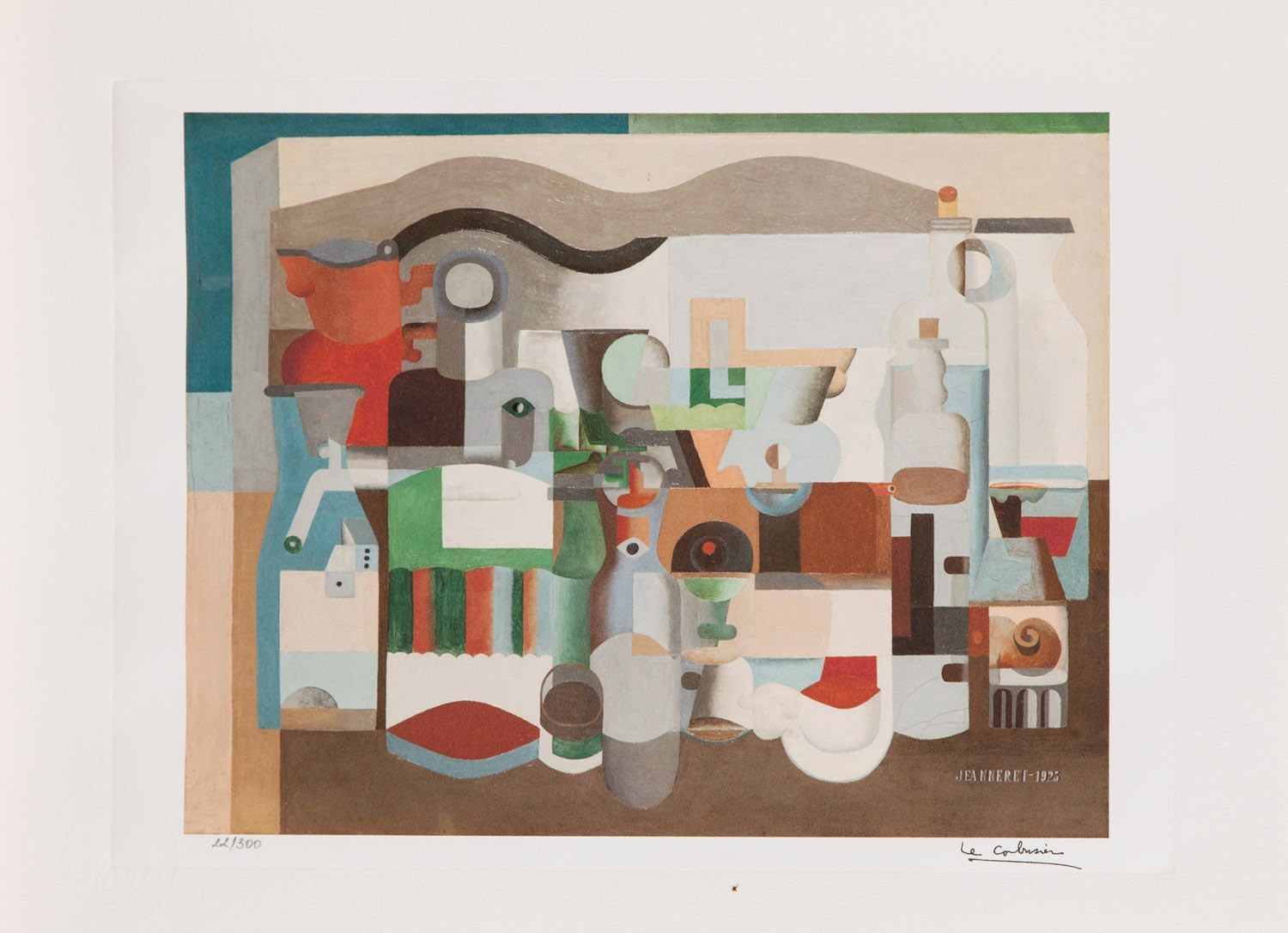
color heliogravure, heavyweight vellum paper, 23 x 31 (plate imprint), 28 x 38 (sheet), numbered in pencil 22/300, signed from plate under composition "Le Corbusier", dry publisher's stamp l.d. : letter K surrounded by the words "EDITION LIMITED CERTIFIED ARTS USA EUROPE SINCE 1998".
Heliogravure, widespread in the 19th century, was later supplanted by rotogravure, as heliogravure is an expensive and very time-consuming method. Nowadays it is sometimes used in fine art printmaking. Plates obtained by the heliogravure technique can be supplemented by other methods of intaglio printing techniques. Occasionally, this technique is also used in the reproduction of works of art, when it is necessary to create a small number of copies of very high quality.
Le Corbusier, actually Charles-Édouard Jeanneret-Gris, was not only an outstanding painter, but also an architect and urban planner who had a great influence on the development of modern architecture. He made his debut in painting in 1917, when Le Corbusier, still called Charles-Edouard Jeanneret, met the artist Amédée Ozenfant and founded Purism with him. Their favorite genre would be still life, everyday objects geometrized in flat areas of color. He devoted several hours a day to painting and from 1917 to 1965 created more than 450 paintings. He was in contact with many artists: Fernand Léger, Pablo Picasso, Juan Gris and André Bauchant, and he reiterated to everyone that "it was in the practice of plastic arts that I found the intellectual juice of my urbanism and my architecture."
His 1923 painting "Nature morte aux nombreux objets" is an oil on canvas signed and dated in the lower right corner as Jeanneret 1923. This painting, also known as "Still Life with Numerous Objects," is an example of Le Corbusier's early work that shows his interest in Cubism and tendency toward abstraction. During this period, Le Corbusier experimented with form and space, which was later reflected in his architectural designs.
"Nature morte aux nombreux objets" is kept at the Fondation Le Corbusier in Paris, an institution dedicated to preserving the artist's legacy and promoting his work. This work is part of a larger collection of Le Corbusier's works that includes both his paintings and architecture, demonstrating his versatility and influence on 20th century art.











Laatst bekeken
Log in om de kavellijst in te zien
Favorieten
Log in om de kavellijst in te zien