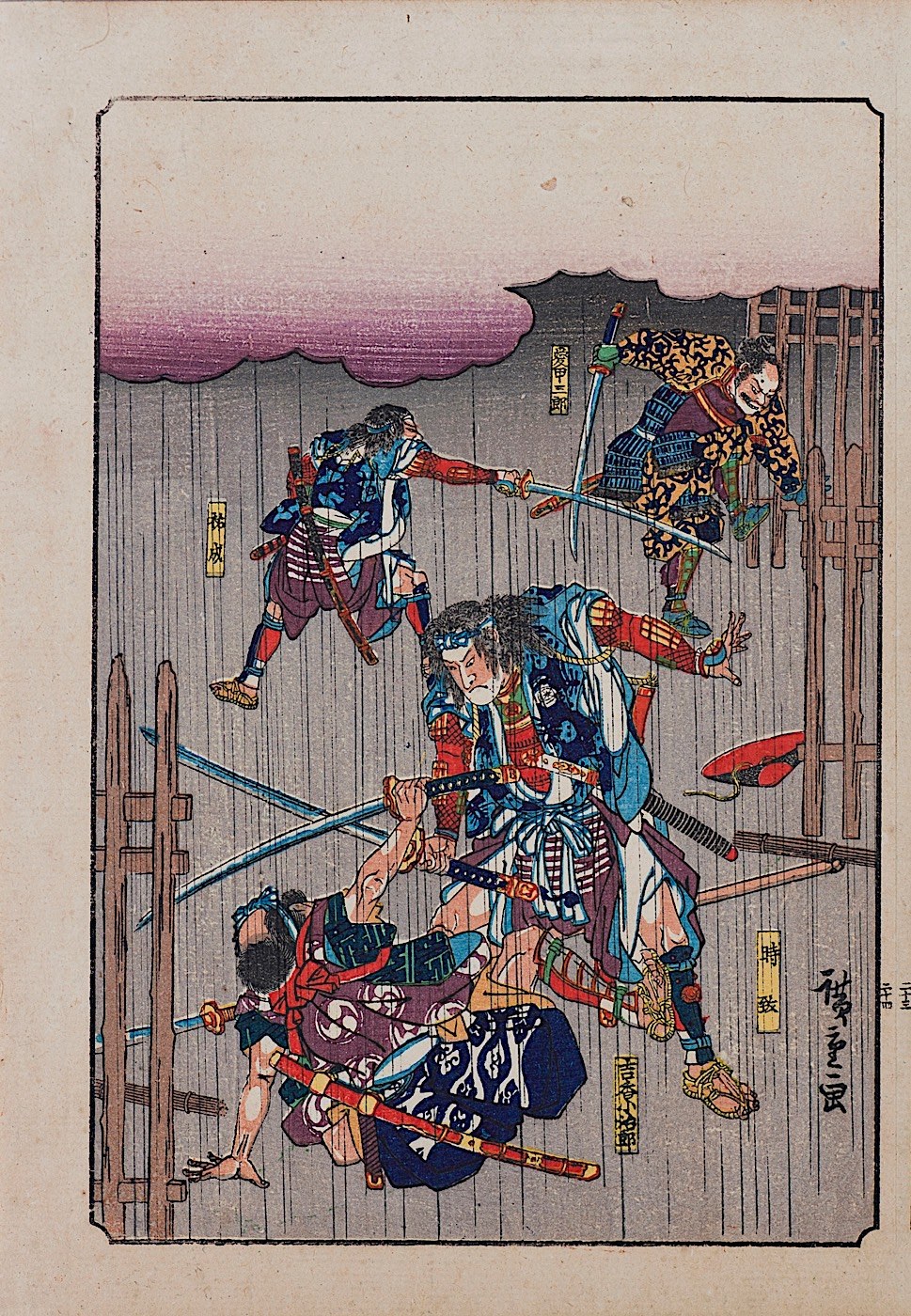
"Fighting in the rain with Yoritomo's vassals, Yoshika Kojirō and Aikō Saburō".
color woodcut, ink, paper, 24.5x16 cm (paper size)
Japanese woodcut series often draw inspiration from popular legends or historical events from Japanese history. One such motif is the story of the Soga brothers Juro and Goro. Between 1843 and 1847 , Ando Hiroshige created a series entitled "Soga Monogatari Zue," an illustrated tale of brothers seeking revenge for the death of their father. Amid tensions following the war, Ito clan member Kawazu Saburo Sukeyasu, who was allied with the Taira clan, died tragically at the hands of his cousin Kudo Suketsune in the Hakone Mountains. The exterminated Kawazu Sukeyasu left behind two small boys, Goro and Juro, aged three and five. Kawazu Sukeyasu's widow later remarried a man named Soga. As the two boys matured, their only goal became clear - to avenge their biological father. The opportunity for revenge came when Kudo Suketsune took part in a hunt organized by Shogun Yoritomo at the foot of Mount Fuji. In their quest for revenge, Juro and Goro killed Kudo Suketsune, but this led to Juro's death during the confrontation, while Goro, the younger brother, was captured and later executed. The story revolves around themes of honor and vendetta. Ultimately, the main characters end tragically, but the story emphasizes the restoration of "honor." This gripping tale was adapted into a kabuki play. Various versions have appeared over time, incorporating many side plots - an approach to storytelling reminiscent of another well-known kabuki play, Chushingura, also known as "Revenge of the 47 ronin." Created between 1843 and 1847, the series of woodcuts consists of 30 works and were inspired by the kabuki depictions prevalent during the Hiroshige era. During the Edo period (until 1868), printmakers primarily catered to the market demand of kabuki theaters. Historical accuracy receded into the background due to censorship regulations prohibiting the depiction of historical events. Consequently, Japanese woodcuts depicting historical scenes appeared mainly during the Meiji period (after 1868). Ando Hiroshige, known for his landscape prints, showed his expertise in this series by introducing landscape elements into many of his designs, despite the main emphasis on depicting figures. This unique combination of figures and landscapes adds to the charm of the series, making it particularly attractive to collectors and enthusiasts of Japanese art.
Hiroshige Andō, also known as Hiroshige Utagawa, is one of Japan's best-known painters and printmakers. His father, Andō Genuemon, was a low-ranking samurai and fire brigade officer. From the age of sixteen, Hiroshige studied in the studio of Utagawa Toyohira, under whose tutelage he developed his skills and talent. Young Hiroshige soaked up the artistic atmosphere while helping in the daily life of his father's brigade. It wasn't until he was 27 that he fully decided to follow the path of artistic creation. After his teacher's death in 1822, he was offered to take over the studio after his master, but Hiroshige declined the offer and set his sights on independence. Hiroshige's artistic output has not been fully catalogued to this day, but it is estimated that some 5,000 works were created, primarily in the color woodcut technique. He began his career with portraits of beautiful women (bijin-ga) and images of kabuki actors (yakusha-e), but after the death of his teacher he focused primarily on native landscapes. Hiroshige came from a samurai family, however, he identified with bourgeois Edo culture. He became primarily known as the creator of landscape series such as Fifty-three Stations on the Tōkaidō Road(Tōkaidō gojūsan tsugi no uchi), One Hundred Views of Famous Places in Edo(Meisho Edo hyakkei) and Sixty-nine Stations on the Kisokaidō Road(Kisokaidō rokujūkyū tsugi no uchi). He masterfully depicted the landscape at different times of the year and day, and was interested in weather phenomena. He experimented with effects and composition and used unconventional shortcuts. A unique element in his works is the depiction of atmospheric phenomena such as snowfall or rainfall, as well as gales and storms. On the other hand, he was interested in the phenomenon of shadow and its effect both in the landscape and domestic interiors.