


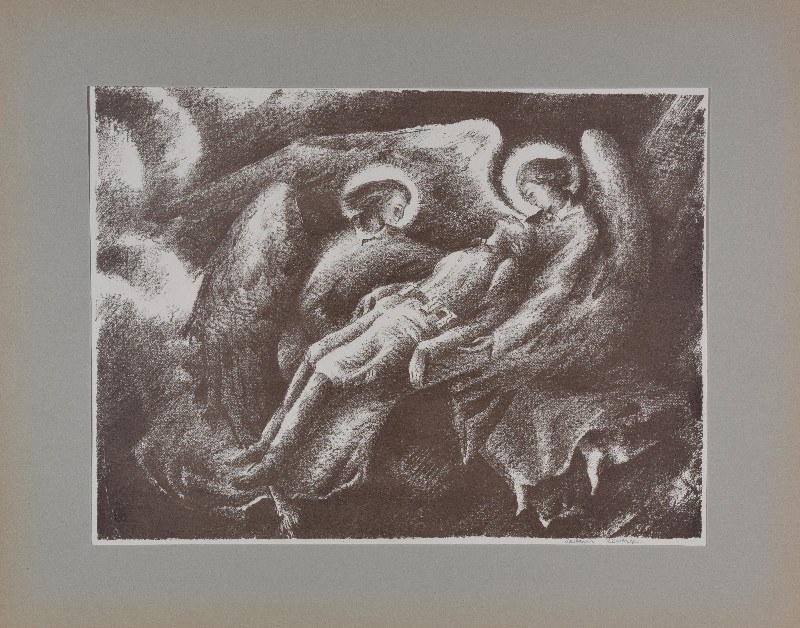
autolithography, paper, 23 x 31 cm
autolithography, paper, 23 x 31 cm; signed p. d. in pencil: Tadeusz Seweryn;
The work comes from "Teka autolitografii artystów legionistów wydana w dwudziestolecie zbrojnego czynnu legionów 1919-1934", Kraków 1934.
Tadeusz Seweryn a.k.a. "Białowąs", "Boryna", "Socha", "Maksymilian Kulesza" (1894 Żabno - 1975 Kraków) ethnographer, painter, graphic artist, museologist and folk art researcher. He attended middle school in Nowy Sącz and Cracow, where he passed his high school diploma in 1913. He then took up studies at the Faculty of Philosophy of the Jagiellonian University (he studied art history, literature and law). At the same time he studied at the Academy of Fine Arts. He graduated from both universities, and belonged to the Riflemen's Association. With the outbreak of World War I, he joined the Legions, but was dismissed from service after a few days due to his health. From February 1917 he worked in the Legion Archives.
Autolithography - a lithograph, created by the author - a graphic artist directly on the lithographic stone. In the 19th century, there were many lithographic workshops where drawings created by artists were transferred by hand by artisan-lithographers (in mirror reflection) onto lithographic stones. Such lithographs lost an important feature of an artist's work - the trace of the creator's hand. Therefore, at the end of the 19th century, artist-engravers (in Poland, among others, Witold Wojtkiewicz, Leon Wyczółkowski and Kazimierz Sichulski) began to create autolithographs, applying the image with lithographic ink or greasy crayon directly on the stone. At the same time, they had to remember that - as in the case of, for example, woodcuts - the image on the stone, including any inscriptions, would appear on the print in a mirror image.










