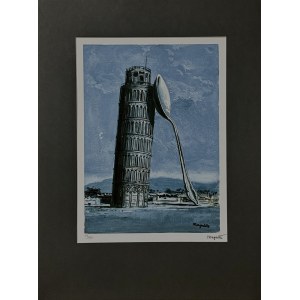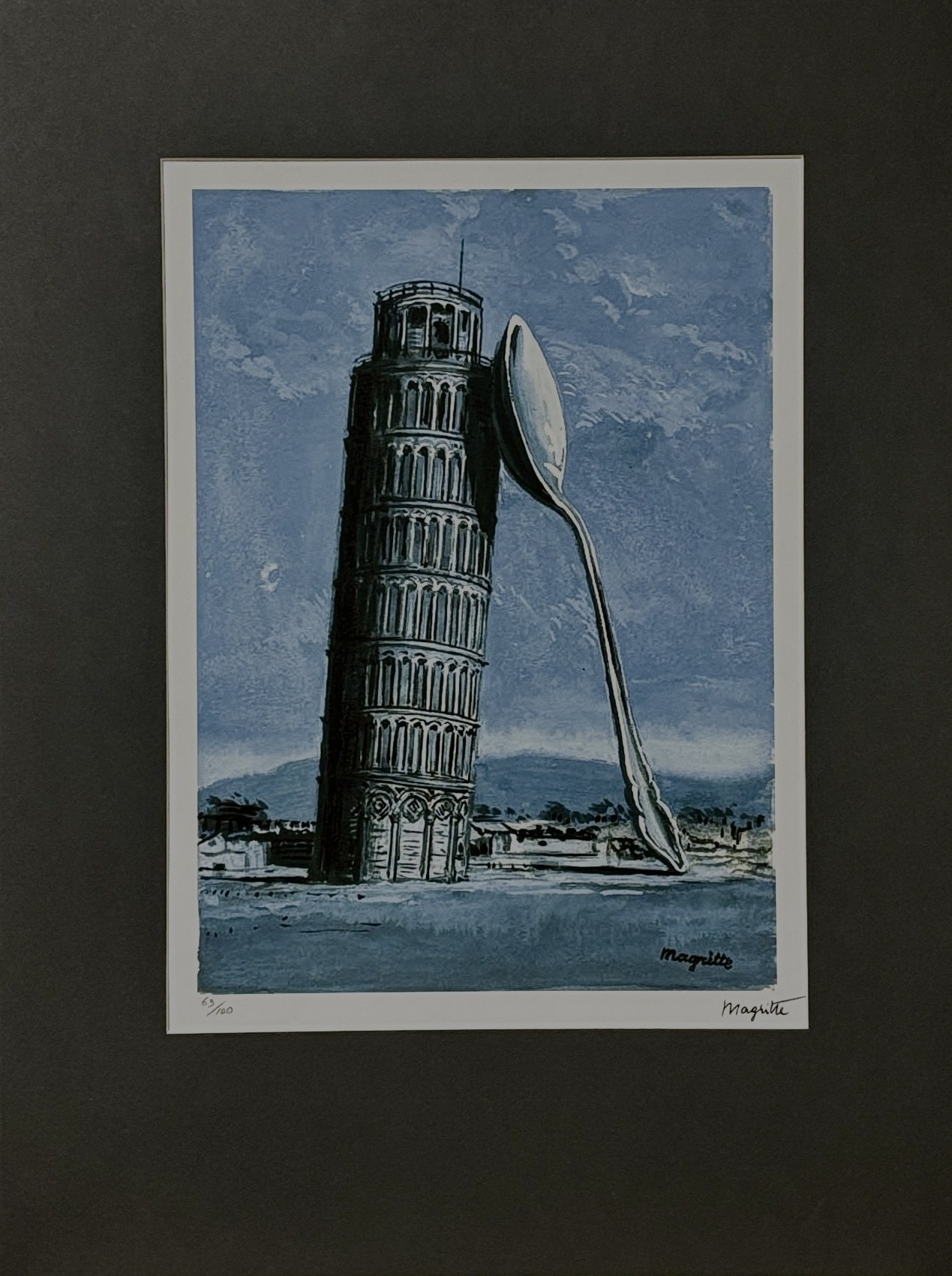
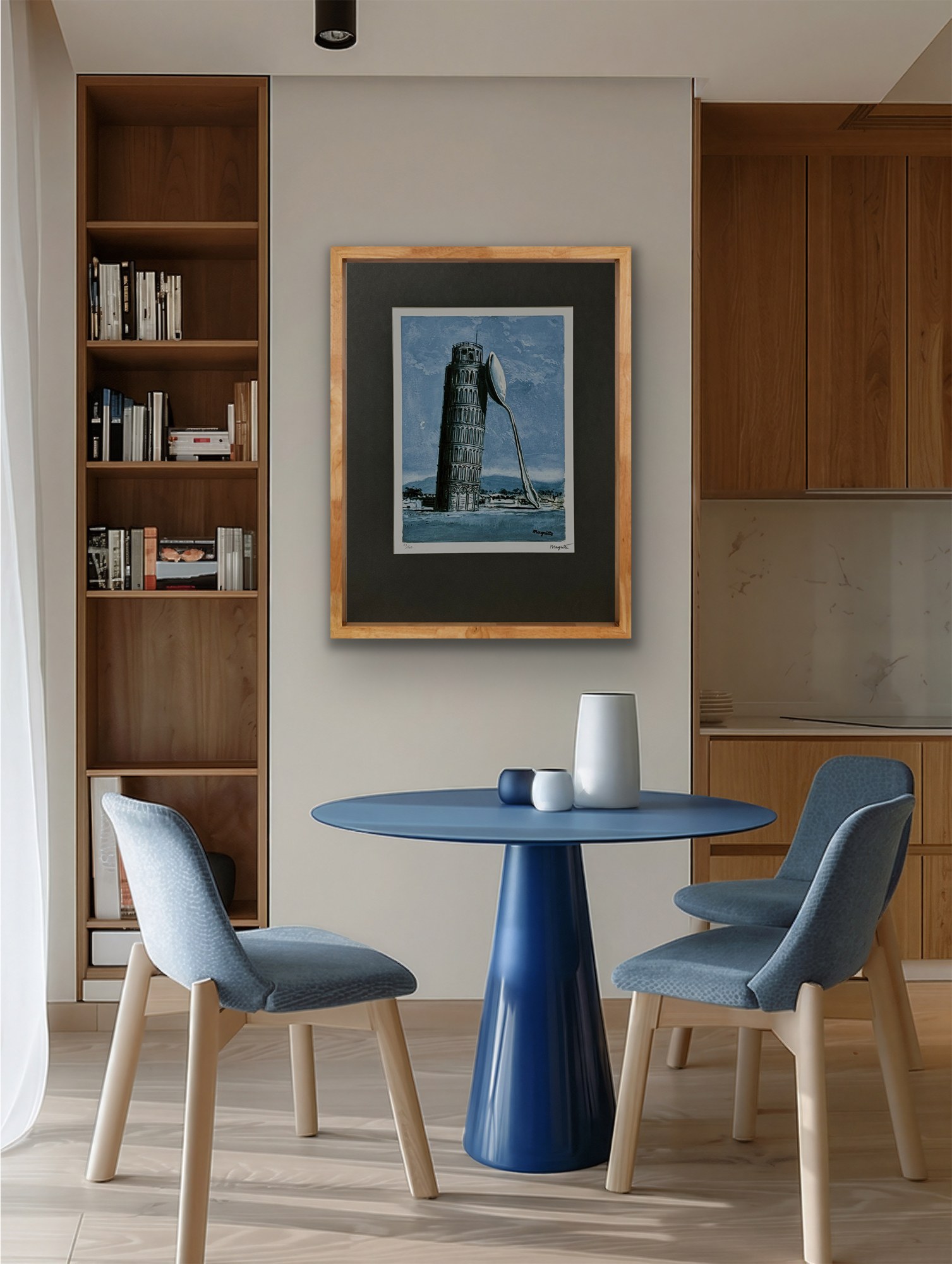
Lithograph, heavyweight vellum paper, 45 x 33 cm clear passe-partout, 66 x 50 framed passe-partout, numbered in pencil 69/100, signed from the plate under the composition "Magritte", publisher's dry stamp p.d. : " EDIZIONI ARO D'ARTE"; ". Dry stamp l.d. : "S.P.A.D.E.M. Paris" (SPADEM is the French equivalent of the Polish ZAIKS), hologram "verification of authenticity" on the back. original certificate.
René François Ghislain Magritte - Belgian painter, surrealist. Called "the author of words and things. His paintings shocked and aroused controversy, they are distinguished by poetic moodiness and precise drawing.
René Magritte in his composition "Souvenir de voyage " (Souvenir of a Journey ) constantly surprises the viewer with an unusual juxtaposition of objects that seemingly have nothing to do with each other.
The tower depicted in René Magritte's painting "Souvenir de voyage" resembles the famous Leaning Tower of Pisa. Magritte, known for his surrealist style, often used recognizable icons and symbols in his works, which he then inserted into surprising contexts. In this case, the Leaning Tower, which is a symbol of architectural awesomeness and historical heritage, is propped up with a simple spoon, creating an absurd yet intriguing image. The tower, which usually symbolizes permanence, stability and strength, is here supported by a delicate spoon, an everyday object that is not inherently associated with anything sturdy. This may suggest that the stability we associate with great structures or ideas may in fact be based on something fragile, not obvious. The spoon, an everyday tool, may also symbolize simplicity, which in this surreal context supports something monumental.
As in many of Magritte's works, interpretation depends on the viewer's sensitivity. It can be a reflection on the fragility of apparent power, a question about the essence of reality, or simply a play with imagination, characteristic of Surrealism. "Souvenir of a Journey" may also suggest that our perception of the world is incomplete and shaped by the bizarre, unexpected connections that Magritte loved to show in his works.