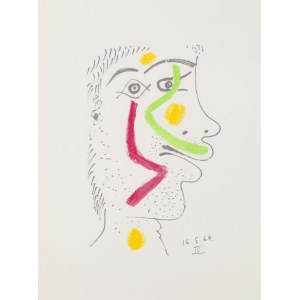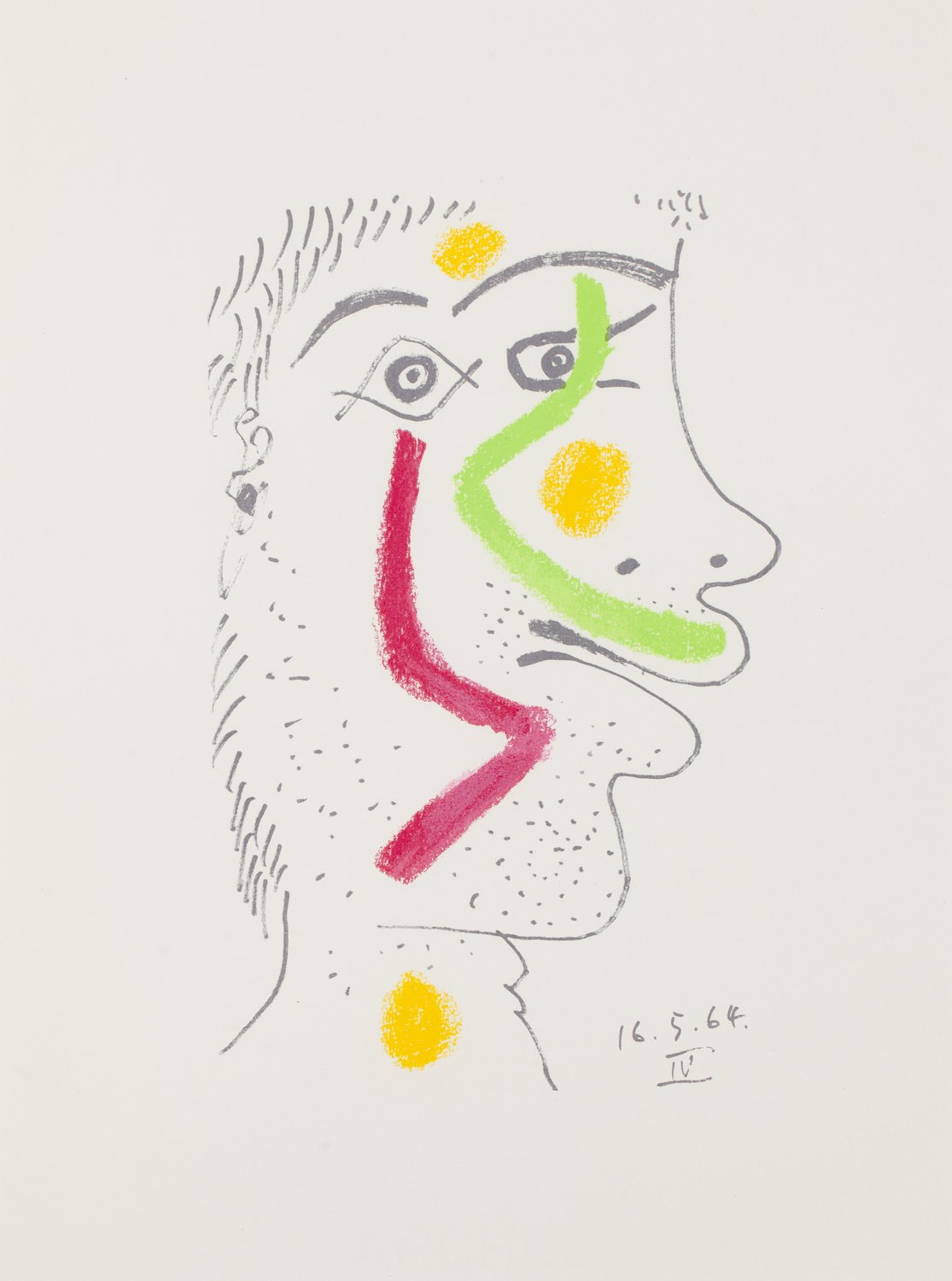
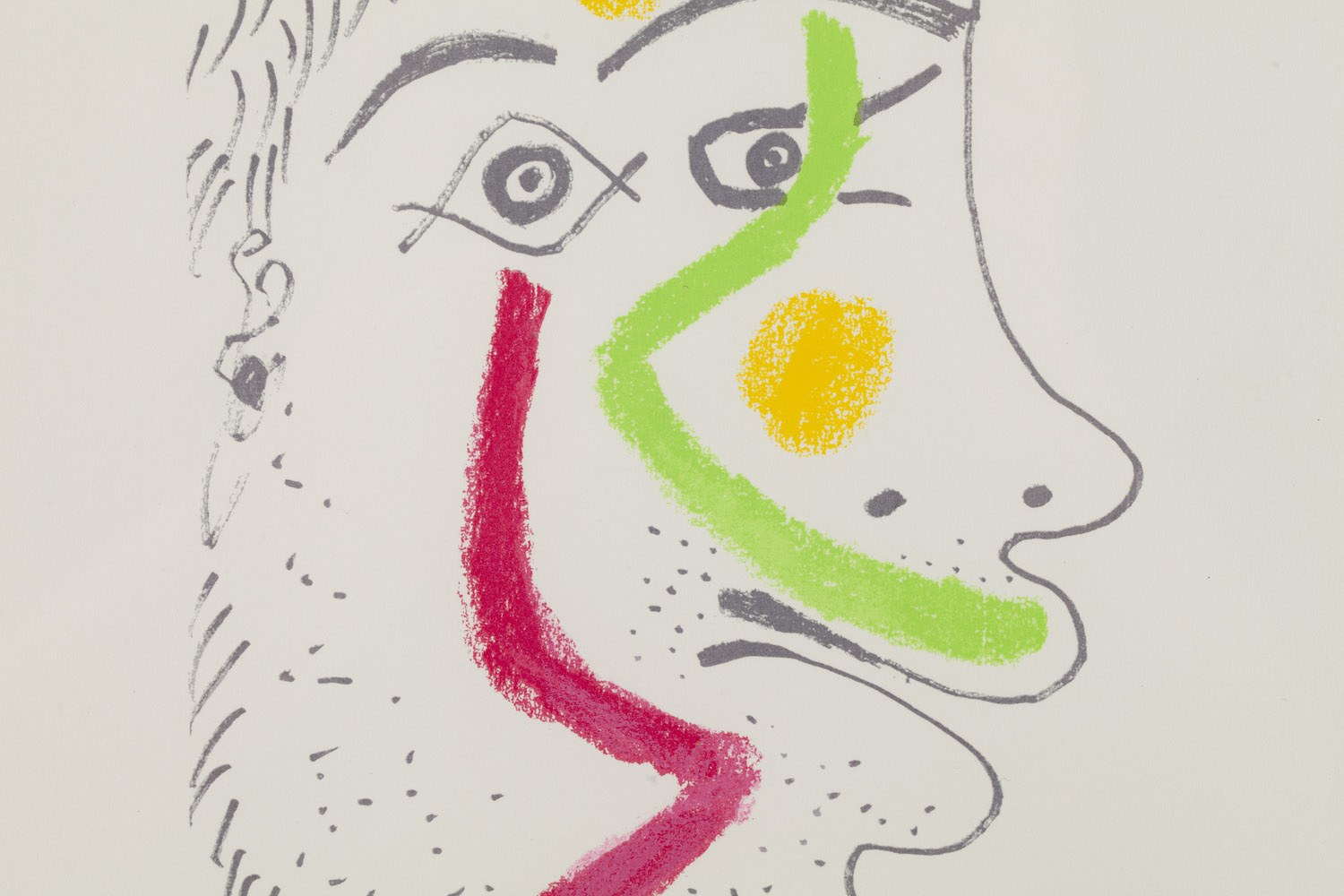
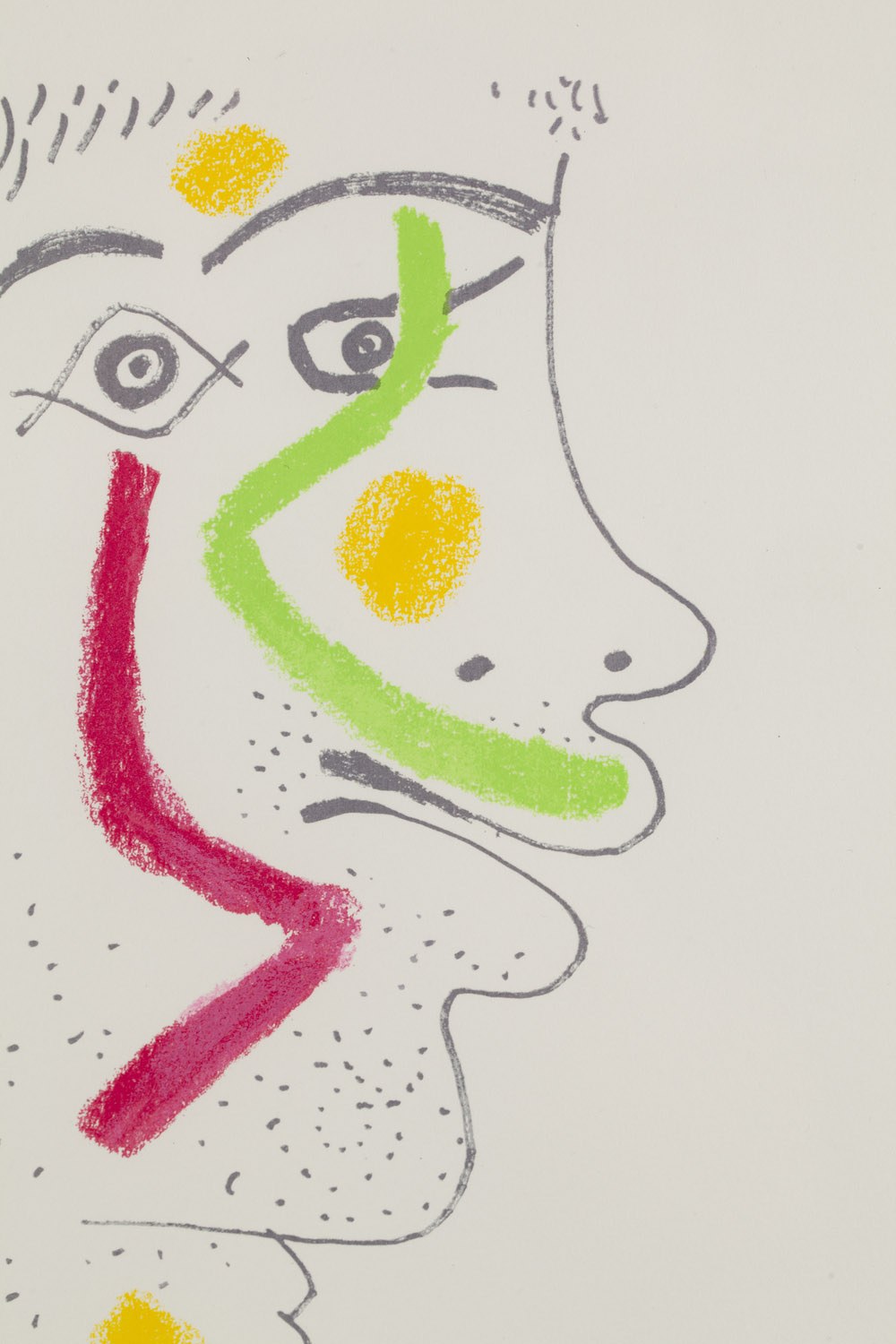
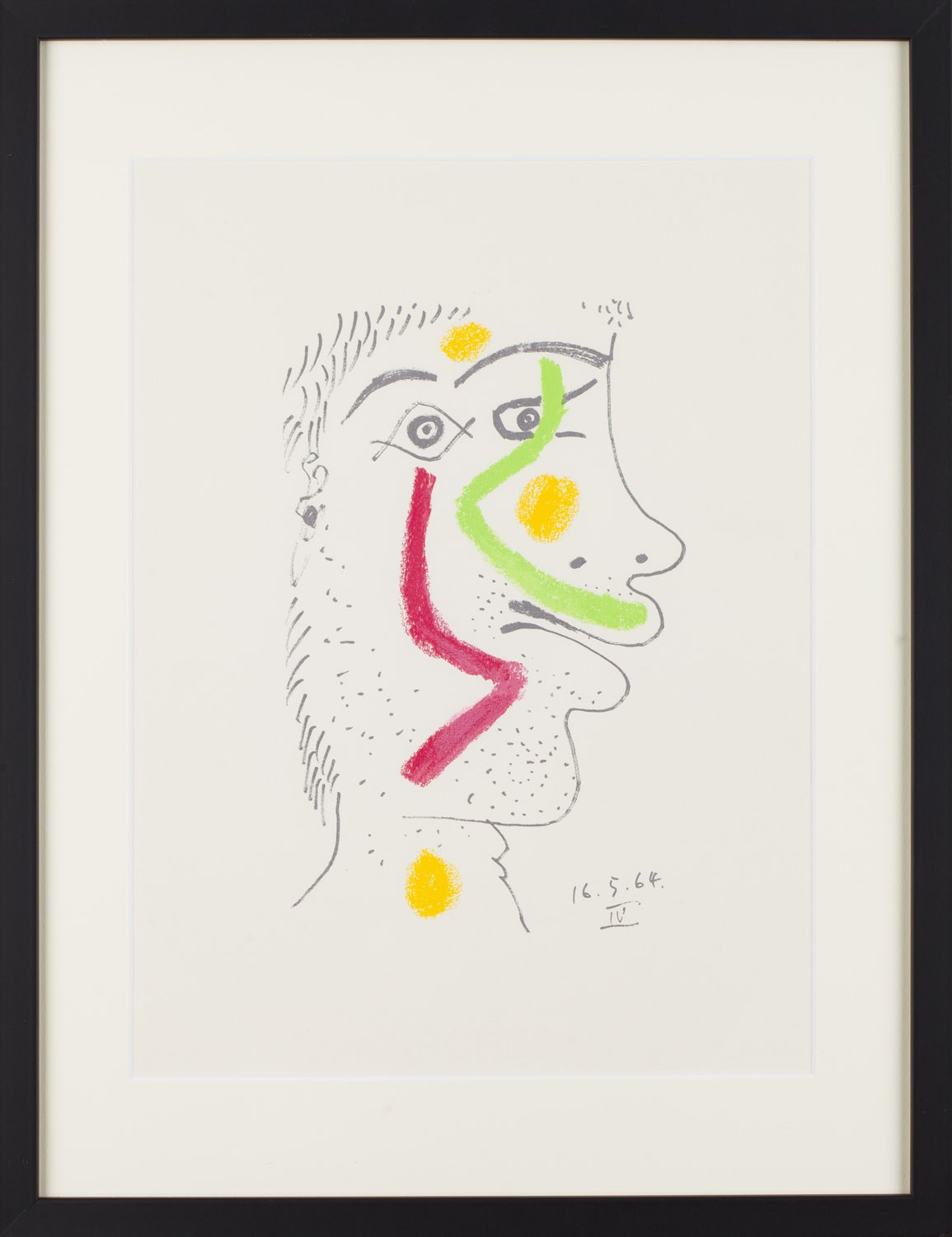

Dimensions: 30 x 23 cm
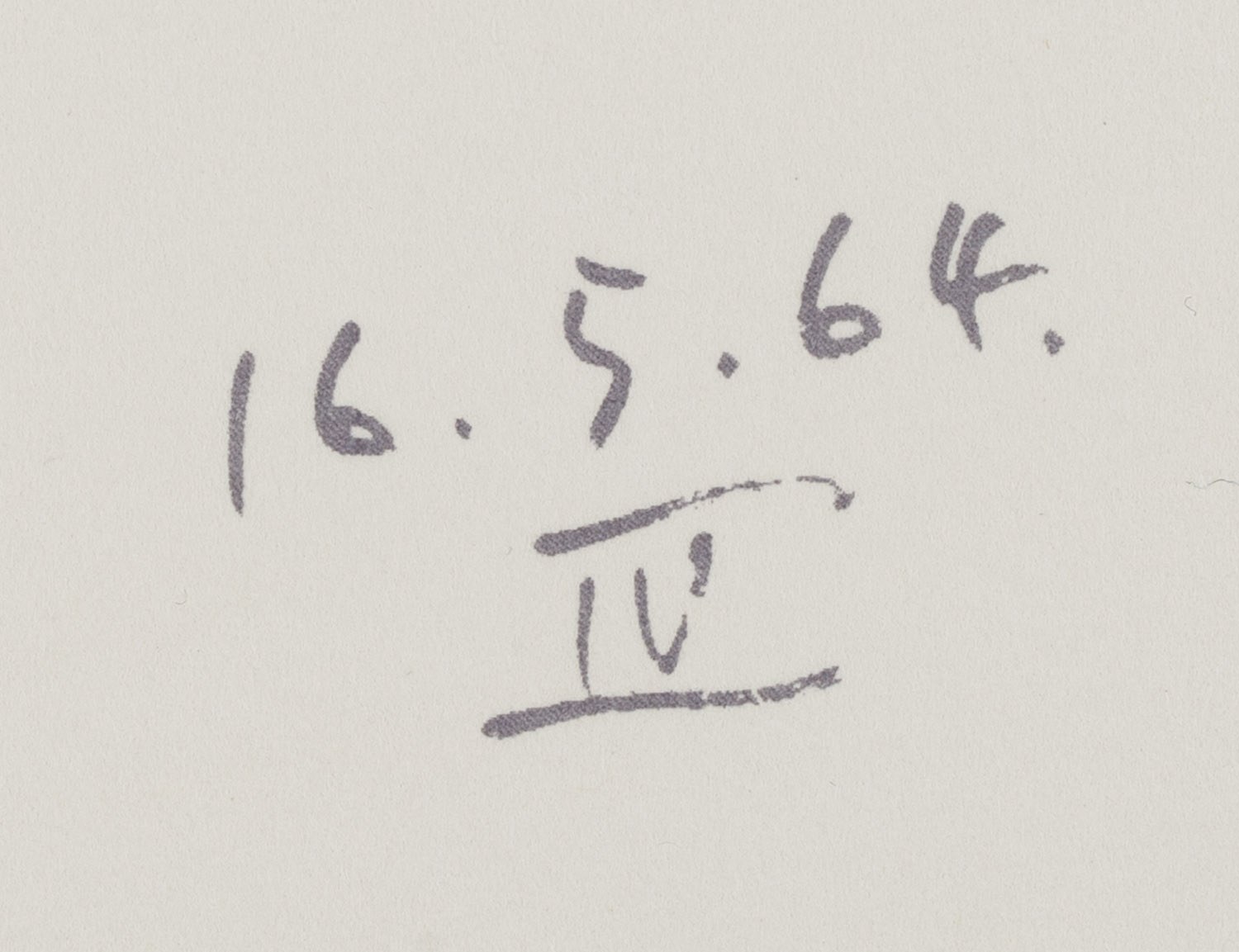
Dated on the stone: '16.5.64/IV'
Biography
A Spanish painter, sculptor, printmaker, and ceramicist, considered one of the most outstanding artists of the 20th century. He and Georges Braque are the founders of the Cubist movement in painting. From a very young age, Pablo demonstrated his talent for painting and the visual arts. He was first educated in Spain, then in Paris (1901–1922), where his encounter with the Post-Impressionists (including Henri de Toulouse-Lautrec, who had a major influence on his work prior to 1901). Picasso’s works from 1901–1904 are referred to as the Blue Period. These were works characterized by a melancholic color palette, depicting the lives and figures of the poor (“Life,” “The Old Guitarist,” “Two Sisters,” “The Ironer”). His studio was located on La Boétie Street. From 1904 onward, he lived at the Bateau-Lavoir at 13 Ravignan Street. After this period, Picasso’s work entered the Rose Period, featuring, among other things, scenes from the lives of circus performers (Girl on a Ball, Jugglers, Dressing Room, Harlequin’s Family). From 1907, influenced by Paul Cézanne as well as Iberian and African art, Picasso began creative experiments with the geometrization and simplification of form, which gave rise to Cubism (Les Demoiselles d’Avignon, Portrait of Gertrude Stein). Later, following his collaboration with Georges Braque, the principles of analytical, hermetic, and synthetic Cubism took shape. The premiere of the stage production *Parade*, with a libretto by Jean Cocteau, music by Erik Satie, and set design by Picasso, was considered the manifesto of Cubism. It was staged in 1917 by Sergei Diaghilev’s “Ballets Russes.” The following years were marked by a constant creative search. When the Spanish Civil War broke out, he sided with the Republicans, and in 1937, commissioned by the Republican government of Spain for 200,000 pesetas, he painted the famous *Guernica*, a painting exhibited in the Spanish Pavilion at the World’s Fair in Paris. He spent World War II in Paris; in 1944, he joined the French Communist Party, and after the war, he became involved in left-wing and peace movements. In 1946, he moved to the French Riviera. In 1948, he settled in Vallauris. In 1948, Picasso traveled to Poland, participated in the World Congress of Intellectuals in Defense of Peace in Wrocław, and also visited Warsaw, where he donated his collection of ceramics, drawings, and color prints to the National Museum. He was a signatory of the Stockholm Appeal in 1950. In 1950, he received the International Lenin Peace Prize (then known as the Stalin Prize)[3]. In the 1940s, he painted anti-war works (Massacre in Korea, War, Peace). Picasso’s postwar creative period is very rich, diverse, and defies classification.