


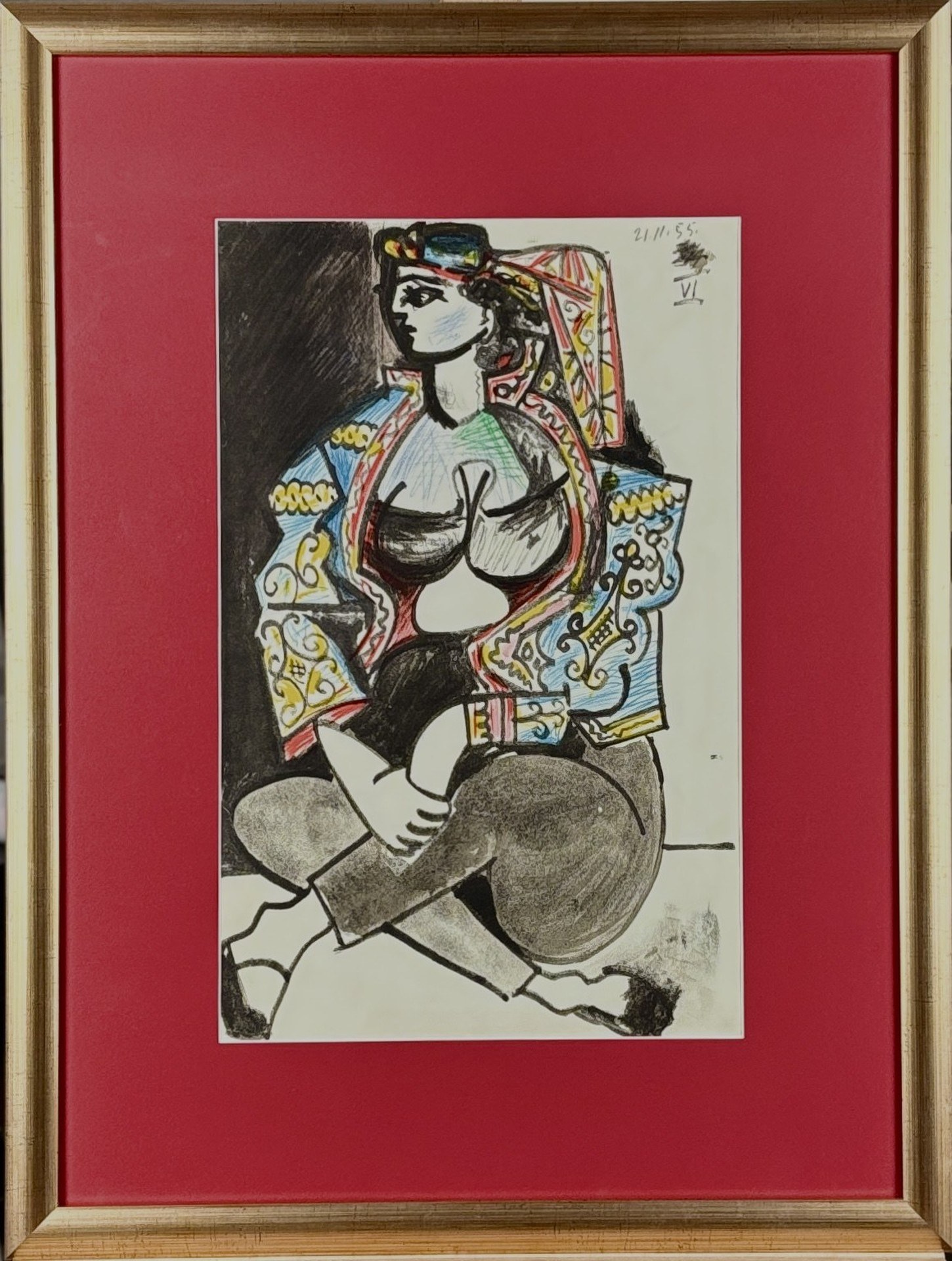
Collector's lithograph on Velin de Rives handmade paper, 42 x 26 cm (composition), mounted in a frame measuring 63 x 47 cm;
dated on the plate, lower left: “21 III 55. VI”;
French edition; limited edition of 1,400 pieces; inscription on the portfolio cover: "Edizione Unica" (Unique Edition).
Publisher: Cercle d’Art, Paris; produced by the renowned Mourlot Frères studio.
The Éditions Cercle d’Art edition is considered a masterpiece of the art of printmaking. The artist personally supervised the creation of the lithograph to ensure that its colors and texture perfectly captured his original drawings; the famous Parisian studio Mourlot Frères was the world’s premier venue for creating artistic lithographs, a guarantee of the highest quality in artistic lithography, which are virtually indistinguishable from Picasso’s original drawings.)
(Edizione Unica—This term is a declaration of exclusivity. It is used almost exclusively for bibliophile editions, art portfolios, and luxury albums. In this way, the publisher declares that this specific publication has been issued only once. There will be no reprints, reissues, or subsequent print runs in exactly the same form.)
The work comes from a unique collector’s edition titled “Carnet de la Californie” (California Sketchbook)—Pablo Picasso’s personal sketchbook, which the artist kept in late 1955 and early 1956. In 1955, Picasso moved into a magnificent 19th-century villa in Cannes known as La Californie. It was there that these sketches were created. The artist turned the grand salon into his studio, and the sketchbook is an intimate record of how he lived and worked during that period. Picasso obsessively drew what he saw around him—large Art Nouveau windows, easels, palm trees outside the window, and an artist’s clutter. Many of the drawings in this sketchbook—especially those depicting decorative windows and vegetation—are considered a painterly dialogue with Matisse’s style. Picasso once said, “When Matisse died, he left me his gardens.”
Many of the sketches feature “Woman in Turkish Attire: Odalisque”—a reference to the classic motif of the odalisque, who for many artists was the embodiment of the exoticism, mystery, and sensuality of the East. Henri Matisse painted an entire series of odalisques. For him, they were a pretext for playing with color, fabric patterns, and the decorative nature of interiors. Picasso, who was greatly influenced by Matisse, often painted his last great love, his muse, and his second wife, Jacqueline Roque, in the pose of an odalisque or in Turkish attire.










Laatst bekeken
Log in om de kavellijst in te zien
Favorieten
Log in om de kavellijst in te zien