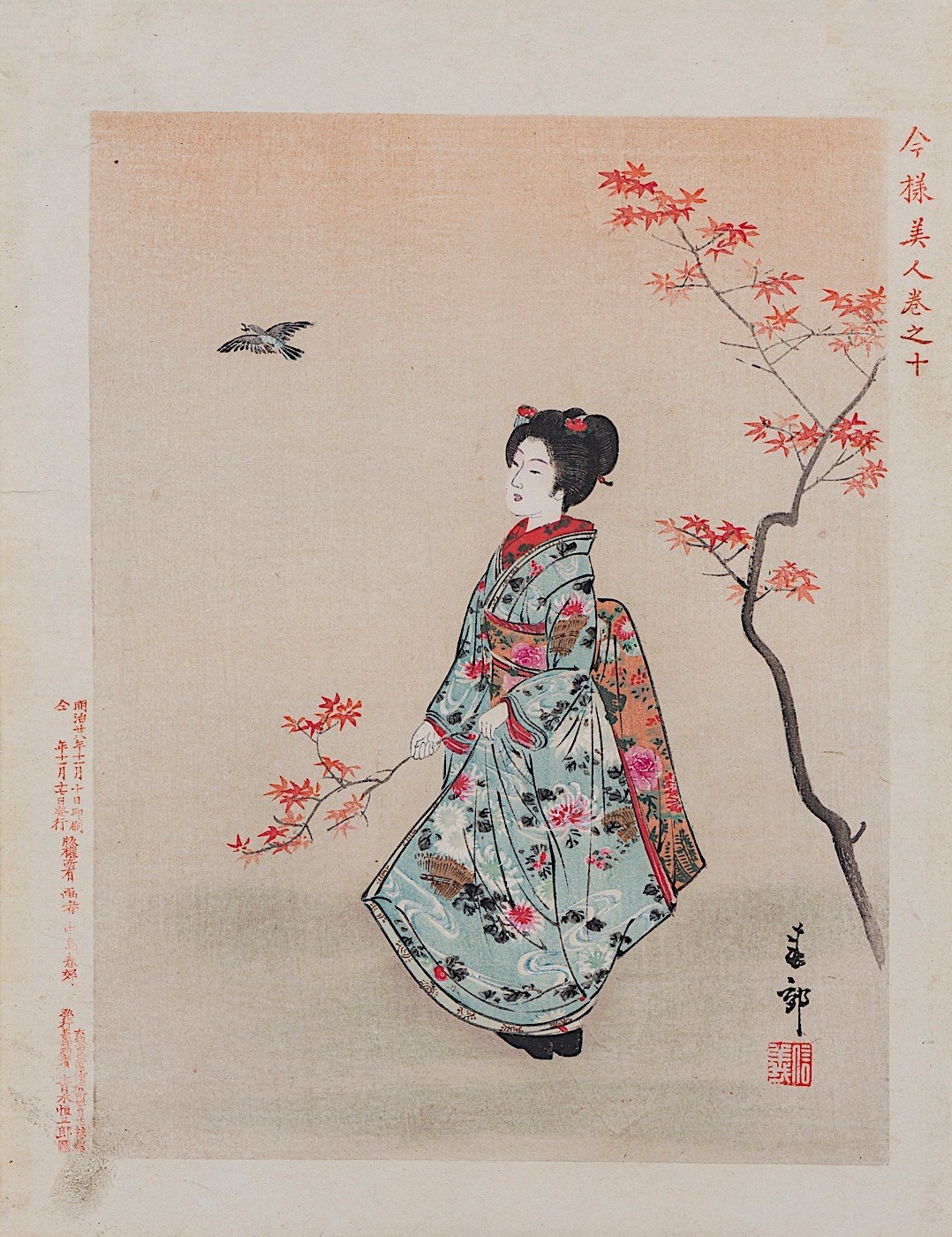
Japanese color woodcut, ink, paper, 27x21 cm (paper size), artist's signature, inscriptions in Japanese in the margins
An analogous woodcut is in the collection of the Minneapolis Institute of Art. A total of 12 woodcuts were issued in the series, corresponding to the 12 months of the year. This is their first and only edition.
This series of woodcuts was published by Tsunesaburo Aoki of Osaka on November 10, 1895. Shunko Nakajima' s work is little recognized by researchers. It is known that he also used the name Nobuyoshi Nakajima, as evidenced by the word "Nobuyoshi" visible in his stamp on each print in the "Modern Beauties" series. He can also be identified with author Kayaokin Shunko of "Somoku Jikken Bonsai Shitate Hiketsu," published by Hakubundo in 1902, for whom Shunko designed gardening and planting guides.
Bijinga, or painting of beautiful women, developed in Japan from the 17th century as a subgenre of ukiyoe, a woodcut technique depicting various aspects of life. The courtesans and geishas of Yoshiwara's pleasure district were very popular, sparking the imaginations of artists as well as the ordinary bourgeoisie and upper class. Artists often showed women as they went about their daily activities, and were particularly fond of the motif of bathing beauties. Due to changes in both the political and socio-cultural fields associated with the Meiji period, in the 19th century bijinga began to be created by women themselves. One of them was Uemura Shōen.