


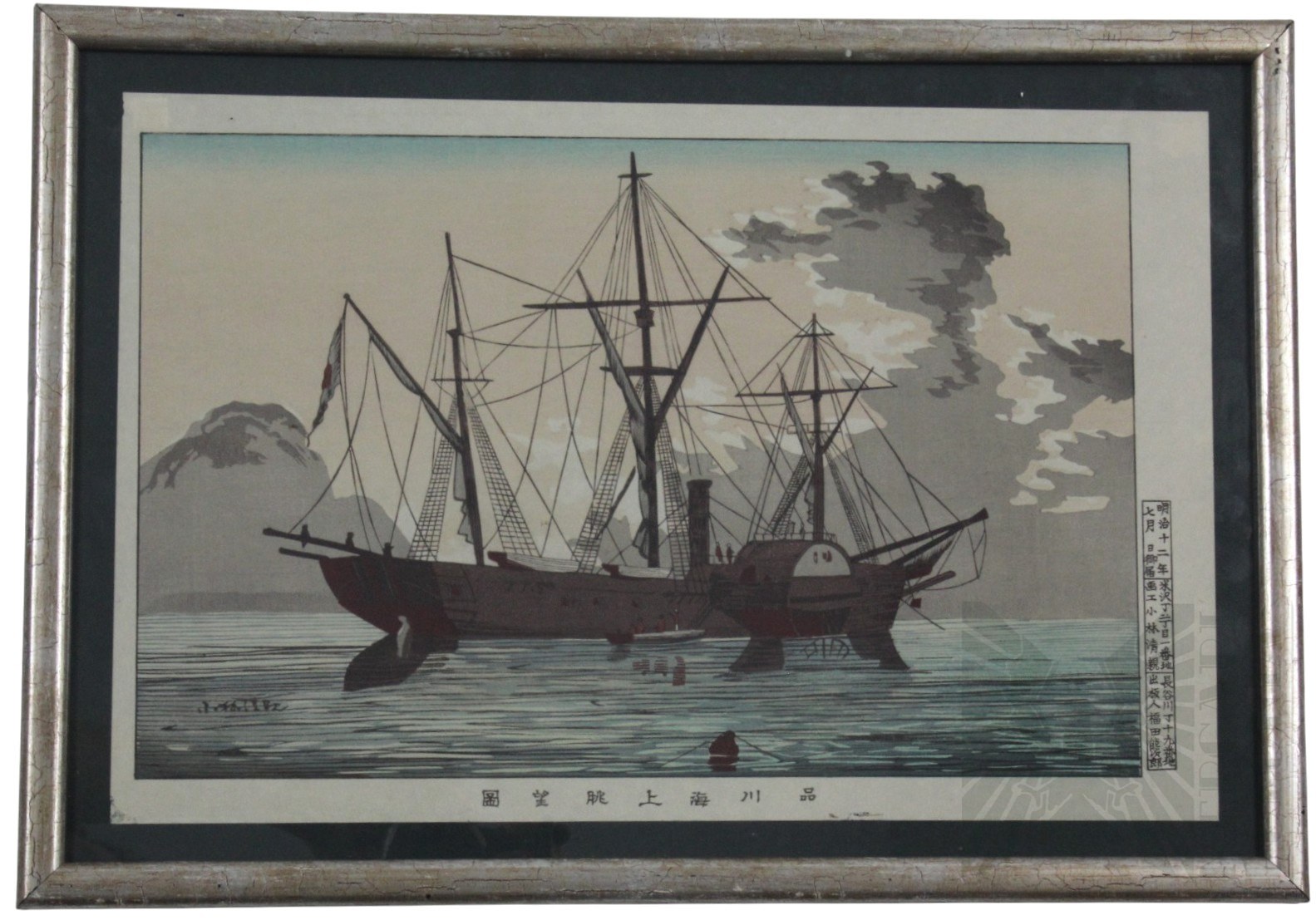
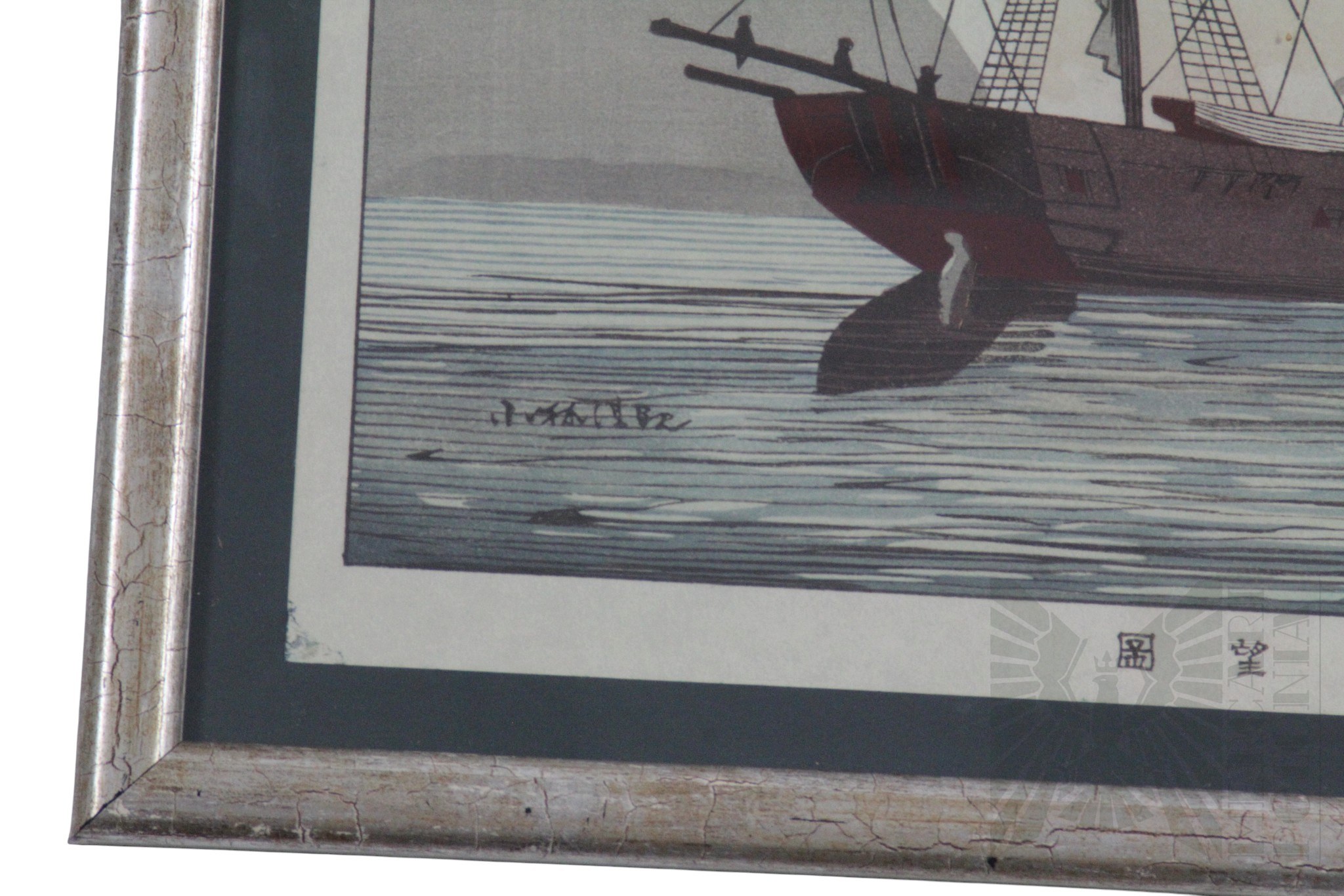
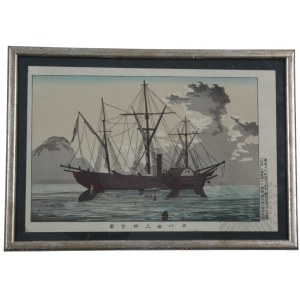
Kobayashi Kiyochika (小林清親, 1847–1915). Title inscribed in the lower margin: 品川海上眺望図 – Shinagawa kaijō chōbō zu, literally “View of the Sea at Shinagawa” or “Panoramic View of the Sea off Shinagawa.” Signature: 小林清親 – Kobayashi Kiyochika, located in the lower left part of the composition. Publication details: The print was published in the seventh month of the 12th year of the Meiji era, that is, in July 1879, by Fukuda Kumajirō (福田熊次郎). Technique: multicolored Japanese nishiki-e woodblock print on paper; horizontal ōban yoko-e format. This information is confirmed by the catalogs of Keio University and the Edo-Tokyo Museum.
Dimensions: 27.5 × 42.5 cm.
In frame: 49 × 34.5 cm.
The woodblock print depicts a side view of a large steamship anchored in the waters of the bay near Shinagawa—a former southern suburb and port area of Tokyo. The vessel combines traditional sails with a modern steam engine. Above the elongated hull, three masts with extensive rigging, a funnel, and a cover for the side paddlewheel are visible. Small figures of crew members are depicted on deck. Long yards, ropes, and rigging elements protrude from the bow and stern. The ship is depicted almost exactly in profile, allowing its dark silhouette to dominate the calm, expansive water surface. A small reddish object on the water—presumably a buoy or a figure in a small boat—adds a splash of color and emphasizes the steamship’s monumental scale.
The color palette is limited to grays, blacks, muted blues, and brownish reds. The subtle tonal transitions of the sky and water contrast with the graphic network of rigging. The composition combines the tradition of Japanese landscape woodblock prints with European approaches to depicting space, light, and modern technology. The ship was not treated merely as a detail of the harbor landscape, but as the central figure of the composition—a symbol of Japan’s transformations in the early decades of the Meiji era.
The work was part of a loosely organized series of views of modern Tokyo, known as Tōkyō meisho. In this series, Kiyochika documented a city undergoing change under the influence of industrialization and contact with the West: steamships, railroads, brick buildings, gas lamps, and new port facilities. A distinctive feature of these compositions was their atmospheric and chiaroscuro effects, which led to them being referred to as kōsen-ga—“pictures of rays of light.”
The original version of this woodblock print was published in 1879. However, 20th-century reprints made from newly carved blocks are also known, including prints published by Maria Shobō from around the 1950s. These reprints retain the title, signature, and original publisher’s plate.
Kobayashi Kiyochika was born in 1847 in Edo, later Tokyo. He came from a family associated with the administration of the Tokugawa shogunate. After the Meiji Restoration, he devoted himself to artistic pursuits. He created landscape woodblock prints, city scenes, press illustrations, satirical depictions, and war-themed compositions. In his work, he combined the ukiyo-e tradition with inspirations drawn from Western painting, photography, and lithography. His views of Tokyo from 1876–1881, documenting the transformation of the former Edo into a modern metropolis, hold a special place in his body of work. The artist died in 1915. He is regarded as one of the most important Japanese woodblock print artists of the late 19th and early 20th centuries and one of the last great masters of ukiyo-e.








Laatst bekeken
Log in om de kavellijst in te zien
Favorieten
Log in om de kavellijst in te zien