


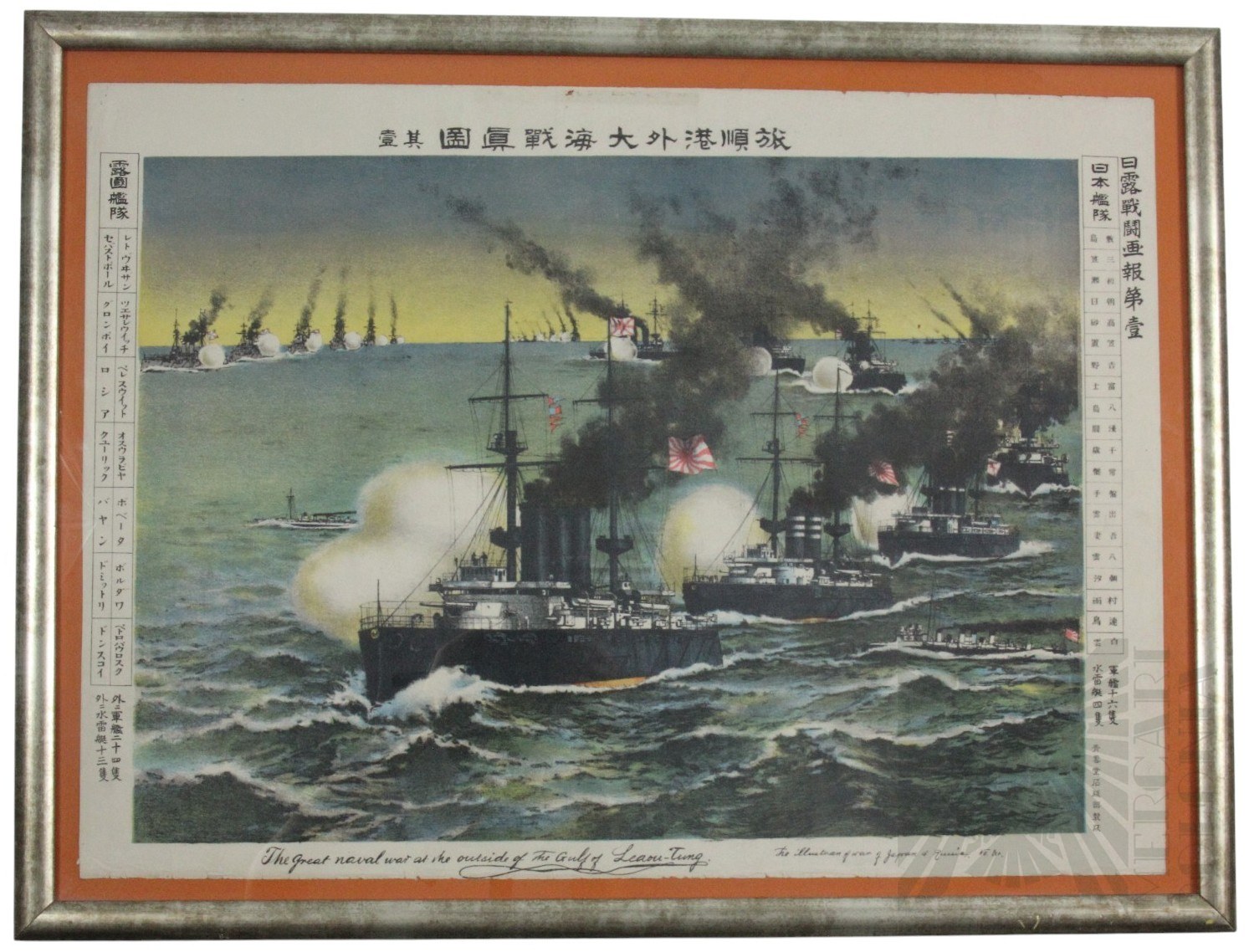
Kasai Torajirō (attributed); Japan, Meiji era, 1904; color chromolithograph on paper.
Sheet dimensions: 45.5 × 62.4 cm.
Dimensions with frame: 70.5 × 53.5 cm.
日露戦闘画報 第壹 Nichiro sentō gahō, dai-ichi – “Illustrated News of the Russo-Japanese War, Issue One”; True Picture of the Great Naval Battle Off Port Arthur, Part One (Ryōjunkō-gai daikaisen shinzu, sono ichi) – “True Picture of the Great Naval Battle Off Port Arthur, Part One.”
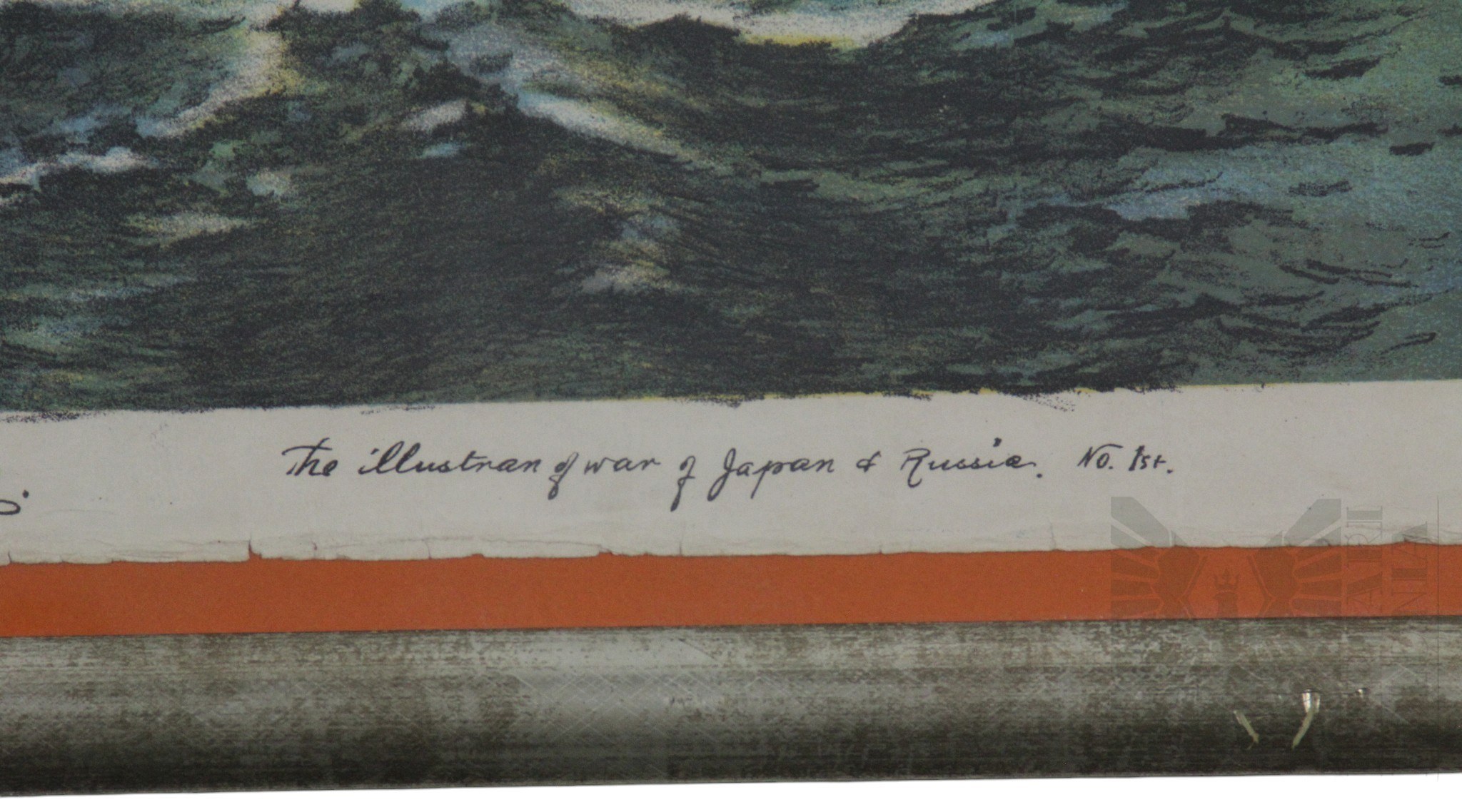
English captions are also included in the lower margin: “The Great Naval War at the Outside of the Gulf of Leao-Tung” and “The Illustration of the War Between Japan and Russia. No. 1st.” Their grammatically incorrect form is characteristic of Japanese prints intended for the mass market and designed to imitate Western illustrated war reports.
The elaborate panoramic composition depicts a clash between the Japanese and Russian fleets at the entrance to Port Arthur. The ships are arranged in two elongated lines, spread across several planes. The violently churning sea, thick clouds of black smoke, flashes of gunfire, and towering columns of water thrown up by falling shells create a vivid picture of an intense exchange of fire. The Japanese vessels are distinguished by flags bearing the rays of the rising sun, while the Russian ships fly white, blue, and red flags. Despite its dynamic battle scene, the depiction is partly schematic: individual ships are shown in a way that allows viewers to recognize their silhouettes, armament, funnels, and mast arrangements.
Detailed lists of the fleets are placed on either side of the composition. Among the Japanese ships listed are, among others, the battleships and cruisers “Mikasa,” “Shikishima,” “Hatsuse,” “Asahi,” “Fuji,” “Yashima,” “Takasago,” “Kasagi,” and “Yoshino.” On the Russian side, the names “Retwizan,” “Cesariewicz,” “Pierieswiet,” “Sevastopol,” “Bajan,” “Rossija,” “Rurik,” and “Gromoboj” appear, among others. The print also lists the number of warships and torpedo boats.
The illustration depicts the attack on the Russian Pacific Fleet at Port Arthur—which marked the opening of the Russo-Japanese War—launched on the night of February 8–9, 1904, and the subsequent daytime exchange of fire. However, it is not a documentary record of the sequence of events, but rather a patriotic reconstruction intended for a broad audience.
In the margin is the inscription: 青雲堂石版部製版 Seiun-dō sekihanbu seihan – “produced in the Seiun-dō lithography department.” This inscription, the texture of the surface, and the catalog data of the surviving piece allow us to unequivocally identify the technique as chromolithography, likely grain lithography. It is therefore not a classic Japanese nishiki-e color woodblock print, even though the composition, narrative style, and propagandistic function directly reference the tradition of sensō-e war woodblock prints.
The Library of Congress and the Cultural Japan database attribute the work to Kasai Torajirō (葛西虎次郎). The print constitutes the first part of a series; the second and third parts are also known, depicting further stages of the fighting and the defeat of the Russian fleet.
Kasai Torajirō was a late Meiji-period printmaker, lithographer, publisher, and creator of popular illustrated publications associated with the Seiun-dō publishing house. Between 1904 and 1905, he produced numerous colorful depictions of the Russo-Japanese War, combining battle scenes, news reports, and propaganda. His surviving works indicate that he was responsible not only for composing the illustrations but also, at times, for printing and publishing. Detailed biographical information, including the dates of his life, remains poorly documented.








Laatst bekeken
Log in om de kavellijst in te zien
Favorieten
Log in om de kavellijst in te zien