


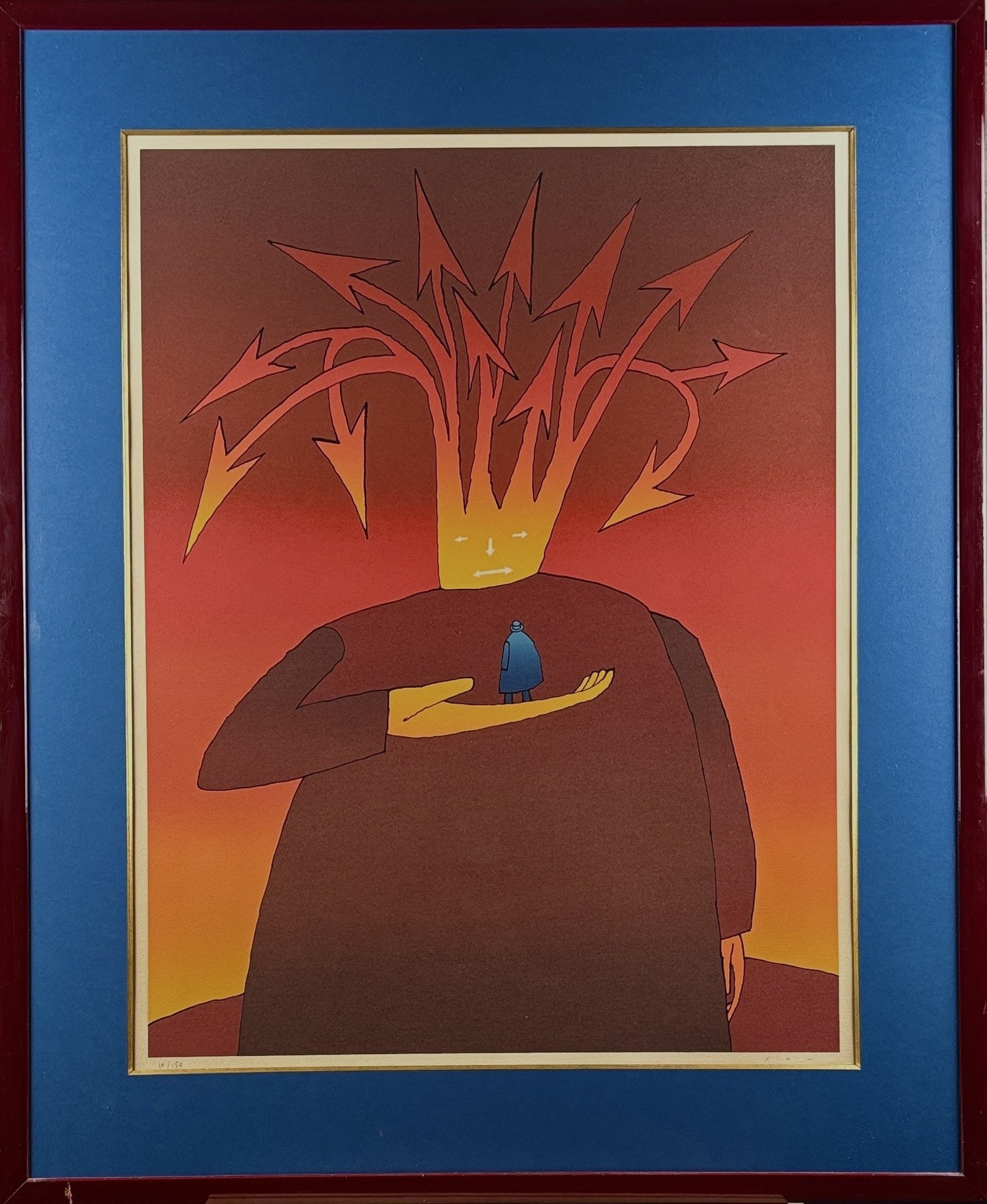
Silkscreen print on Arches Velin paper, 74 x 56 inside the mat, framed in a 94.5 x 78 frame, limited edition, hand-numbered 10/150, intended for the collector’s market, signed by the artist lower left
Jean-Michel Folon’s enigmatic landscapes and mysterious humanoid forms revolutionized the conceptual approach to illustration in the late 20th century. Folon worked in many disciplines—including painting, textiles, sculpture, stained glass, and printmaking—but he gained international fame and recognition as an outstanding poster artist (he created over 600 posters), which were characterized by their ability to communicate quickly and poetically with the viewer. As a printmaker, in addition to promotional posters, he created limited-edition prints on special paper using the artistic screen-printing technique.
“Macbeth” was created in 1972 for the Théâtre de l’Est Parisien (TEP). Folon frequently collaborated with theaters and festivals (including the one in Cannes), creating posters that became works of art in their own right. In Folon’s vision, “Macbeth” is not a story about battles, but about the imprisonment of one’s own mind. The power of Folon’s work lies in contrast. His style is seemingly gentle, almost childlike, but when juxtaposed with the title “Macbeth,” it evokes unease. It shows that evil is not always loud—it is often quiet, sad, and lonely. Folon’s characters rarely have distinct facial features. In his interpretation, Macbeth becomes “Everyman”—a symbol of the universal downfall of a man tempted by ambition.
Folon was exceptionally fortunate with his directors. His style was a perfect fit for auteur and intellectual cinema. Jean-Michel Folon created a series of posters for Woody Allen’s films that became absolutely iconic, especially in Europe, where Folon’s style was highly regarded. *The Purple Rose of Cairo*, *September* for Woody Allen, *Stalker* for Tarkovsky, and *Quoi?* for Polanski.
If we look at a poster from the ’70s or ’80s dominated by watercolor blues, red, and violets, and the main character is a small figure in a coat and hat (often seen from behind) or a flying figure, it is almost certainly Folon. Folon’s works were featured in numerous exhibitions during his lifetime, including at institutions such as Les Arts Décoratifs, the Museum Boijmans Van Beuningen, the Metropolitan Museum of Art, the Institute of Contemporary Arts in London, and the Musée Picasso. Folon’s drawings were published in magazines such as Esquire, *The New Yorker*, and *Time*, and he also illustrated many well-known books.
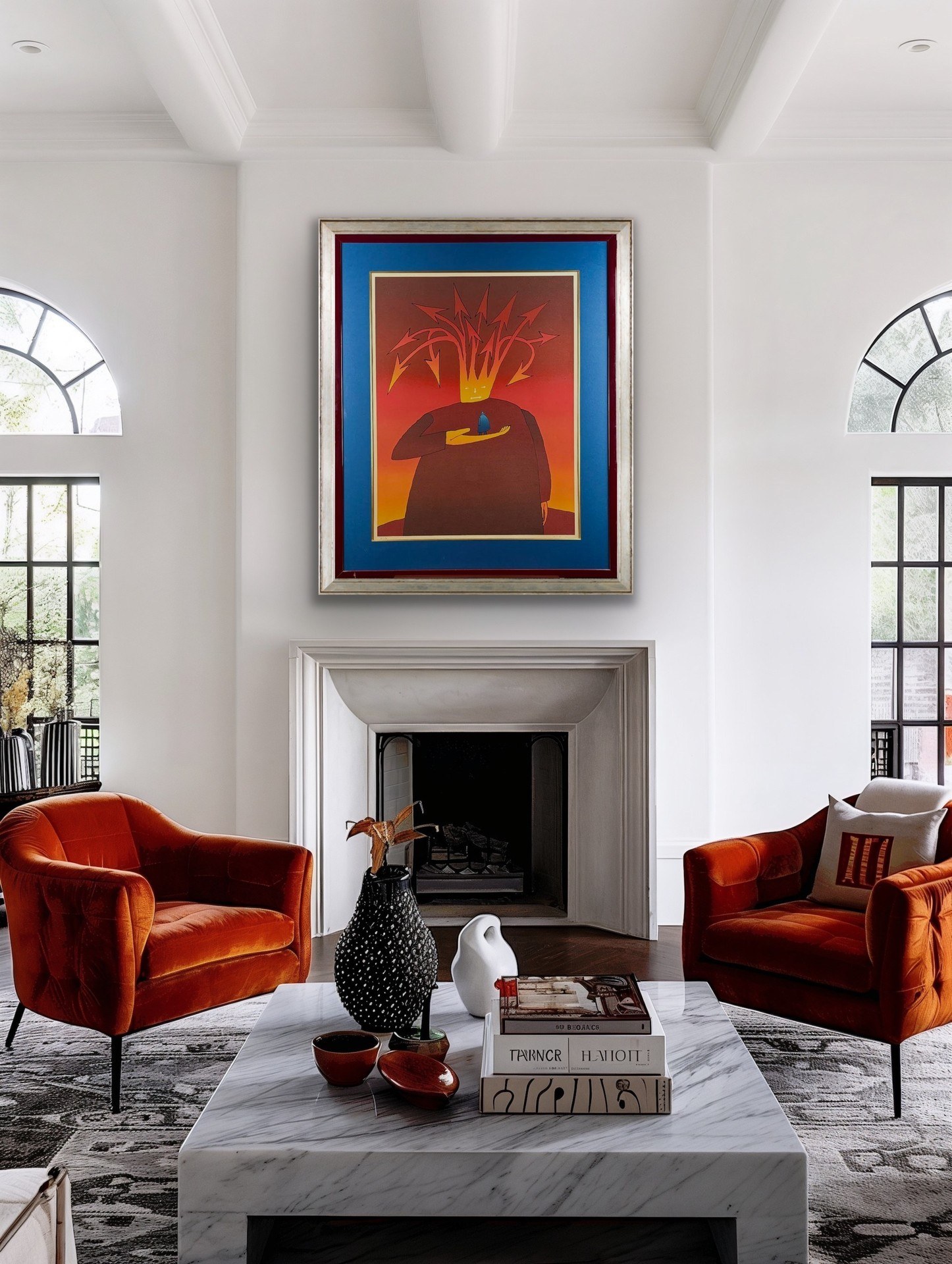
The frames shown in the renderings are for illustrative purposes only and do not constitute a commercial offer.










Laatst bekeken
Log in om de kavellijst in te zien
Favorieten
Log in om de kavellijst in te zien