


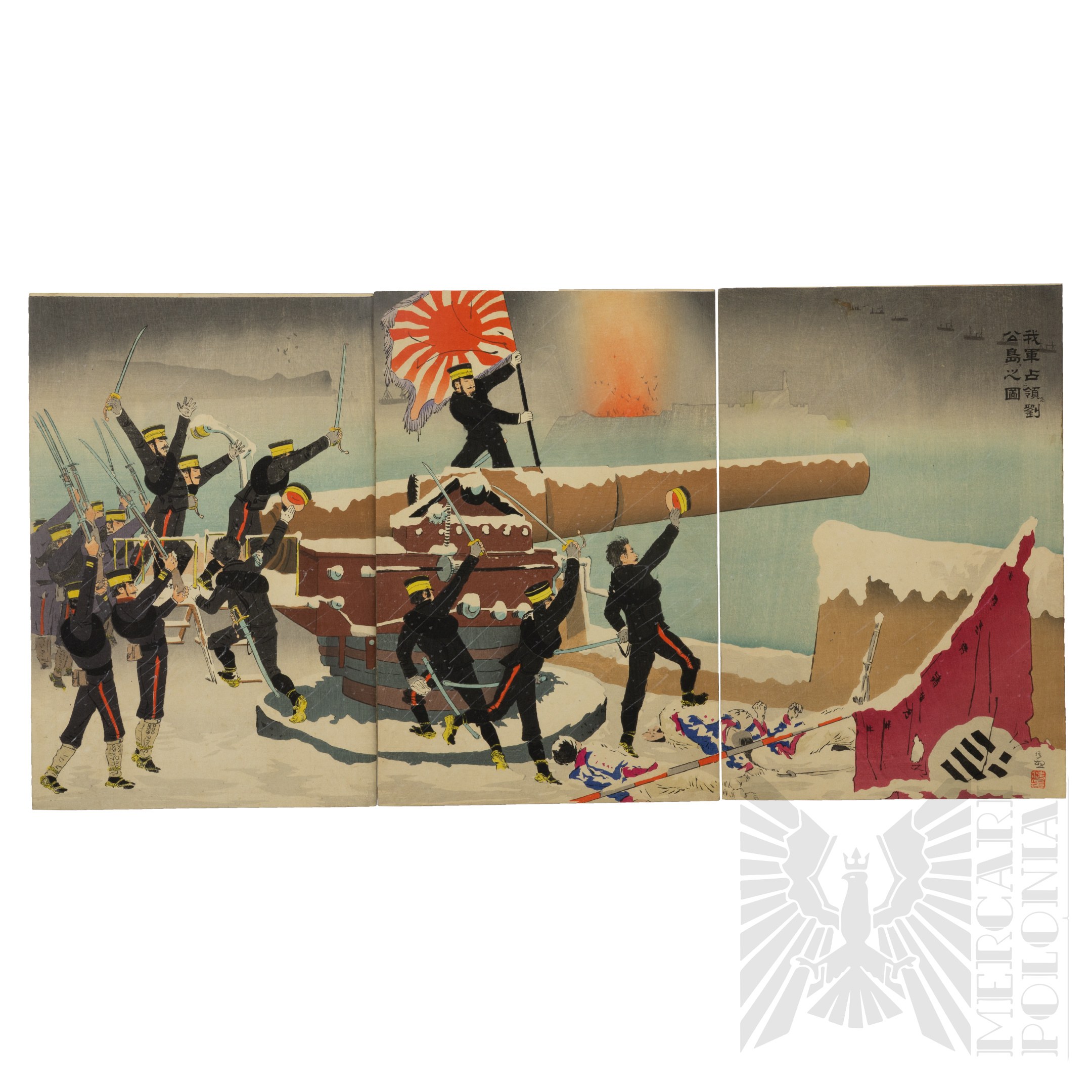
Dimensions: The piece measures approx. 37 × 75 cm; each sheet measures approx. 35 × 23.5 cm
Technique: multicolored nishiki-e woodblock print, printed with ink on Japanese paper; three vertical ōban tate-e sheets forming a panoramic triptych.
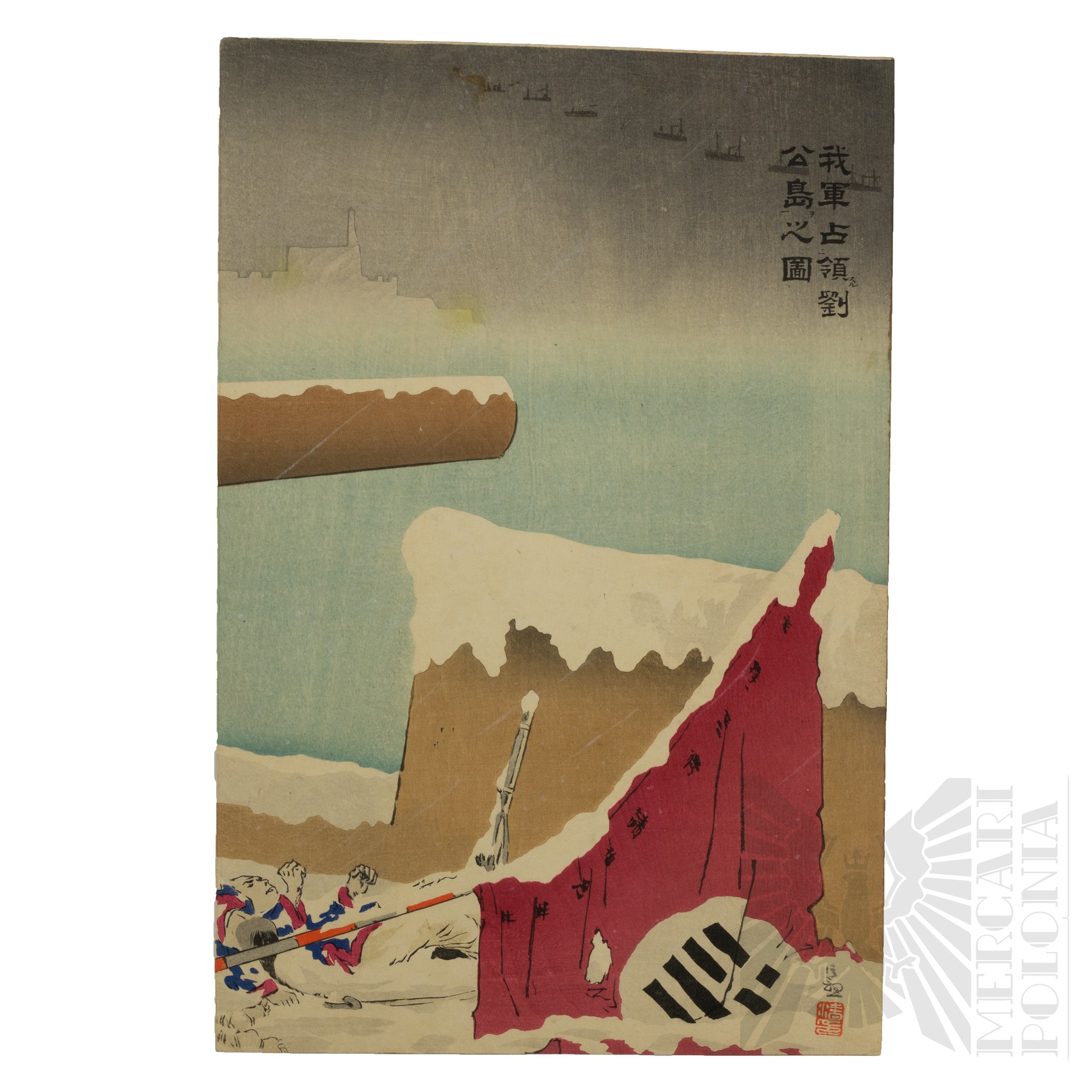
Original title: Waga gun Ryūkōtō o senryō suru no zu (我軍占領劉公島之図), literally: “Depiction of Our Troops Occupying Liugong Island.” A vertical title inscription is placed in the upper right corner of the composition, while the artist’s signature “Kiyochika” along with a red seal is visible at the lower edge of the right panel. Museum pieces identify Matsuki Heikichi, operating under the name Daikokuya, as the publisher. The woodblock print was published in March 1895.
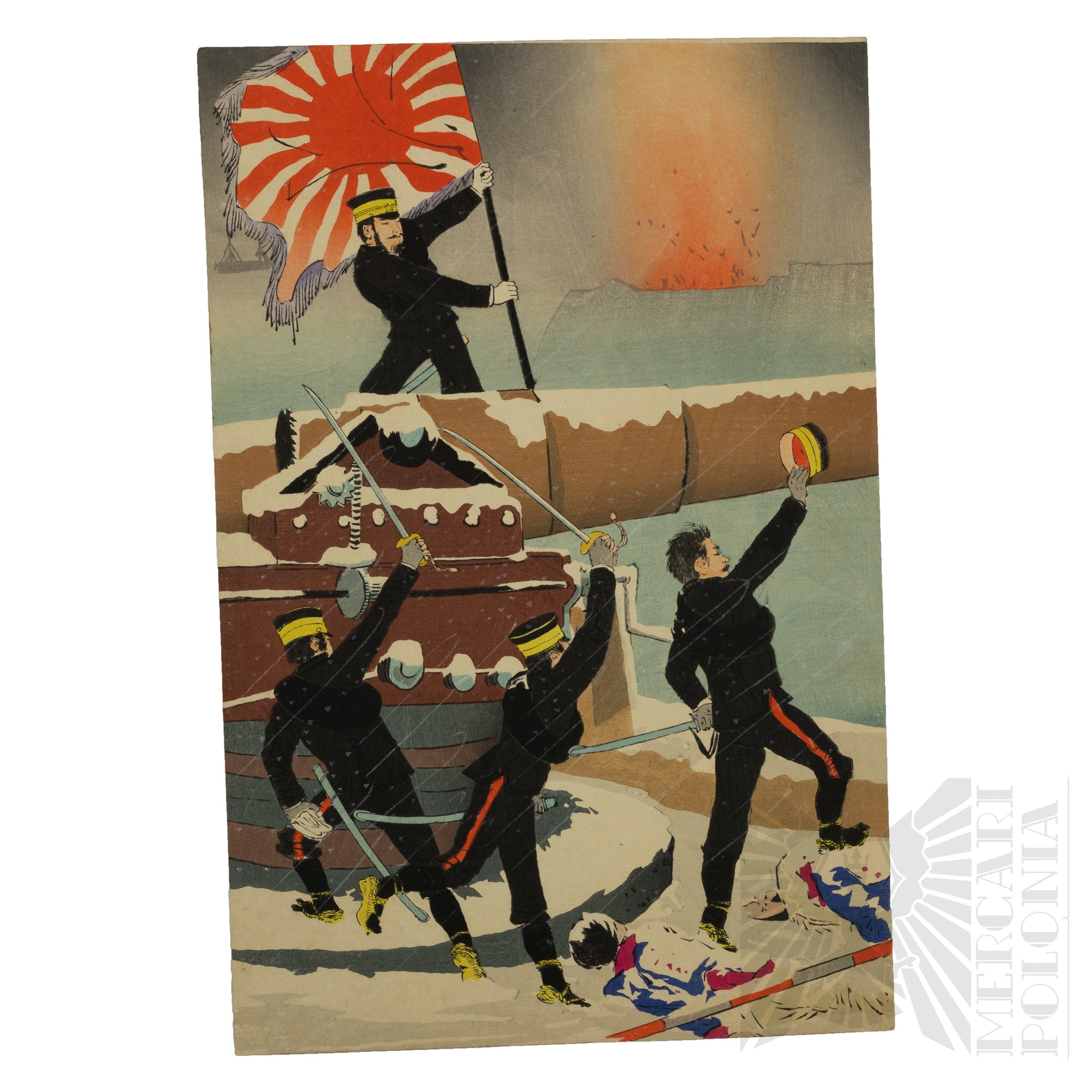
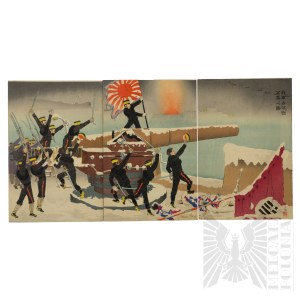
The triptych depicts a detachment of Japanese soldiers capturing a Chinese coastal artillery battery on Liugong Island, located near the port of Weihaiwei—now Weihai—on the coast of Shandong Province. The scene refers to the final phase of the First Sino-Japanese War, during which the island served as the main base of the Chinese Beiyang Fleet.
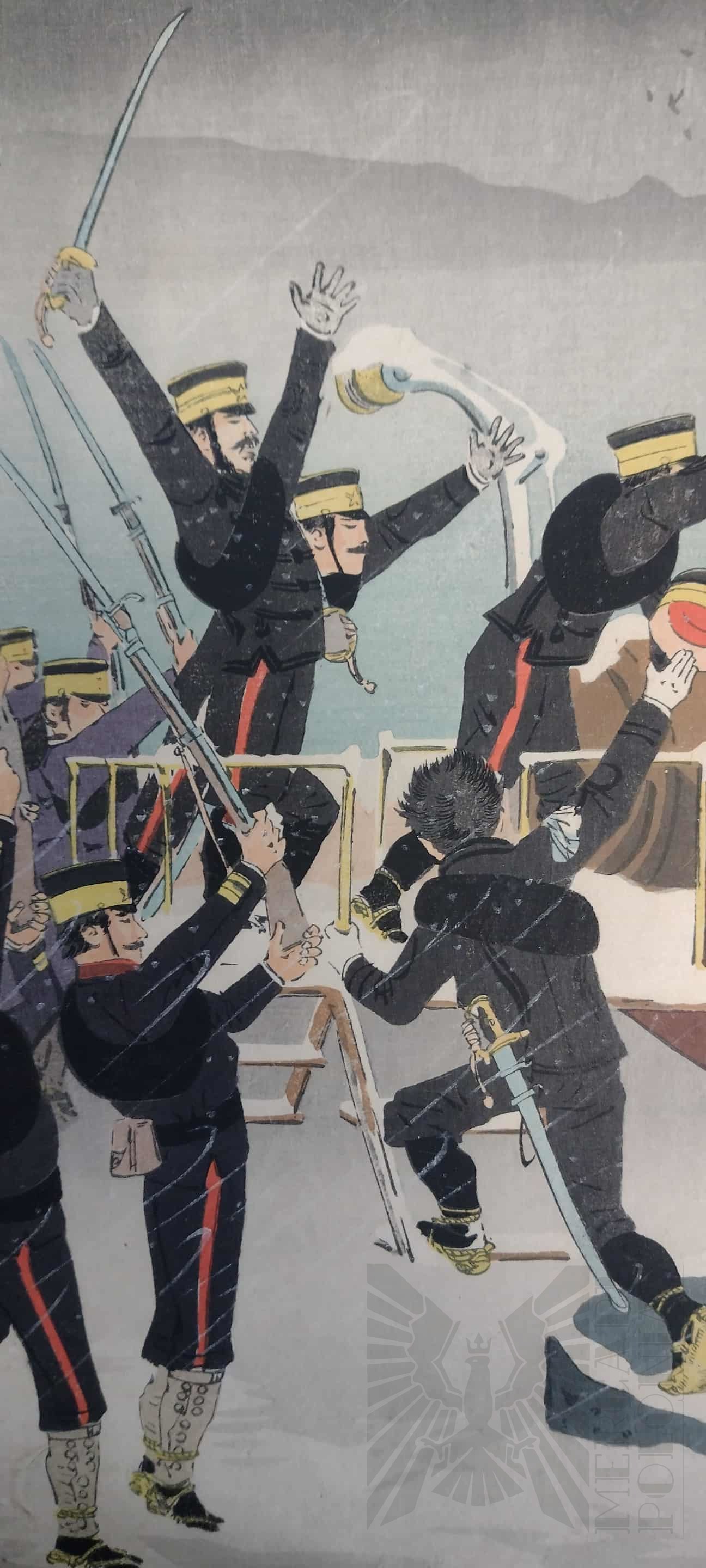
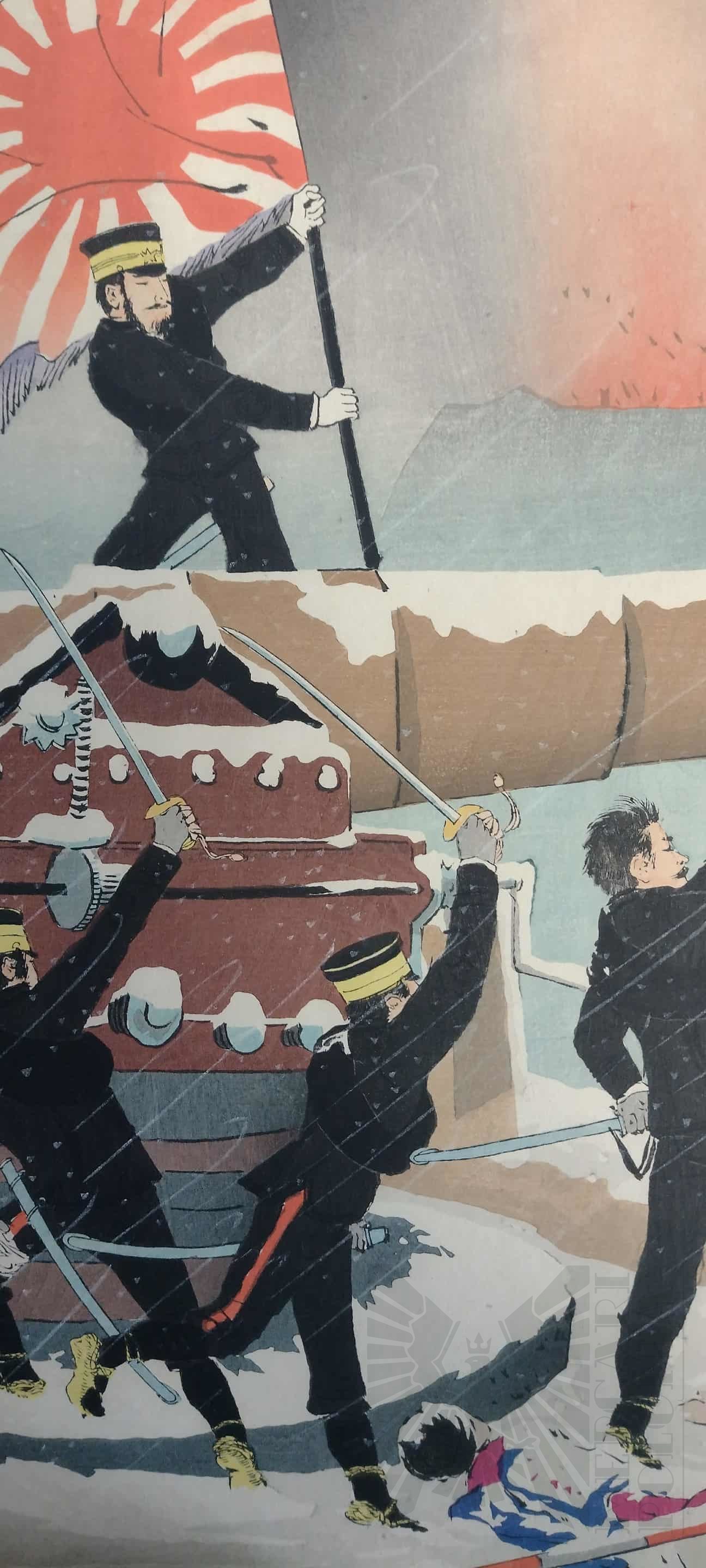
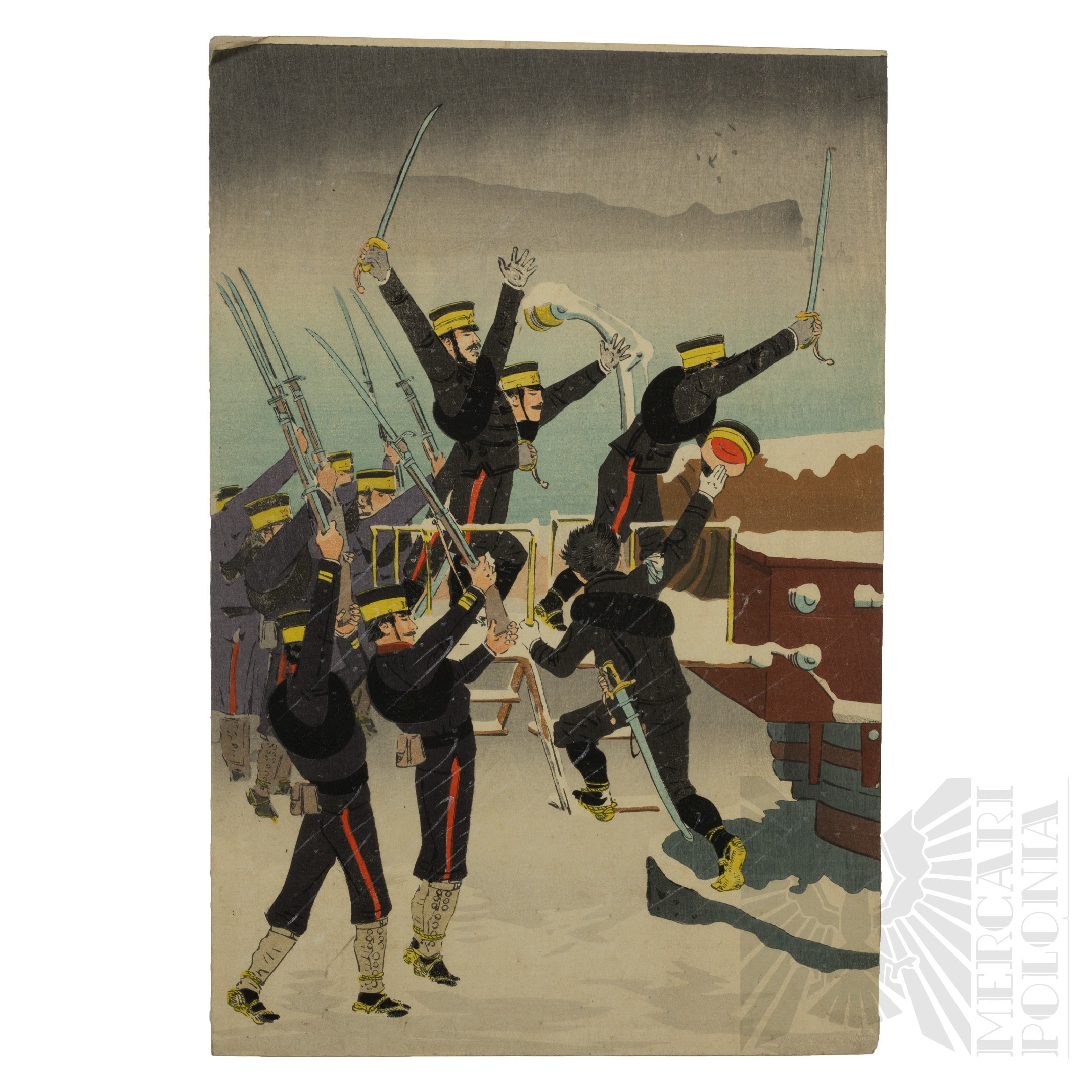
The composition is centered around a massive fortress cannon, whose long barrel spans nearly the entire width of the painting. The cannon’s design, its armored base, and its position on the coastal emplacement emphasize the modern, technological nature of the conflict. A dozen or so Japanese soldiers in dark navy-blue, European-style uniforms—with distinctive red stripes on their trousers and caps with light-colored bands—are gathered around the battery.
On the left, infantrymen with rifles fitted with bayonets are storming the artillery position. Some of the soldiers are brandishing sabers, while others are climbing onto the gun’s structure. One of the soldiers raises his hands in a gesture of triumph, and a white pennant or banner is visible next to him. The arrangement of the figures is compact and dynamic; their silhouettes overlap, creating the impression of a violent assault and the attackers’ numerical superiority.
In the center, on the battery rampart, a soldier raises a large flag of the Imperial Japanese Army featuring a red disc with radiating rays. The flag serves as the dominant element of the entire scene, both in terms of color and symbolism. Its unfurled surface contrasts with the dark sky and the monochromatic tones of the winter landscape, symbolizing the capture of the fortifications and Japan’s victory.
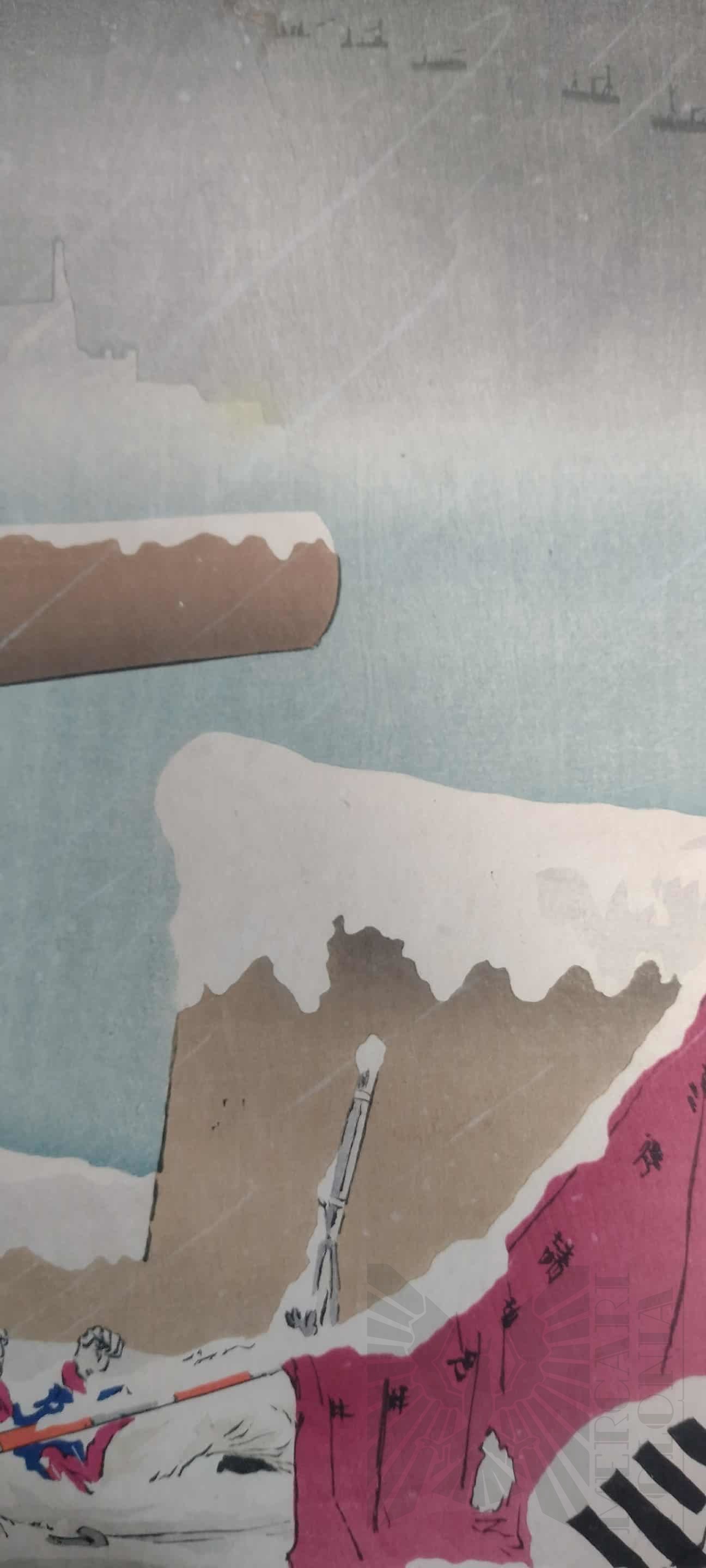
In the foreground, soldiers wave their sabers and caps, celebrating the capture of the battery. On the right, partially obscured by snow-covered sections of the fortifications, lie the fallen Chinese defenders. Fragments of blue and purple uniforms and abandoned weapons are visible. The artist contrasted the dynamic, upright figures of the Japanese with the lifeless bodies of their opponents, shaping the composition into a propaganda image of total victory.
In the background stretches the coastline, frozen by the winter chill. Through the gray-green fog, the outlines of fortifications, artillery positions, and ships anchored in the roadstead are visible. Above one of the forts rises the intense red glow of an explosion, surrounded by a cloud of yellowish smoke. Heavy, dark-gray clouds dominate the sky above. The combination of the white snow, the cool green of the sea, and the subdued sky lends the scene a stark character.
Kiyochika combined the traditional flatness of Japanese woodblock prints with techniques drawn from Western art: color gradation, three-dimensional modeling, atmospheric perspective, and the deliberate use of light. The explosion visible in the distance serves as an internal light source, illuminating the clouds and drawing the eye toward the coastline. The monumental cannon barrel forms a strong horizontal axis, while the silhouettes of soldiers, sabers, bayonets, and flagpoles introduce a pattern of intersecting diagonal lines.
The woodcut belongs to the sensō-e genre—war prints published in Japan during the conflicts of the late 19th century. Works of this kind served a function similar to that of the illustrated press: they reported on military events, shaped their public image, and served as state propaganda. However, they were not journalistic accounts of the fighting. Artists generally did not observe the events firsthand, but based their compositions on military communiqués, press reports, and established conventions for depicting battles. The scene depicted here is therefore a heroic reconstruction rather than a strict iconographic document.
Liugong Island was the center of the Chinese naval base at Weihaiwei and the stationing site of the Beiyang Fleet, one of the Qing Dynasty’s most modern naval formations. The operation against Weihaiwei began in January 1895. Japanese troops captured the land fortifications surrounding the port, while the navy blockaded the Chinese fleet and carried out torpedo attacks. After losing more ships and fortifications, the Chinese command surrendered in February 1895. The publication of the triptych as early as March underscores its almost immediate connection to current war news.
Kobayashi Kiyochika, whose real name was Kobayashi Katsunosuke, was born on September 10, 1847, in Edo, and died on November 28, 1915, in Tokyo. He came from a family of a low-ranking official in the service of the Tokugawa shogunate. During the Boshin War, he sided with the shogunate and participated in operations against the imperial forces. After the Meiji Restoration, he returned to Tokyo and devoted himself to artistic pursuits.
Kiyochika was interested in photography, Western painting, and traditional Japanese art. He gained fame for his views of a modernizing Tokyo, which he began creating in the mid-1870s. In these works, he employed chiaroscuro effects known as kōsen-ga, or “images of rays of light.” He depicted train stations, bridges, brick buildings, ships, fires, and streets illuminated by modern streetlights, capturing the transformation of the former Edo into the modern capital of the empire.
Between 1894 and 1895, the artist created a large series of triptychs related to the Sino-Japanese War. These stood out for their atmospheric depiction of the battlefield, the effects of nighttime lighting, fog, snow, and explosions, as well as a more subdued color palette than in the works of many of his contemporaries. Kiyochika is sometimes described as the last great master of traditional ukiyo-e and, at the same time, one of the first significant printmakers of modern Japan.
The operation against Weihaiwei was led by Marshal Ōyama Iwao (1842–1916), commander of the Japanese 2nd Army. He was descended from the samurai of the Satsuma domain, participated in the Meiji Restoration, and subsequently played a pivotal role in the organization of the modern Japanese ground forces. During the First Sino-Japanese War, he commanded operations on the Liaodong Peninsula and the campaign against Weihaiwei. However, none of the figures in the woodcut can be identified as his portrait.
The Japanese fleet operating off Weihaiwei was commanded by Admiral Itō Sukeyuki (1843–1914), one of the founders of the Imperial Navy. After the victory at the mouth of the Jalu River, he participated in the blockade of the Chinese base and accepted its surrender. Admiral Ding Ruchang (1836–1895) was the commander of the Beiyang Fleet defending the Chinese island. Faced with defeat and unwilling to personally sign the act of surrender, he committed suicide. His figure is also not directly depicted in the composition.
Comparable pieces can be found, among other places, at the Museum of Fine Arts in Boston and the National Museum of Asian Art in Washington, D.C. The composition is also sometimes cataloged under the English title *Our Forces Occupying Liugong Island*.
Condition: as shown in the photos.








Laatst bekeken
Log in om de kavellijst in te zien
Favorieten
Log in om de kavellijst in te zien