


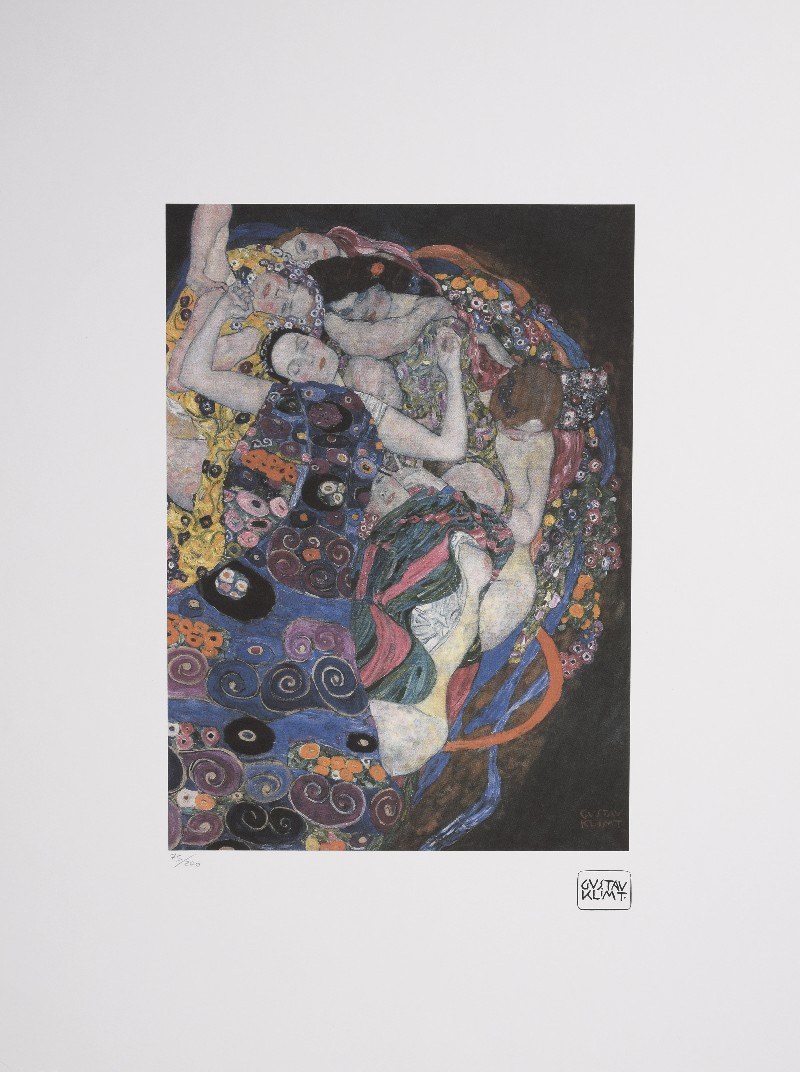
color lithograph, heavy vellum paper; 44 x 30 cm (composition), 70 x 50 cm (sheet); signed on.
plate under the composition p. d. Gustav Klimt and numbered in pencil "52/200". Publisher's dry stamp l. d.: "trec Edizioni Pregiate" and on the back the hologram "verification of authenticity".
Gustav Klimt - Austrian painter and printmaker, symbolist. One of the most prominent representatives of Art Nouveau, representative of Viennese Modernism. From about 1890 Klimt began to increasingly develop his unique expressionist style, which is distinguished by characteristic flat ornaments. In 1890, he left the Künstlerhaus artists' association and, together with other artists, founded the Vienna Secession. An association that made Art Nouveau, or Art Nouveau, a departure, a separation from the prevailing norms, rules and traditions in art. In 1897, Gustav Klimt stands in the spotlight of the jupiter in an instant. As president of the Association of Austrian Artists, he is a leading figure among the so-called Art Nouveauists, striving for a renewal in art. "The Virgins" ("Die Jungfrauen") is one of the most famous paintings by Gustav Klimt, an Austrian painter associated with the Viennese Art Nouveau movement. The painting was created between 1912 and 1913 and is now in the National Gallery in Prague. The work is considered one of Klimt's last great works before his death in 1918.
"The Virgins" depicts six women entwined in an intimate, almost surreal embrace, in a vortex-like composition. The women are positioned in the center of the painting, with their bodies forming a circle that exudes sensuality and mystery. The figures appear to be immersed in daydreams, surrounded by a wealth of colors and patterns characteristic of Klimt's style.
Klimt uses his characteristic technique, combining realistic depictions of faces and bodies with abstract, richly decorated fabrics. The background is filled with ornamental patterns, giving the entire composition a decorative yet mystical feel. The use of gold and bright colors emphasizes the sensuality and richness of the depicted scene.
The painting "Virgins" depicts various stages of femininity and sexuality. Klimt's paintings have often been analyzed in a psychological and sexual context, reflecting his interest in the human psyche and the complexity of emotions. "The Virgins" is one of Klimt's last monumental works, reflecting his mastery of combining realistic portraits with abstract decoration. The painting also shows the influence of Symbolism and Art Nouveau on his work, while highlighting his unique style, which had a significant impact on the development of art in the early 20th century. "Virgins" Gustav Klimt's "Virgins" is not only a masterpiece of Viennese Art Nouveau, but also a deeply symbolic and sensual depiction of femininity that leaves a great deal of room for interpretation and reflection.











Laatst bekeken
Log in om de kavellijst in te zien
Favorieten
Log in om de kavellijst in te zien